
BQE Core Visual Settings Guide
A visual walkthrough of every BQE Core integration setting in Mosaic
What this page covers: This guide walks through each provisioning setting available in the BQE Core integration. Use it to plan your configuration before onboarding, reference during setup, or review when adjusting settings later.
| Applies to | BQE Core (Cloud, OAuth) |
| When to use | Before onboarding, during setup, or when changing settings |
| Related guides | BQE Core Integration Setup · Project & Phase Status Matching |
Overview
These provisioning settings control how data flows between BQE Core and Mosaic. Each setting determines whether a specific data type is transferred, how it is mapped, and what values are used.
The choices you make here should align with the Standard Operating Procedures (SOP) discussed with your Customer Success Manager (CSM). These settings bring in the data to match your expected workflows.
Settings are organized by data type. Each section covers the configuration options, setting values, and numbering.
Before you apply settings: Selecting Transfer or Automatically linked for Projects and Phases will immediately begin syncing all matching records. It is strongly recommended to save as draft first, then apply after your onboarding/SOP call with your CSM and Solutions Engineers.
About "Transfer updates from today forward": Once saved, this option displays the date the setting was last changed — for example, Transfer updates from 8/19/2026 forward. The date is shown for reference only; it is not enforced as a sync cut-off.
Sections at a Glance
| Section | What It Covers |
|---|---|
| Connection | OAuth credentials for connecting to BQE Core |
| Members | Member Roles, Cost Rates, Bill Rates, rate overrides, and archiving |
| Portfolios | Organizing Projects into Portfolio folders |
| Projects | Project linking, statuses, fees, and naming |
| Phases | Phase linking, budgets, statuses, archiving, and ordering |
| Work Categories | Activity item linking from BQE Core |
| Time Entries | Timesheet data, billable status, hourly rates, and approval status |
Connection
Connection Settings
1. Connection Credentials
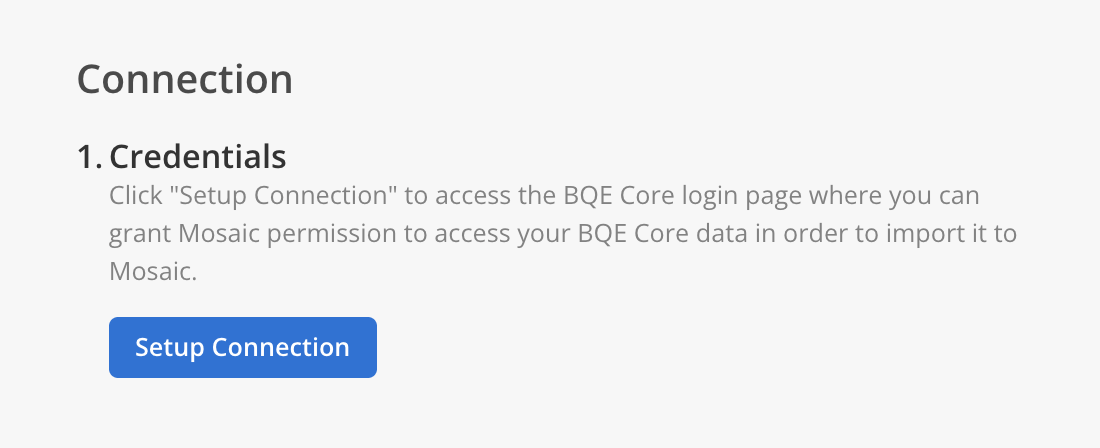
In Mosaic
Connection Credentials allow Mosaic to authenticate and connect to your BQE Core environment. BQE Core uses an OAuth-based connection — you authorize Mosaic from within BQE Core, and BQE Core returns the access and refresh tokens that Mosaic stores securely.
In BQE Core: Authorization is performed by signing in to BQE Core with your administrator credentials when prompted by Mosaic. BQE Core issues the OAuth tokens automatically — there are no API keys to copy or paste.
To Get Started
- Follow the full setup instructions in the BQE Core Integration Setup guide.
- From the Mosaic integration settings modal, initiate the connection — you will be redirected to BQE Core to sign in and authorize the integration.
- After authorizing, you will be redirected back to Mosaic and the connection will be marked as active.
After authorizing, Mosaic verifies the connection by fetching sample records. If the test fails, double-check that the BQE Core user account has the required permissions and that your BQE Core subscription includes API access.
OAuth tokens can expire or be revoked. Periodically return to this section to confirm the connection is still active so syncing is not interrupted.
2. Connection Name (optional)
In Mosaic
An optional name for this connection. It distinguishes this connection from other BQE Core connections on the same team, and appears wherever the connection is referenced in Mosaic. Leave it blank to show none.
This is a text input with a 50-character limit — for example, Houston Office.
Members
Members in Mosaic represent the people in your organization — your BQE Core employees. Each Member must be manually linked in Mosaic to their corresponding BQE Core employee record. The settings below control which Member fields are transferred and how they are mapped.
Member Settings
1. Standard Roles
In Mosaic
Standard Roles define the set of available Roles that can be assigned to Members across the platform. These are used for resource planning, filtering, and rate calculations.
In BQE Core: Standard Roles are derived from the Title field on the BQE Core employee record. Each unique title becomes a Standard Role in Mosaic.
Setting Options
- Transfer updates from today forward — BQE Core Standard Roles will be transferred to Mosaic after changes in BQE Core. Required for syncing Labor Billing Terms. This setting will overwrite Standard Roles on Mosaic.
- Do not transfer (recommended) — BQE Core Standard Roles will not be transferred to Mosaic. Select this option if manual management in Mosaic is preferred.
2. Default Roles
In Mosaic
A Member's Default Role determines which Role is automatically assigned when they are added to a Project. This drives resource planning defaults and rate assignments.
In BQE Core: The Default Role maps to the Title field on the employee record.
Setting Options
- Transfer updates from today forward — BQE Core Member Default Org Roles will be transferred to Mosaic after changes in BQE Core. This is required for syncing Labor Billing Terms. This setting will overwrite Member Default Org Roles on Mosaic.
- Transfer one time at first link — BQE Core Member Org Roles will only be transferred to Mosaic when the BQE Core Member is first linked.
- Do not transfer (recommended) — BQE Core Member Org Roles will not be transferred to Mosaic. Select this option if manual management in Mosaic is preferred.
3. Cost Rates
In Mosaic
Cost Rates represent a Member's salary or expected cost per hour. They appear on Member profiles and are used for financial calculations including profit margins, project health metrics, and budget forecasting.
In BQE Core: Cost Rates come from the Member Rate entries associated with each employee. BQE Core supports rate entries with effective start and end dates.
You must Enable Cost Rates for the Organization to transfer Cost Rates. This setting is controlled by the Cost Rates feature flag — contact your Mosaic team if this option is not visible.
Setting Options
- Transfer updates from today forward (recommended) — This setting will overwrite Member Default Cost Rates on Mosaic. BQE Core Cost Rates will be transferred to Mosaic after changes in BQE Core. Note that new rates are not passed down to existing projects. Enable Cost Rates for the Organization to transfer Cost Rates. This is required for transferring Labor Billing Terms if the Billing Type is Rate Times Multiplier.
- Do not transfer — BQE Core Cost Rates will not be transferred to Mosaic. Select this option if manual management in Mosaic is preferred.
4. Bill Rates
In Mosaic
Member Bill Rates from BQE Core are synced as date-ranged rate entries on each Member. This setting controls whether BQE Core Bill Rates are transferred to Mosaic at all. Transferred rates overwrite Member Default Bill Rates in Mosaic; new rates are not passed down to existing projects.
In BQE Core: Member Bill Rates are stored as rate entries with effective start and end dates on each employee record.
Setting Options
- Transfer updates from today forward — BQE Core Bill Rates will be transferred to Mosaic after changes in BQE Core. This setting will overwrite Member Default Bill Rates on Mosaic. Note that new rates are not passed down to existing projects.
- Do not transfer (recommended) — BQE Core Bill Rates will not be transferred to Mosaic. Select this option if manual management in Mosaic is preferred.
To control whether updated Member Bill Rates also apply to existing Project- and Phase-level rates in Mosaic, see the Bill Rate Override setting below.
5. Bill Rate Override
In Mosaic
Bill Rate Override determines how far an updated Member Bill Rate from BQE Core reaches in Mosaic. It either overrides all existing Project- and Phase-level Member Bill Rates, or applies only to new Projects created after the update.
This setting appears when Bill Rates are supported by your connection.
Setting Options
- Override all existing rates (recommended) — When BQE Core Member Bill Rates are updated, they will override all existing Mosaic Project- and Phase-level Member Bill Rates.
- Do not override — When BQE Core Member Bill Rates are updated, only new Projects created after the update will use the new Member Bill Rates in Mosaic.
6. Employee Archive Status
In Mosaic
Employee Archive Status controls whether the archive status of BQE Core employees is carried over to their linked Mosaic Members. When transferred, the archive status is applied to all currently transferred Members and kept up to date with further changes in BQE Core, overwriting the Archive Status in Mosaic.
Setting Options
- Transfer all + updates — BQE Core Employee Archive Statuses will be transferred to Mosaic for all currently transferred Members. Additional updates in BQE Core will also be transferred. This setting will overwrite Archive Status on Mosaic.
- Do not transfer (recommended) — BQE Core Employee Archive Statuses will not be transferred to Mosaic. Select this option if manual management in Mosaic is preferred.
Portfolios
Portfolio Settings
1. Default for new Projects
In Mosaic
A Portfolio is a folder used to organize multiple Projects — for example, by department, client, manager, or type of work. This setting determines which Portfolio newly linked BQE Core Projects are placed into by default.
In BQE Core: There is no direct equivalent to Portfolios in BQE Core. This is a Mosaic-only organizational concept.
Setting Options
- No Portfolio (default) — Newly linked Projects will not be assigned to any Portfolio. They can be moved into a Portfolio manually later.
- Import — A built-in Portfolio provided by Mosaic specifically for integration-linked Projects. Convenient if you want all imported Projects to land in one place before being organized further.
- [Your Portfolios] — Select any other existing Mosaic Portfolio to automatically place newly linked BQE Core Projects into that Portfolio.
This setting only applies to new Projects at the time they are first linked. It does not retroactively move existing linked Projects.
Many firms start by selecting Import as the default, then periodically sort imported Projects into department- or client-specific Portfolios.
Projects
Project Settings
1. Linking Method
In Mosaic
This setting determines how BQE Core Projects are connected to Mosaic. Importing means bringing a Project from BQE Core into Mosaic for the first time. Linking means establishing an ongoing connection so that changes in BQE Core are synced to Mosaic automatically.
In BQE Core: Projects are managed in the Projects module. The data imported includes: billable status, project status, start/end dates, client information, project fee (contract amount), archived status, project code, and project name.
Setting Options
- Manually linked — No Projects will be automatically linked.
- Automatically linked (recommended) — All Projects that meet the criteria specified in the Automatic Linking Filter will be automatically linked. Projects that do not meet the criteria may be manually linked.
2. Linked Project and Phase Titles
In Mosaic
This setting controls whether Mosaic keeps Project and Phase titles in sync with BQE Core, or allows them to diverge after the initial link.
Setting Options
- Overwrite (recommended) — Mosaic Project and Phase titles will match the BQE Core Project and Phase titles after changes in BQE Core. If a linked Mosaic Project or Phase title is edited in Mosaic, it may not match the title of the BQE Core Project or Phase until any value of the Project or Phase is changed in BQE Core.
- Do not overwrite — If a Mosaic Project or Phase title is edited, it may not match the BQE Core Project or Phase title making it hard to uniquely identify matching Projects.
If you choose Overwrite, ensure that team members do not edit Project or Phase titles directly in Mosaic, as those changes will be lost on the next sync.
3. Linked Project and Phase Ref #s
In Mosaic
Reference numbers (Ref #s) uniquely identify Projects and Phases. This setting controls whether the BQE Core Project and Phase numbers overwrite the Ref #s on linked Mosaic Projects and Phases.
This setting is being rolled out gradually. If you do not see it in your integration settings yet, contact your Customer Success Manager.
Setting Options
- Overwrite (recommended) — Mosaic Project and Phase Ref #s will match the BQE Core Project and Phase Ref #s after changes in BQE Core. If a linked Mosaic Project or Phase Ref # is edited in Mosaic, it may not match the Ref # of the BQE Core Project or Phase until any value of the Project or Phase is changed in BQE Core.
- Do not overwrite — If a Mosaic Project or Phase Ref # is edited, it may not match the BQE Core Project or Phase Ref # making it hard to uniquely identify matching Projects.
4. Project and Phase Billable
In Mosaic
The billable status indicates whether a Project or Phase is charged to the client. This is used for financial reporting accuracy across the platform.
In BQE Core: Billable status is derived from the Contract Type on the Project or Phase record.
| BQE Core Contract Type | Mosaic Billable Status |
|---|---|
| Marketing | Not Billable |
| Overhead | Not Billable |
| All other types | Billable |
Setting Options
- Transfer updates from today forward (recommended) — BQE Core Project and Phase billable statuses will be transferred to Mosaic after changes in BQE Core. This setting will overwrite billable statuses on Mosaic.
- Transfer one time at first link — BQE Core Project and Phase billable statuses will only be transferred to Mosaic when the BQE Core Project or Phase is first linked.
- Do not transfer — BQE Core Project and Phase billable statuses will not be transferred to Mosaic. Select this option if manual management in Mosaic is preferred.
5. Project and Phase Dates
In Mosaic
Project and Phase start and end dates drive timelines, scheduling, and resource planning in Mosaic.
In BQE Core: Dates come from the Start Date, Due Date, and Completed On fields on the Project or Phase record. Mosaic uses the Completed On date as the end date when present; otherwise it uses Due Date.
Setting Options
- Transfer updates from today forward (recommended) — BQE Core Project and Phase dates will be transferred to Mosaic after changes in BQE Core. This setting will overwrite dates on Mosaic.
- Transfer one time at first link — BQE Core Project and Phase dates will only be transferred to Mosaic when the BQE Core Project and Phase is first linked.
- Do not transfer — BQE Core Project and Phase dates will not be transferred to Mosaic. Select this option if manual management in Mosaic is preferred.
If you choose Transfer, avoid editing Project or Phase dates directly in Mosaic — those changes will be overwritten on the next sync.
6. Project and Phase Fee
In Mosaic
The Fee represents the total amount you plan to bill for a Project, or the portion allocated to a specific Phase. It is used for budget tracking across the platform.
In BQE Core: The Fee value comes from the Contract Amount field on the Project or Phase record.
Setting Options
- Transfer updates from today forward (recommended) — BQE Core Project and Phase Fees will be transferred to Mosaic after changes in BQE Core. This setting will overwrite Fees on Mosaic.
- Transfer one time at first link — BQE Core Project and Phase Fees will only be transferred to Mosaic when the BQE Core Project or Phase is first linked.
- Do not transfer — BQE Core Project and Phase Fees will not be transferred to Mosaic. Select this option if manual management in Mosaic is preferred.
7. Project-Level Roles
In Mosaic
Controls whether BQE Core project staff classifications are transferred to Mosaic as project-level Member Roles.
In BQE Core: Project-level Roles are assigned on the Project's staff list, where each employee can have a specific Classification for that Project.
Setting Options
- Transfer — BQE Core Project-level roles will be transferred to Mosaic.
- Do not transfer (recommended) — BQE Core Project-level roles will not be transferred to Mosaic.
8. Project Status Matching
In Mosaic
Maps each BQE Core project status to a corresponding Mosaic Project status. The mapping is applied any time a project's status changes in BQE Core.
In BQE Core: Project Status is set on the Project record and includes the values Active, Completed, Hold, Inactive, Canceled, and Draft.
Default Mapping
| BQE Core Status | Mosaic Status |
|---|---|
| Active | Active |
| Completed | Complete |
| Hold | Hold |
| Inactive | Hold |
| Canceled | Hold |
| Draft | Proposal |
For each BQE Core status, select the Mosaic Project status that should be applied. The change is applied when the status is updated in BQE Core.
How it works
- Each BQE Core status is matched to a Mosaic status. The list of source statuses comes from your connected tool, so you'll need a tested connection before you can edit.
- Unmapped statuses sync as Active — if a status isn't listed, Mosaic sets the project or phase to Active.
- Click Reset to default at any time to restore Mosaic's recommended mapping for this integration.
- Changes apply on Save (the button reads Done when there are no changes). Updates affect future syncs; already-synced records keep their current status until they next change in BQE Core.
For a full walkthrough of the mapping editor, see Project & Phase Status Matching.
Phases
Phase Settings
1. Linking Method
In Mosaic
A Phase is a distinct stage within a Project's lifecycle, with its own date range, Fee, and status. This setting determines how BQE Core Phases are connected to Mosaic.
In BQE Core: Phases are modeled as sub-projects under a root project. They appear in the BQE Core Projects module with the parent project set.
Setting Options
- Manually linked — No Phases will be automatically linked.
- Automatically linked (recommended) — All Phases that meet the criteria specified in the Automatic Linking Filter will be automatically linked. Phases that do not meet the criteria may be manually linked.
2. Non-Billable Fee as Budget
In Mosaic
This setting applies to non-billable Phases. When transferred, the fee of a non-billable BQE Core Phase is used as the Phase budget in Mosaic, overwriting the existing budget.
This setting appears when Phases with a billable status are supported by your connection.
Setting Options
- Transfer updates from today forward (recommended) — BQE Core Phase fees will be transferred to Mosaic Phase budgets after changes in BQE Core. This setting will overwrite budgets on Mosaic.
- Do not transfer — BQE Core Phase fees will not be transferred to Mosaic Phase budgets. Select this option if manual management in Mosaic is preferred.
3. Order
In Mosaic
This setting controls how Phases within a Project are ordered in Mosaic.
In BQE Core: Phase ordering comes from the Phase Order field on the Phase record.
Setting Options
- Phase Order (recommended) — Orders Phases using the explicit Phase order from BQE Core after changes in BQE Core. This setting will overwrite Phase order on Mosaic.
- Phase Ref# (Task Order) — Orders Phases using the Phase's reference number from smallest to largest from BQE Core after changes in BQE Core. This setting will overwrite Phase order on Mosaic.
- Phase Name — Orders Phases alphabetically by the Phase's name from BQE Core after changes in BQE Core. This setting will overwrite Phase order on Mosaic.
- Set on Mosaic — BQE Core Phase order will not be transferred to Mosaic. Select this option if manual management in Mosaic is preferred.
Maintain a single source of truth for ordering consistency. If you choose a BQE Core-synced option, avoid reordering Phases manually in Mosaic.
4. Phase Status Matching
In Mosaic
Maps each BQE Core phase status to a corresponding Mosaic Phase status. The mapping is applied any time a phase's status changes in BQE Core.
In BQE Core: Phases use the same status values as Projects (Active, Completed, Hold, Inactive, Canceled, Draft).
Default Mapping
| BQE Core Status | Mosaic Status |
|---|---|
| Active | Active |
| Completed | Complete |
| Hold | Hold |
| Inactive | Not Started |
| Canceled | Not Started |
| Draft | Not Started |
For each BQE Core status, select the Mosaic Phase status that should be applied. The change is applied when the status is updated in BQE Core.
How it works
- Each BQE Core status is matched to a Mosaic status. The list of source statuses comes from your connected tool, so you'll need a tested connection before you can edit.
- Unmapped statuses sync as Active — if a status isn't listed, Mosaic sets the project or phase to Active.
- Click Reset to default at any time to restore Mosaic's recommended mapping for this integration.
- Changes apply on Save (the button reads Done when there are no changes). Updates affect future syncs; already-synced records keep their current status until they next change in BQE Core.
For a full walkthrough of the mapping editor, see Project & Phase Status Matching.
Previously (before Status Matching)
Inactive Phase Status (discrete setting, pre-Status Matching)
When a Phase in BQE Core had a status of Inactive or Canceled, this setting determined the Mosaic Phase status to use instead of the default mapping.
Select the Mosaic Phase status that should be applied when a BQE Core Phase is set to Inactive or Canceled. If left unset, the default Project Status Matching is used.
- Not Started (recommended) — Inactive BQE Core Phases are set to Not Started in Mosaic.
- Hold — Inactive BQE Core Phases are set to Hold in Mosaic.
- Active — Inactive BQE Core Phases remain Active in Mosaic.
- Completed — Inactive BQE Core Phases are set to Completed in Mosaic.
5. Archived Phases
In Mosaic
Configures which BQE Core Phase statuses should automatically trigger archiving in Mosaic. Both options are checkboxes — you can enable both, one, or neither. Archive status will only be transferred if Phase statuses are transferred.
Setting Options
- Archive Canceled Phases (recommended) — Archives Mosaic Phases marked as Canceled in BQE Core.
- Archive Inactive Phases (recommended) — Archives Mosaic Phases marked as Inactive in BQE Core.
Work Categories
Work Category Settings
1. Linking Method
In Mosaic
Work Categories classify the type of work being performed (e.g., Design, Project Management, Research). They are used to categorize Time Entries across Projects.
In BQE Core: Work Categories correspond to Activity Items in BQE Core.
Setting Options
- Manually linked — No Work Categories will be automatically linked.
- Automatically linked (recommended) — All Work Categories that meet the specified criteria will be automatically linked. Work Categories that do not meet the criteria may be manually linked.
Time Entries
Time Entry Settings
1. Transfer
In Mosaic
Time Entries are records of a Member's actual hours spent on Projects, usually entered on timesheets. They appear in Project Spent tabs, power budget analysis, and enable management features like approve/reject, billable overrides, rate resets, and bulk edits.
In BQE Core: Time Entries come from the Time Entries module. Mosaic syncs Time Entries along with their approval workflow state (Submitted, Approved, Rejected, or Not Submitted).
Setting Options
- Transfer one-way from BQE Core to Mosaic (recommended) — BQE Core Time Entries will be transferred one-way to Mosaic after changes in BQE Core. Mosaic Time Entries will not be transferred to BQE Core.
- Transfer one-way from Mosaic to BQE Core — Mosaic Time Entries will be transferred one-way to BQE Core after changes in Mosaic. BQE Core Time Entries will not be transferred to Mosaic.
- Transfer two-way between Mosaic and BQE Core — Time Entries will be transferred two-way between Mosaic and BQE Core after changes on either side.
- Do not transfer — Time Entries will not be transferred to or from BQE Core. Select this option if manual management in Mosaic is preferred.
2. Billable
In Mosaic
The billable status on a Time Entry indicates whether the recorded hours are chargeable to a client. This is independent of whether the Project or Phase itself is marked as billable.
In BQE Core: The billable flag is set on each individual Time Entry record.
Setting Options
- Transfer updates from today forward (recommended) — BQE Core Time Entry billable statuses will be transferred to Mosaic after changes in BQE Core. This setting will overwrite billable statuses on Mosaic.
- Transfer one time at first link — BQE Core Time Entry billable statuses will only be transferred to Mosaic when the BQE Core Time Entry is first linked.
- Do not transfer — BQE Core Time Entry billable statuses will not be transferred to Mosaic. Select this option if manual management in Mosaic is preferred.
3. Hourly Rates
In Mosaic
Hourly Rates are the billing rates associated with each individual Time Entry record. They affect the spent amounts shown in Project budget views.
In BQE Core: Hourly Rates come from the Bill Rate field on each Time Entry.
Setting Options
- Transfer updates from today forward (recommended) — BQE Core Time Entry hourly rates will be transferred to Mosaic after changes in BQE Core. This setting will overwrite hourly rates on Mosaic.
- Transfer one time at first link — BQE Core Time Entry hourly rates will only be transferred to Mosaic when the BQE Core Time Entry is first linked.
- Do not transfer — BQE Core Time Entry hourly rates will not be transferred to Mosaic. Select this option if manual management in Mosaic is preferred.
Known display issue: in the settings modal, the Do not transfer option currently shows the Transfer one time at first link description. The option behaves as its label says — no hourly rates are transferred.
Contact the Mosaic Solutions team if you need assistance configuring any of these settings or if you'd like to discuss the best configuration for your workflow.
Updated about 1 month ago