
Vantagepoint Visual Settings Guide
A visual walkthrough of every Deltek Vantagepoint integration setting in Mosaic, explaining what each option does and how it maps data.
What this page covers: This guide walks through each provisioning setting available in the Deltek Vantagepoint integration. Use it to plan your configuration before onboarding, reference during setup, or review when adjusting settings later.
| Applies to | Deltek Vantagepoint Cloud & On-Premise |
| When to use | Before onboarding, during setup, or when changing settings |
| Related guides | Vantagepoint Cloud Integration Setup, Vantagepoint On-Premise Integration Setup, Project & Phase Status Matching |
Overview
These provisioning settings control how data flows between Deltek Vantagepoint and Mosaic. Each setting determines whether a specific data type is transferred, how it is mapped, and what values are used. The choices you make here should align with the Standard Operating Procedures (SOP) discussed with your Customer Success Manager (CSM) — these settings bring in the data to match your expected workflows.
Settings are organized by data type. Each section has tabs for Vantagepoint Cloud and Vantagepoint On-Premise — select the tab that matches your deployment type, as settings, options, and numbering may differ between the two.
Before you apply settings: Selecting Transfer or Automatically linked for Projects and Phases will immediately begin syncing all matching records. It is strongly recommended to save as draft first, then apply after your onboarding/SOP call with your CSM and Solutions Engineers.
Sections at a Glance
| Section | What It Covers | Cloud Settings | On-Prem Settings |
|---|---|---|---|
| Connection | Credentials and stored procedures for connecting to Vantagepoint | 2 | — |
| Members | Employee records, roles, and cost rates | 4 | 5 |
| Portfolios | Organizing projects into portfolio folders | 1 | 1 |
| Projects | Project linking, statuses, fees, rates, and naming | 21 | 22 |
| Phases | Phase linking, statuses, naming, and ordering | 7 | 7 |
| Work Categories | Labor code linking from Vantagepoint | 1 | 1 |
| Time Entries | Timesheet data, billable status, and hourly rates | 4 | 5 |
| Work Plans | Resource allocation and project plans | 1 | 1 |
| Rates | Rate groups, role rates, and rate descriptions | 5 | 6 |
For a quick-reference table of all settings and recommended defaults, see the Settings Summary.
Connection
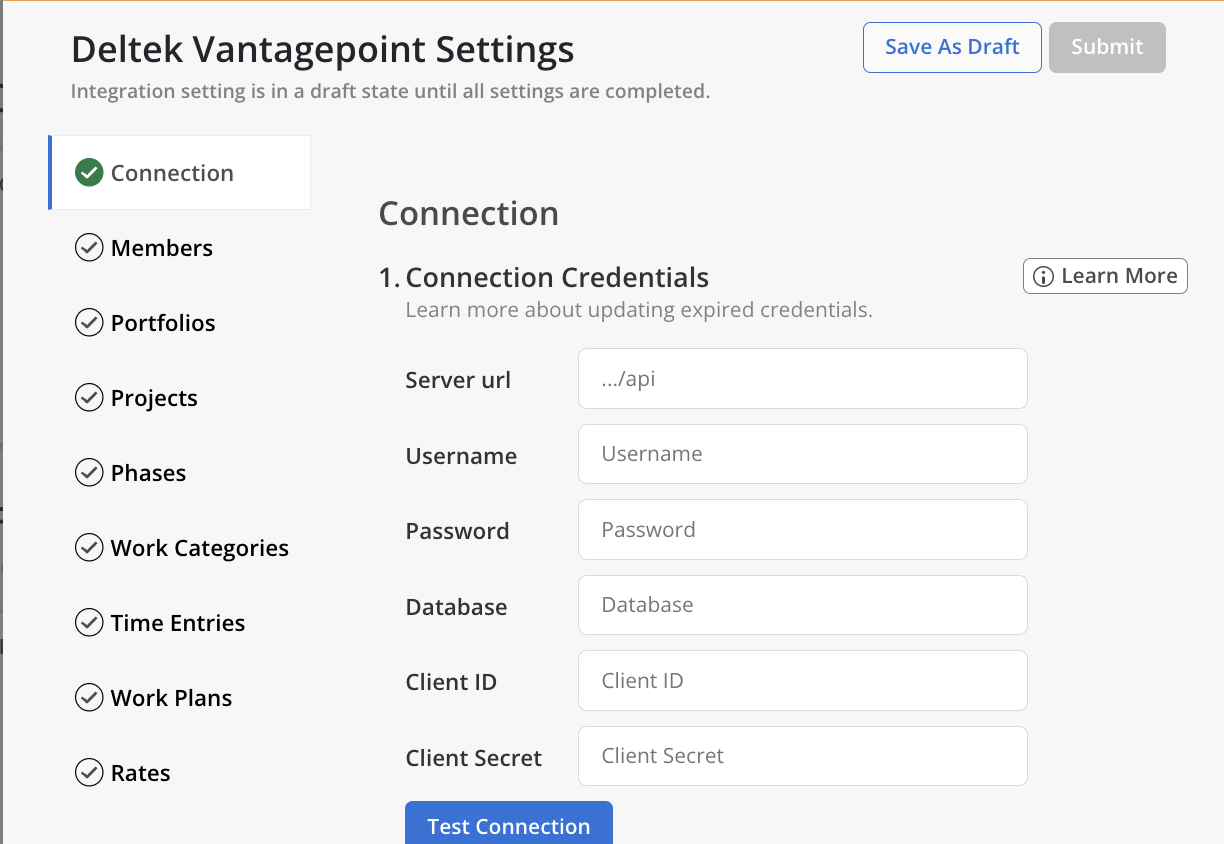
1. Connection Credentials
Definition
This is where you enter the credentials that allow Mosaic to connect to your Deltek Vantagepoint environment and bring in your data. Enter the credentials below to allow Mosaic to connect to your Vantagepoint Cloud environment.
Fields
Cloud deployments require all six fields:
| Field | Description |
|---|---|
| Server URL | The base URL of your Vantagepoint Cloud API. Must end with /api (e.g., https://yourfirm.deltekfirst.com/YourDatabase/api). |
| Username | The Vantagepoint API user's username. This should be a dedicated integration user, not a personal login. |
| Password | The password for the API user account. |
| Database | The name of the Vantagepoint database to connect to. |
| Client ID | The OAuth Client ID generated in Vantagepoint under Utilities > Integrations > OAuth Client Credentials. |
| Client Secret | The OAuth Client Secret generated alongside the Client ID. This value is encrypted at rest. |
To Get Started
- Ensure your Vantagepoint administrator has created a dedicated API user and generated OAuth Client Credentials under Utilities > Integrations > OAuth Client Credentials.
- Review the full setup instructions in the Vantagepoint Cloud Integration Setup guide.
In Mosaic
After entering your credentials, click the Test Connection button to verify that Mosaic can successfully authenticate and reach your Vantagepoint environment. The test attempts to fetch a sample record for each supported data type (e.g., Employees, Projects, Time Entries) to confirm end-to-end connectivity.
If the test fails, double-check your credentials and refer to the Vantagepoint Cloud Troubleshooting guide. Common issues include expired passwords, incorrect Server URLs (missing the /api suffix), or insufficient user permissions.
Credentials may expire or rotate over time. Periodically return to this section to update your credentials so syncing is not interrupted.
2. API Configuration
Definition
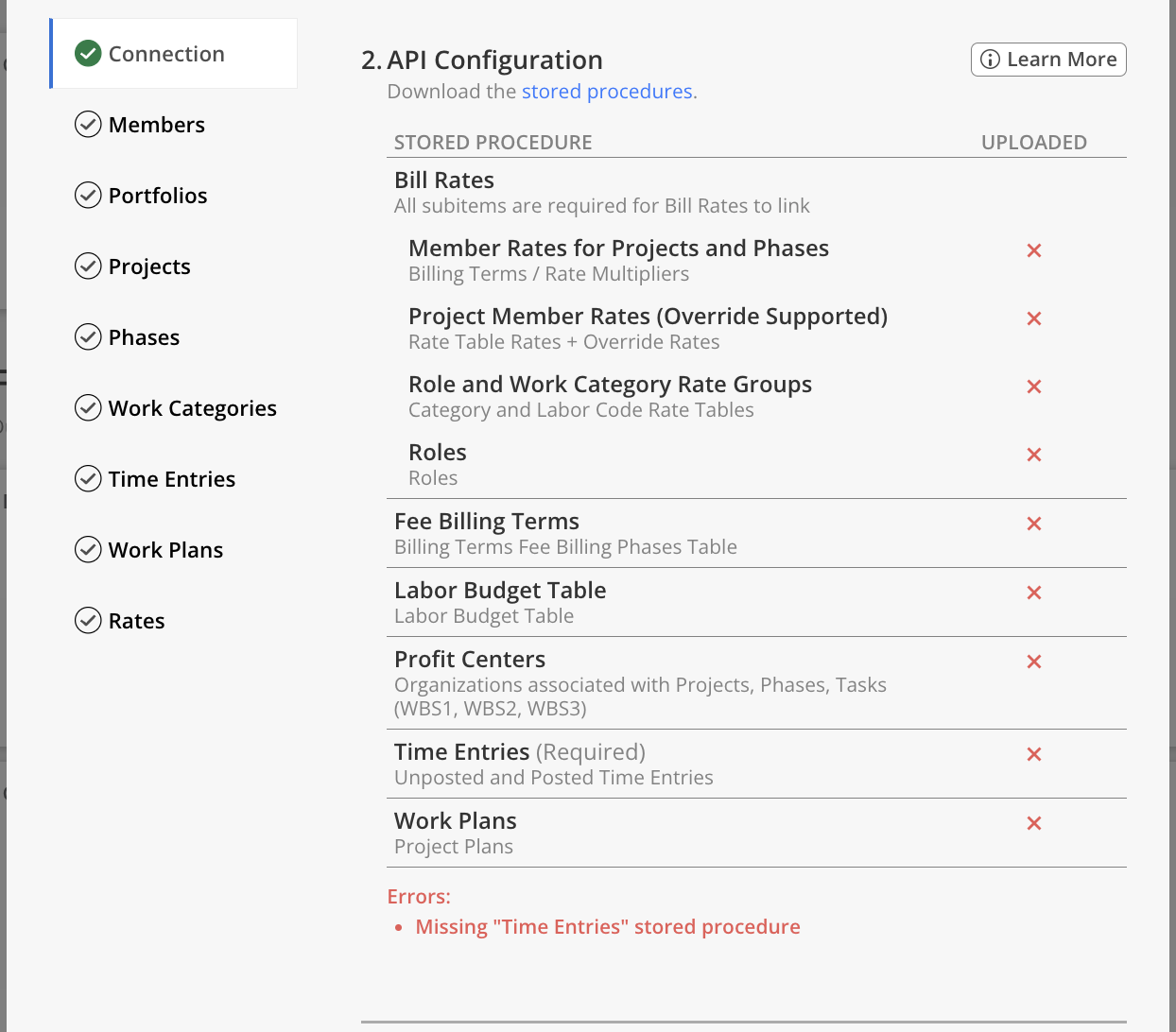
This setting displays the stored procedures that have been installed in your Vantagepoint Cloud environment. Stored procedures are custom database queries that enable Mosaic to access data that is not available through the standard Vantagepoint API — such as unposted time entries, work plans, labor budgets, and project-level billing details.
The modal shows a two-column table with Stored Procedure (name and description) and Uploaded (status). A checkmark indicates the procedure is installed; an X indicates it has not been uploaded yet.
Stored Procedures
Some stored procedures are standalone, while others are grouped. The Bill Rates group contains four sub-items that must all be installed for bill rate data to link correctly.
Bill Rates — All subitems are required for Bill Rates to link
| Stored Procedure | Description | What It Enables |
|---|---|---|
| Member Rates for Projects and Phases | Billing Terms / Rate Multipliers | Transfers billing terms and rate multipliers for project-level member rates. |
| Project Member Rates (Override Supported) | Rate Table Rates + Override Rates | Transfers rate table rates and override rates for project-specific member billing. |
| Role and Work Category Rate Groups | Category and Labor Code Rate Tables | Transfers category and labor code rate tables for role and work category rates. |
| Roles | Roles | Transfers labor category descriptions as role definitions in Mosaic. |
Standalone Stored Procedures
| Stored Procedure | Description | What It Enables |
|---|---|---|
| Time Entries (Required) | Unposted and Posted Time Entries | Transfers both unposted and posted time entries. Without this, only posted time is available. |
| Work Plans | Project Plans | Transfers project plans from Vantagepoint to Mosaic as Work Plans. |
| Labor Budget Table | Labor Budget Table | Enables the "Labor Budgets" fee source options for Projects and Phases. |
| Profit Centers | Organizations associated with Projects, Phases, Tasks (WBS1, WBS2, WBS3) | Transfers organization data for use in Phase Profit Center names and reporting. |
| Fee Billing Terms | Billing Terms Fee Billing Phases Table | Enables the "Fee Billing Terms" fee source option for Projects and Phases. |
The Time Entries stored procedure is required. If it is not installed, the modal will display an error: Missing "Time Entries" stored procedure. You must resolve this before submitting your settings.
To Get Started
- Click the stored procedures link in the modal (or download them from the link provided by your Mosaic Solutions team).
- Follow the installation instructions in the Adding Stored Procedures to Vantagepoint guide.
- After installation, return to this section in Mosaic — the table will automatically detect which stored procedures are installed and update the Uploaded column.
In Mosaic
The API Configuration table auto-detects which stored procedures are present in your Vantagepoint environment. Procedures that are installed show a checkmark in the Uploaded column; those that are missing show an X.
If any required stored procedures are missing, an Errors section appears below the table listing each missing procedure. You must install all required procedures (at minimum, Time Entries) before you can submit your integration settings.
Certain integration features — such as "Combined Time" for time entries, "Labor Budgets" as a fee source, or bill rate syncing — will only become available after their corresponding stored procedures are installed.
This section only applies to Cloud deployments. On-Premise integrations access data directly through the replica database and do not require stored procedures.
1. Connection Credentials
On-Premise connection setup is not part of the integration settings modal. Credentials are configured separately during initial onboarding with the Mosaic Solutions team.
Fields
On-Premise (Hosted) deployments require the following to be configured:
| Field | Description |
|---|---|
| Server URL | The MSSQL host address for the Vantagepoint replica database. |
| Username | The SQL Server username with read access to the Vantagepoint replica database. |
| Password | The password for the SQL Server user. |
| Database | The name of the replica database that Mosaic connects to. |
To Get Started
- Ensure your replica database is set up and accessible, and that the SQL Server user has appropriate read permissions.
- Review the full setup instructions in the Vantagepoint On-Premise Integration Setup guide.
- Contact the Mosaic Solutions team to complete the connection configuration.
Members
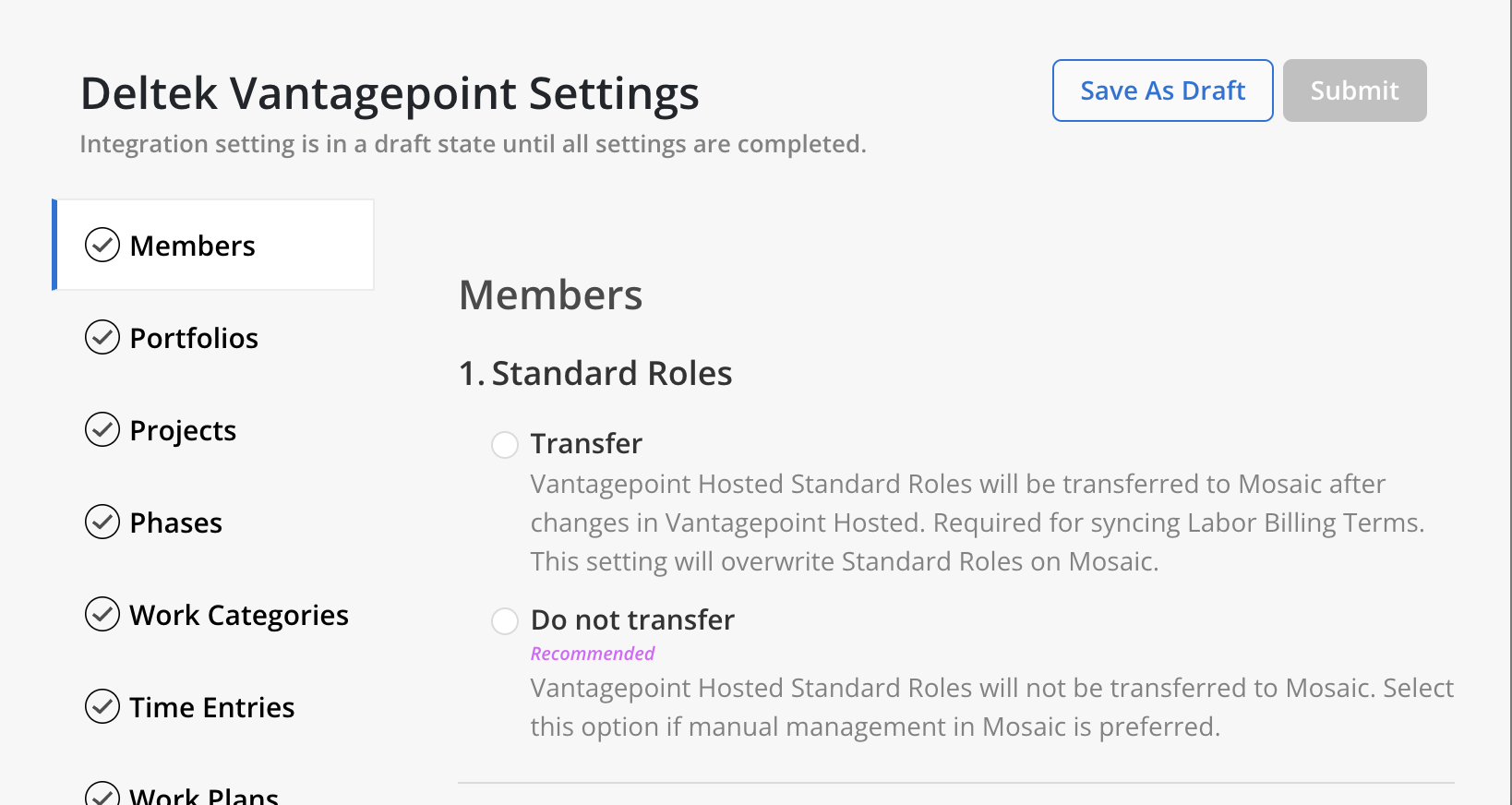
1. Standard Roles
Definition
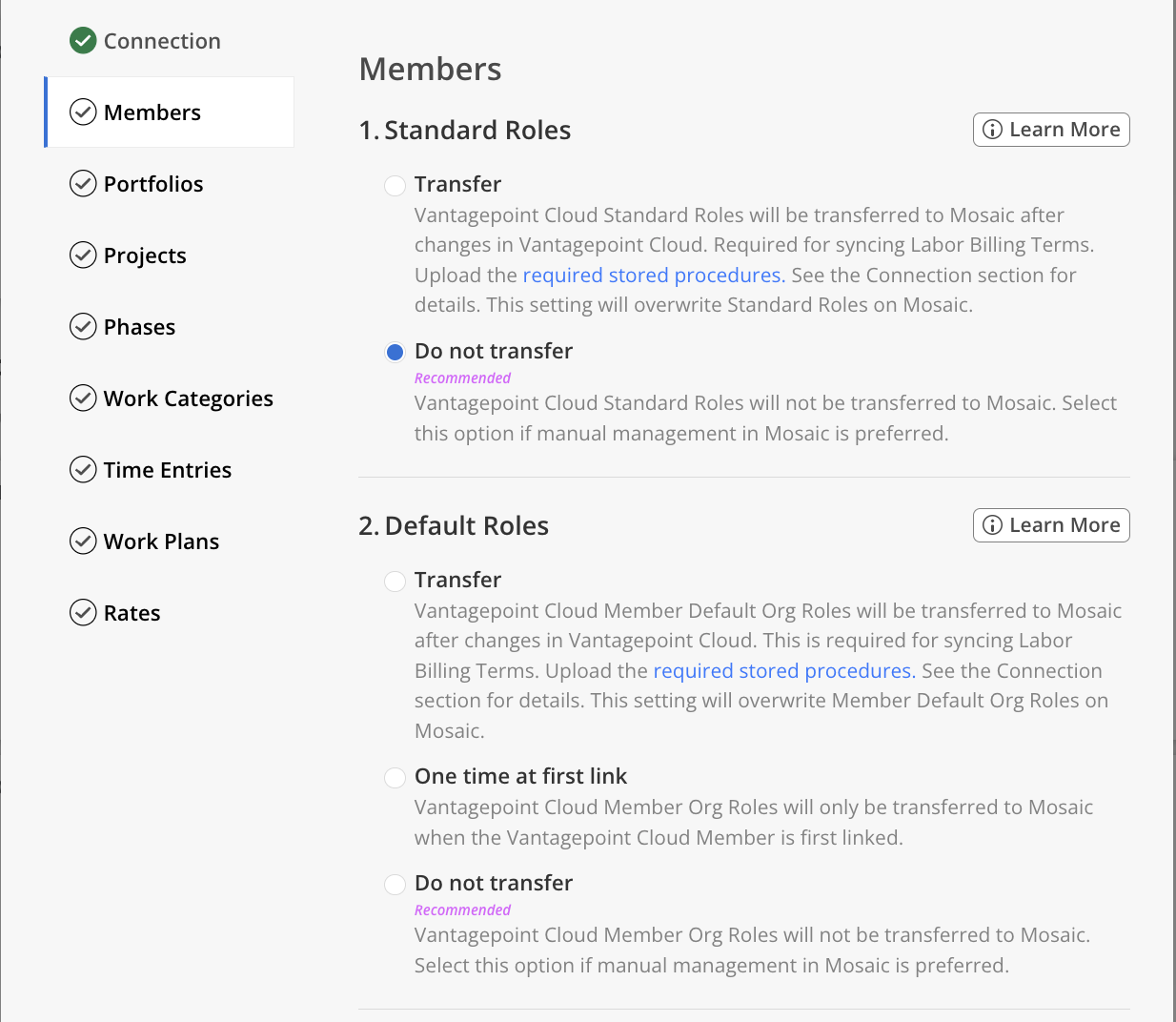
This setting controls whether Standard Roles (labor categories) from Vantagepoint are transferred to Mosaic. In Vantagepoint, these are the labor categories found in the Labor Category Table — sometimes referred to as employee Titles (e.g., Principal, Engineer II, Project Manager). Standard Roles define the set of available roles that can be assigned to members across the platform.
Transferring Standard Roles requires syncing Labor Billing Terms. Upload the required stored procedures.
In Mosaic
When set to Transfer, the full list of Vantagepoint labor categories will appear as available Roles in Mosaic. These roles are used for resource planning, filtering, and rate calculations. Any changes to Standard Roles in Vantagepoint will overwrite the corresponding roles in Mosaic on each sync.
When set to Do not transfer, roles must be created and maintained manually within Mosaic. Choose this if your firm manages roles independently in Mosaic or if the Vantagepoint role list does not align with how your team plans work.
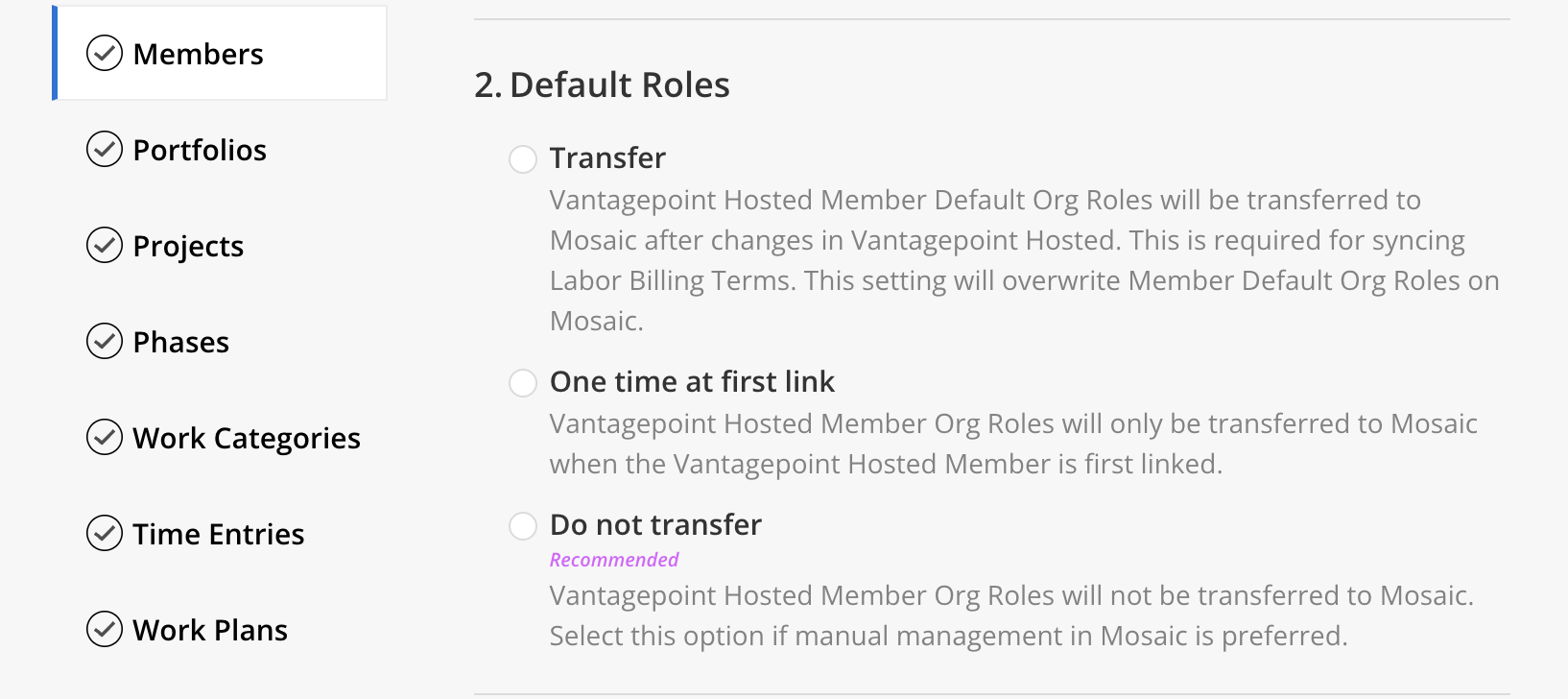
2. Default Roles
Definition
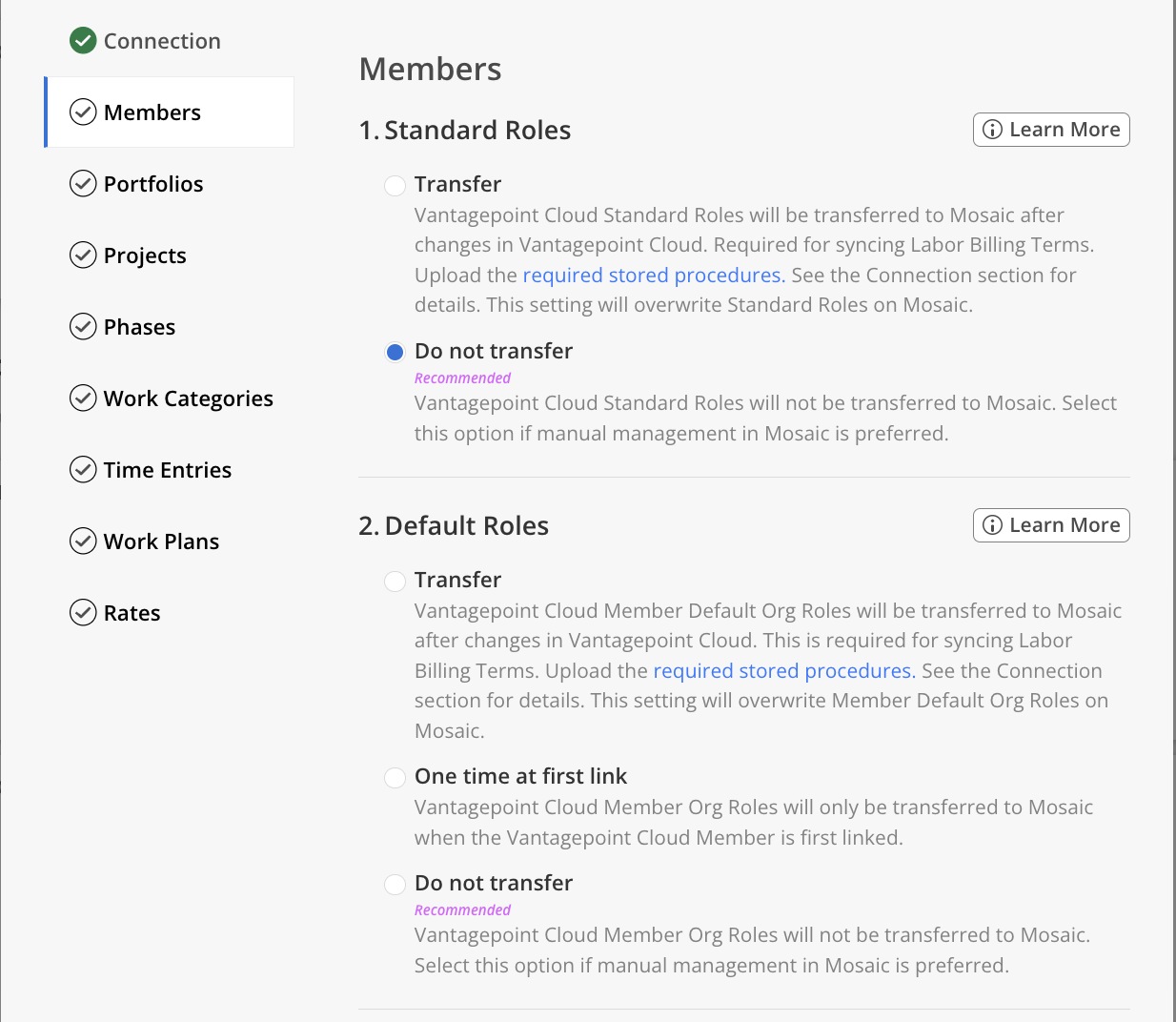
This setting controls whether a member's default organizational role from Vantagepoint is transferred to Mosaic. The default role determines which role is automatically assigned to a member when they are added to a project.
Transferring Default Roles requires syncing Labor Billing Terms. Upload the required stored procedures.
In Mosaic
When set to Transfer, each member's default role is kept in sync with Vantagepoint. Any time the member's role changes in Vantagepoint, it will be updated in Mosaic on the next sync. This is useful when Vantagepoint is the source of truth for organizational role assignments.
When set to One time at first link, the role is transferred once during the initial member link. After that, the role can be changed independently in Mosaic without being overwritten. This is useful if your team wants to start with Vantagepoint roles but manage them in Mosaic going forward.
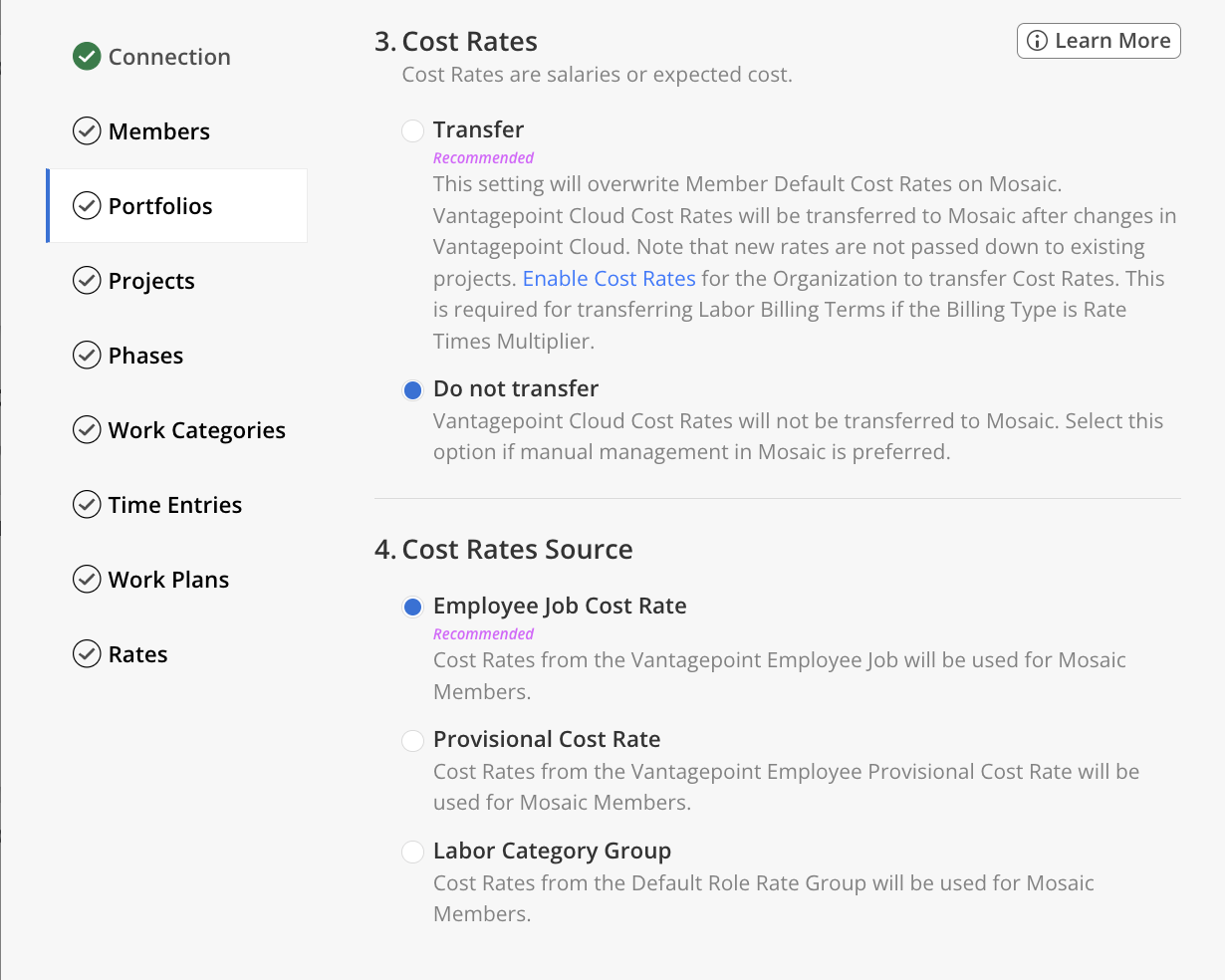
3. Cost Rates
Definition
Cost Rates are salaries or expected cost. This setting controls whether Member Default Cost Rates from Vantagepoint are transferred to Mosaic.
Transferring Cost Rates is required for Labor Billing Terms if the Billing Type is Rate Times Multiplier.
You must Enable Cost Rates for the Organization to transfer Cost Rates. This setting is controlled by the Cost Rates feature flag — contact your Mosaic team if this option is not visible.
In Mosaic
When set to Transfer, each member's default cost rate is kept in sync with Vantagepoint. Cost rates appear on Member profiles and are used for financial calculations across the platform, including profit margins, project health metrics, and budget forecasting. Note that transferred rates apply to new project assignments only — existing project-level rates are not retroactively updated.
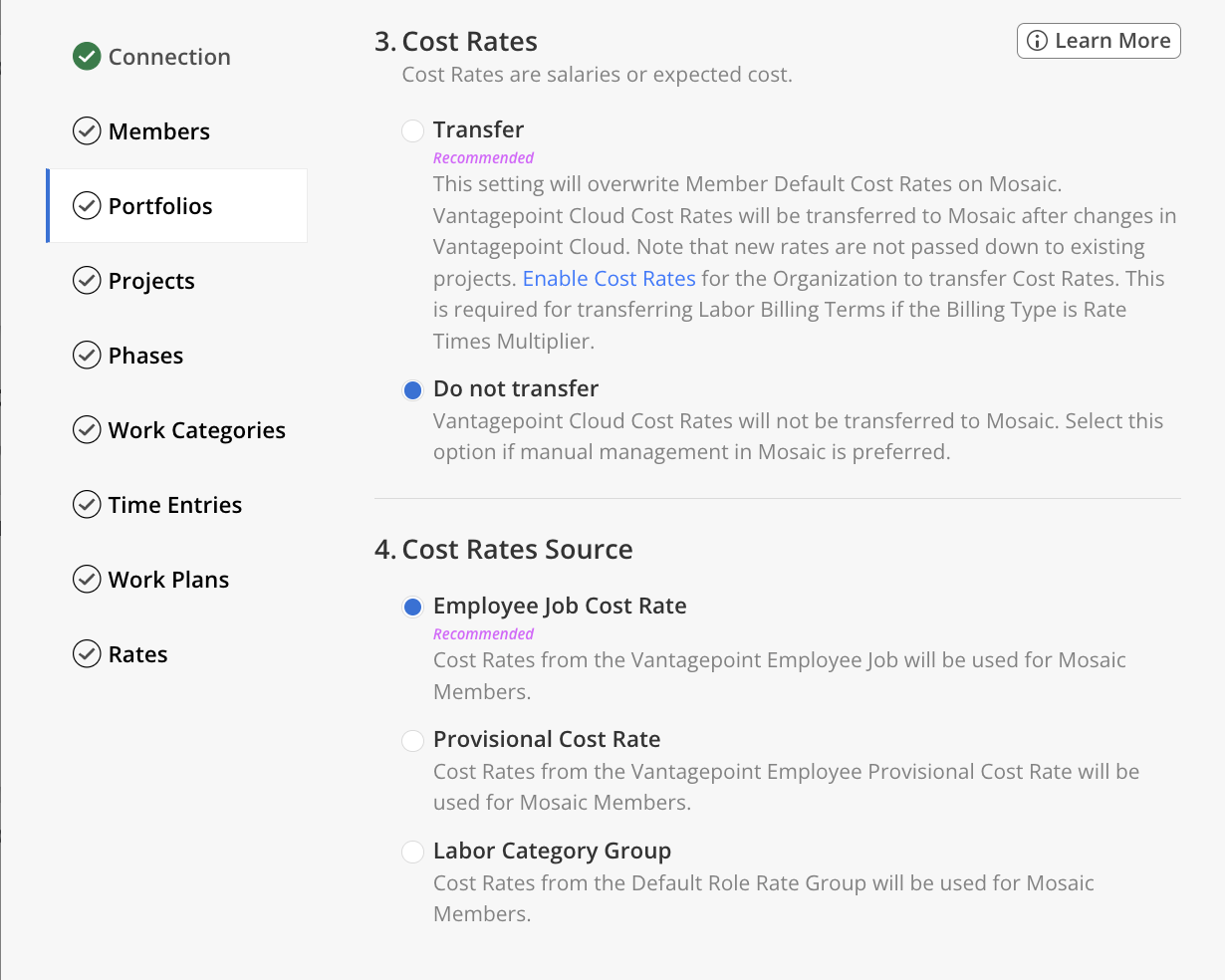
4. Cost Rates Source
Definition
Determines which Vantagepoint field is used as the source for Member cost rates in Mosaic. This setting controls where the cost rate value comes from — not whether it is transferred (that is controlled by the Cost Rates setting above).
Settings Choices
- Employee Job Cost Rate (Recommended) — Cost Rates from the Vantagepoint Employee Job will be used for Mosaic Members.
- Provisional Cost Rate — Cost Rates from the Vantagepoint Employee Provisional Cost Rate will be used for Mosaic Members.
- Labor Category Group — Cost Rates from the Default Role Rate Group will be used for Mosaic Members. This option uses the rate group specified in the Default Role Rate Group setting under the Rates section.
In Mosaic
The selected source determines which Vantagepoint field populates each member's cost rate. Cost rates appear on Member profiles and are used for financial calculations across the platform, including profit margins and project health metrics.
- Employee Job Cost Rate is the most common choice and pulls from each employee's individual job record.
- Provisional Cost Rate is useful for firms that use provisional (budgeted) rates rather than actual payroll rates.
- Labor Category Group applies a rate based on the member's role category rather than their individual employee record, which can be useful for standardized cost structures.
This setting is controlled by the Cost Rates feature flag. Contact your Mosaic team if this option is not visible.
1. Standard Roles
Definition
This setting controls whether Standard Roles (labor categories) from Vantagepoint are transferred to Mosaic. In Vantagepoint, these are the labor categories found in the Labor Category Table — sometimes referred to as employee Titles (e.g., Principal, Engineer II, Project Manager). Standard Roles define the set of available roles that can be assigned to members across the platform.
Transferring Standard Roles requires syncing Labor Billing Terms. Upload the required stored procedures.
In Mosaic
When set to Transfer, the full list of Vantagepoint labor categories will appear as available Roles in Mosaic. These roles are used for resource planning, filtering, and rate calculations. Any changes to Standard Roles in Vantagepoint will overwrite the corresponding roles in Mosaic on each sync.
When set to Do not transfer, roles must be created and maintained manually within Mosaic. Choose this if your firm manages roles independently in Mosaic or if the Vantagepoint role list does not align with how your team plans work.
2. Default Roles
Definition
This setting controls whether a member's default organizational role from Vantagepoint is transferred to Mosaic. The default role determines which role is automatically assigned to a member when they are added to a project.
Transferring Default Roles requires syncing Labor Billing Terms. Upload the required stored procedures.
In Mosaic
When set to Transfer, each member's default role is kept in sync with Vantagepoint. Any time the member's role changes in Vantagepoint, it will be updated in Mosaic on the next sync. This is useful when Vantagepoint is the source of truth for organizational role assignments.
When set to One time at first link, the role is transferred once during the initial member link. After that, the role can be changed independently in Mosaic without being overwritten. This is useful if your team wants to start with Vantagepoint roles but manage them in Mosaic going forward.
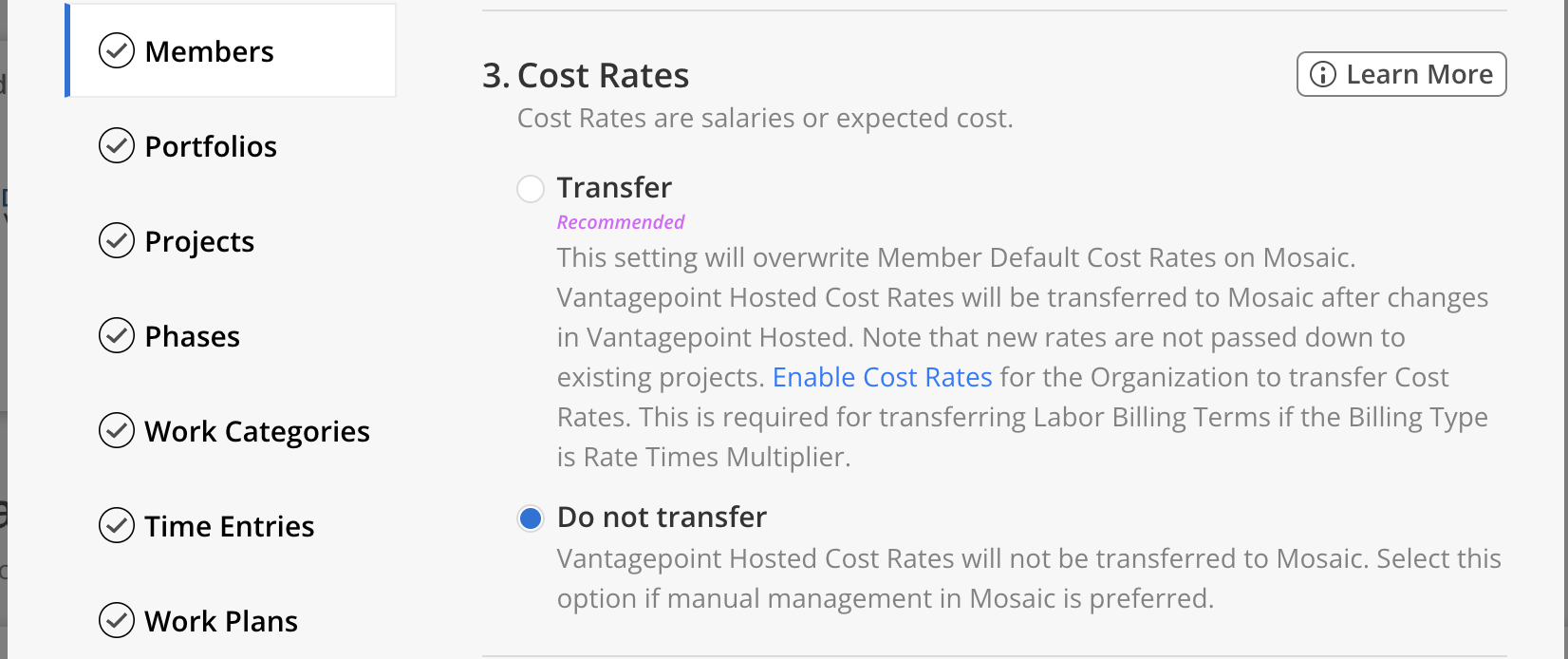
3. Cost Rates
Definition
Cost Rates are salaries or expected cost. This setting controls whether Member Default Cost Rates from Vantagepoint are transferred to Mosaic.
Transferring Cost Rates is required for Labor Billing Terms if the Billing Type is Rate Times Multiplier.
You must Enable Cost Rates for the Organization to transfer Cost Rates. This setting is controlled by the Cost Rates feature flag — contact your Mosaic team if this option is not visible.
In Mosaic
When set to Transfer, each member's default cost rate is kept in sync with Vantagepoint. Cost rates appear on Member profiles and are used for financial calculations across the platform, including profit margins, project health metrics, and budget forecasting. Note that transferred rates apply to new project assignments only — existing project-level rates are not retroactively updated.
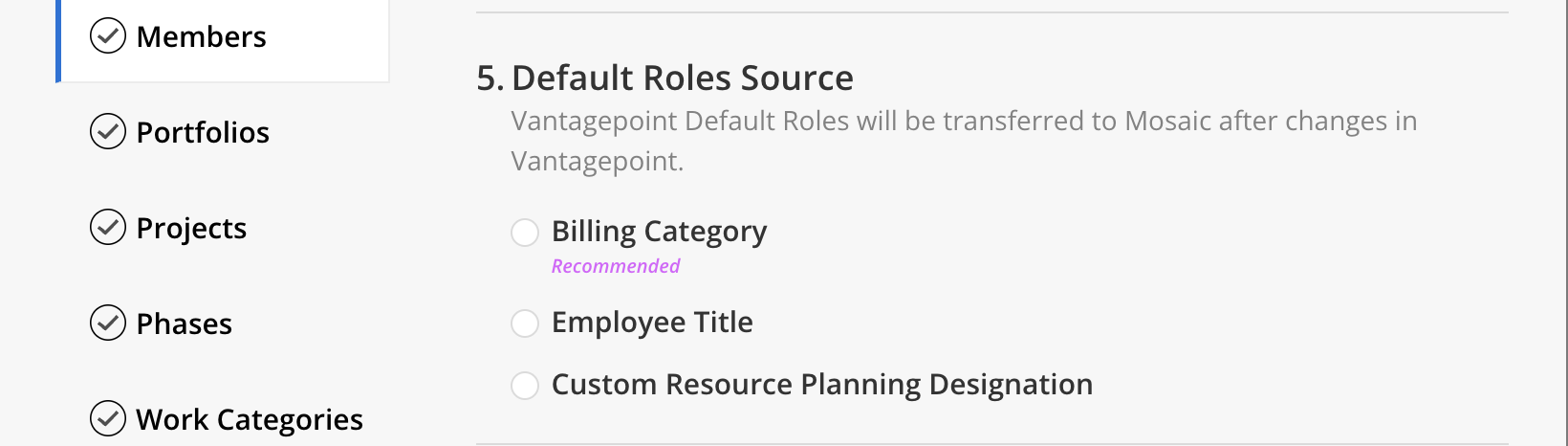
4. Default Roles Source
Definition
Determines which Vantagepoint field is used as the default Role for Members in Mosaic.
Settings Choices
- Billing Category (Recommended) — Uses the Vantagepoint Billing Category as the Member's default role.
- Employee Title — Uses the Vantagepoint Employee Title as the Member's default role.
- Custom Resource Planning Designation — Uses a custom Vantagepoint Resource Planning Designation field as the Member's default role.
In Mosaic
Vantagepoint Default Roles are transferred to Mosaic after changes in Vantagepoint. This determines each member's default role assignment across projects.
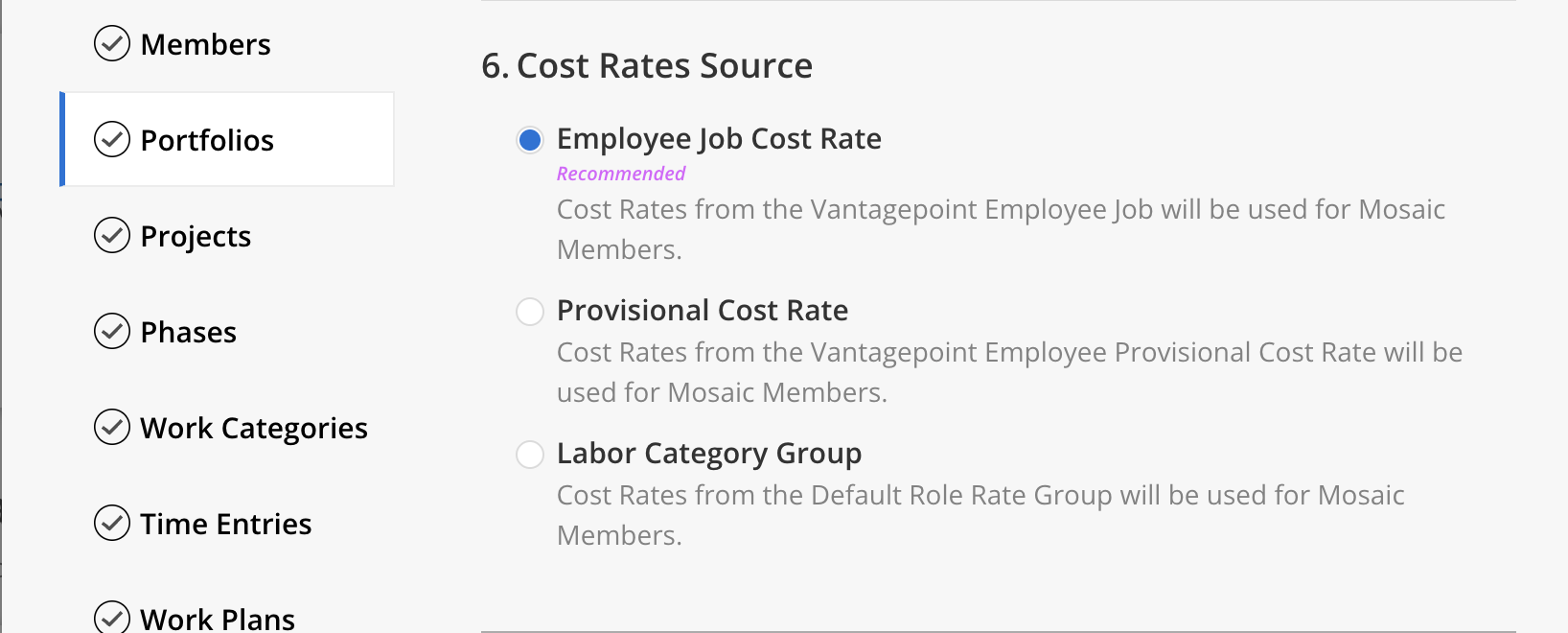
5. Cost Rates Source
Definition
Determines which Vantagepoint field is used as the source for Member cost rates in Mosaic. This setting controls where the cost rate value comes from — not whether it is transferred (that is controlled by the Cost Rates setting above).
Settings Choices
- Employee Job Cost Rate (Recommended) — Cost Rates from the Vantagepoint Employee Job will be used for Mosaic Members.
- Provisional Cost Rate — Cost Rates from the Vantagepoint Employee Provisional Cost Rate will be used for Mosaic Members.
- Labor Category Group — Cost Rates from the Default Role Rate Group will be used for Mosaic Members. This option uses the rate group specified in the Default Role Rate Group setting under the Rates section.
In Mosaic
The selected source determines which Vantagepoint field populates each member's cost rate. Cost rates appear on Member profiles and are used for financial calculations across the platform, including profit margins and project health metrics.
- Employee Job Cost Rate is the most common choice and pulls from each employee's individual job record.
- Provisional Cost Rate is useful for firms that use provisional (budgeted) rates rather than actual payroll rates.
- Labor Category Group applies a rate based on the member's role category rather than their individual employee record, which can be useful for standardized cost structures.
This setting is controlled by the Cost Rates feature flag. Contact your Mosaic team if this option is not visible.
Portfolios
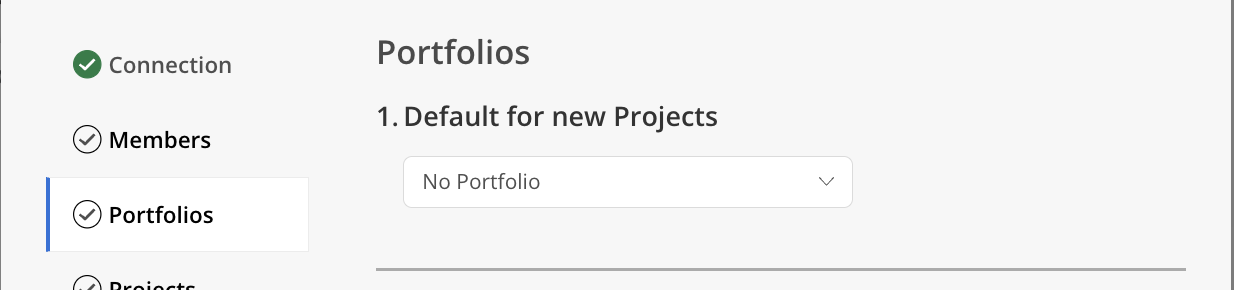
1. Default for new Projects
Definition
A Portfolio in Mosaic is a folder used to organize multiple projects — for example, by department, client, manager, or type of work. This setting determines which Portfolio newly linked Vantagepoint projects are placed into by default.
Settings Choices
This is a dropdown that lists all Portfolios currently configured in your Mosaic organization, including:
- No Portfolio (default) — Newly linked projects will not be assigned to any Portfolio. They can be moved into a Portfolio manually later.
- Import — A built-in Portfolio provided by Mosaic specifically for integration-linked projects. This is a convenient default if you want all imported projects to land in one place before being organized further.
- [Your Portfolios] — Select any other existing Mosaic Portfolio to automatically place newly linked Vantagepoint projects into that Portfolio.
In Mosaic
This setting only applies to new projects at the time they are first linked from Vantagepoint. It does not retroactively move existing linked projects into the selected Portfolio.
To organize projects beyond the default, you can manually move projects between Portfolios at any time from the Projects view in Mosaic. Many firms start by selecting Import as the default, then periodically sort imported projects into department- or client-specific Portfolios. If your firm needs automatic routing of projects into different Portfolios based on criteria (e.g., client or department), contact the Mosaic Solutions team to discuss customization options.
1. Default for new Projects
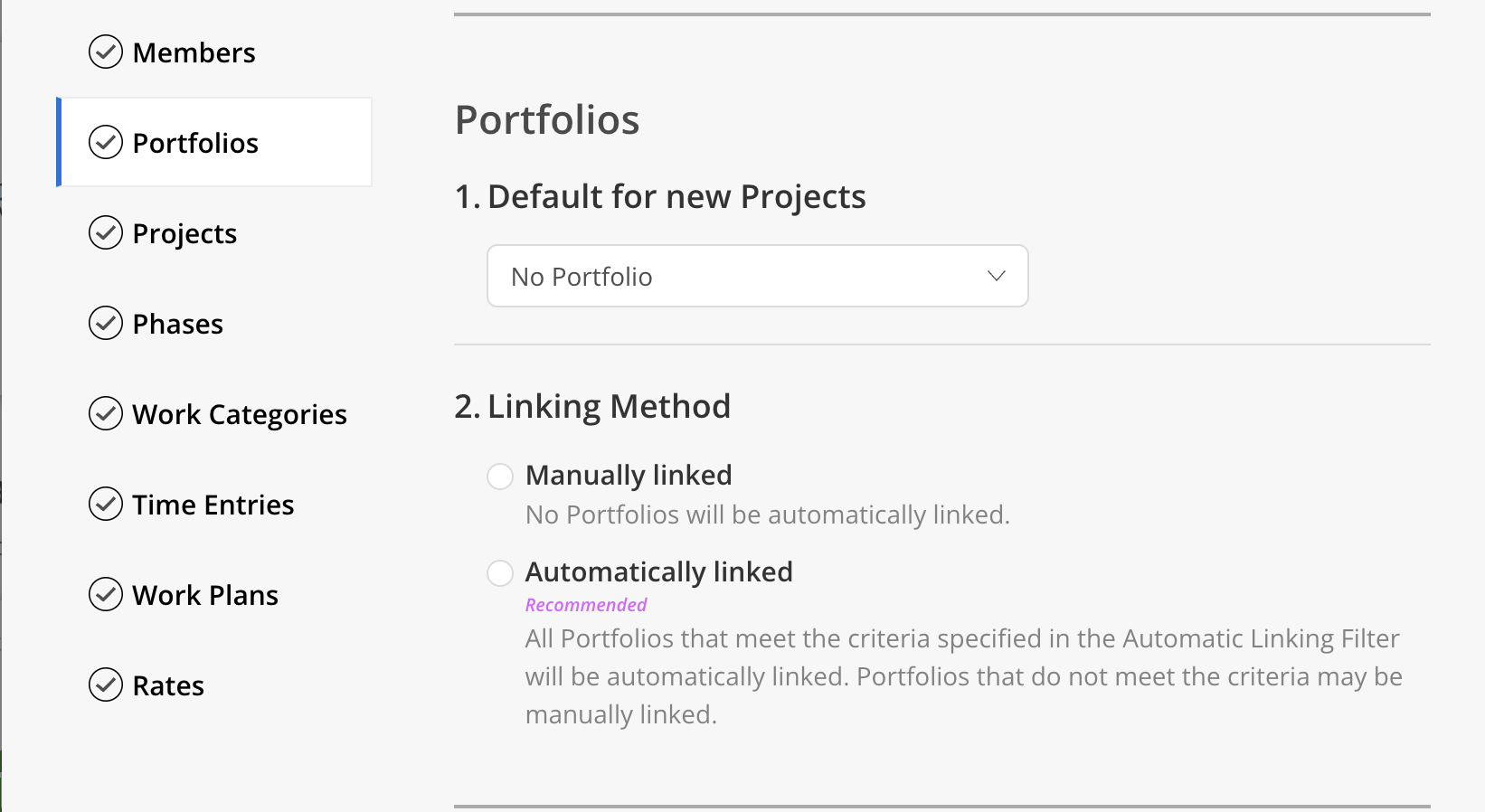
Definition
A Portfolio in Mosaic is a folder used to organize multiple projects — for example, by department, client, manager, or type of work. This setting determines which Portfolio newly linked Vantagepoint projects are placed into by default.
Settings Choices
This is a dropdown that lists all Portfolios currently configured in your Mosaic organization, including:
- No Portfolio (default) — Newly linked projects will not be assigned to any Portfolio. They can be moved into a Portfolio manually later.
- Import — A built-in Portfolio provided by Mosaic specifically for integration-linked projects. This is a convenient default if you want all imported projects to land in one place before being organized further.
- [Your Portfolios] — Select any other existing Mosaic Portfolio to automatically place newly linked Vantagepoint projects into that Portfolio.
In Mosaic
This setting only applies to new projects at the time they are first linked from Vantagepoint. It does not retroactively move existing linked projects into the selected Portfolio.
To organize projects beyond the default, you can manually move projects between Portfolios at any time from the Projects view in Mosaic. Many firms start by selecting Import as the default, then periodically sort imported projects into department- or client-specific Portfolios. If your firm needs automatic routing of projects into different Portfolios based on criteria (e.g., client or department), contact the Mosaic Solutions team to discuss customization options.
Projects
1. Linking Method
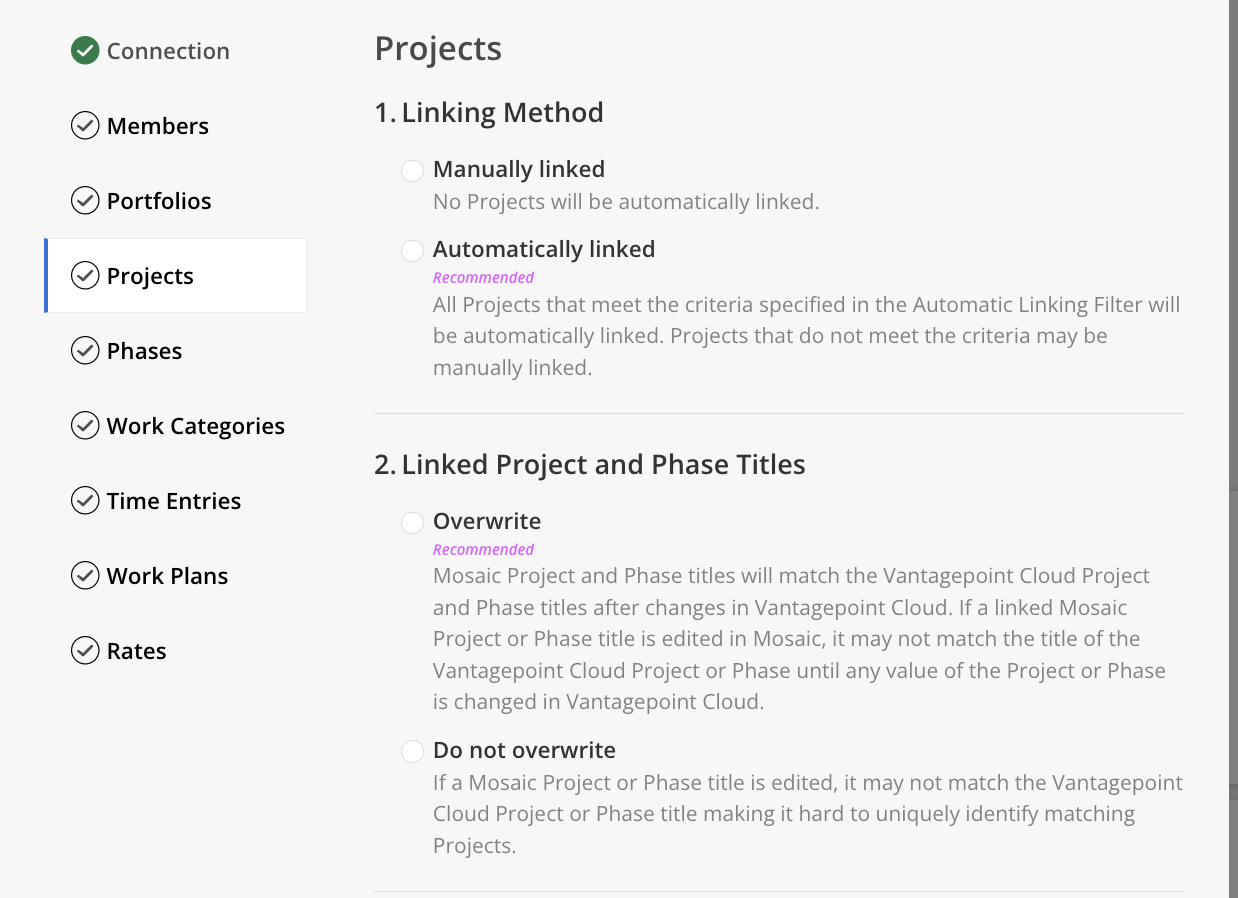
Definition
This setting determines how Vantagepoint projects are connected to Mosaic. Importing means bringing a project from Vantagepoint into Mosaic for the first time. Linking means establishing an ongoing connection so that changes in Vantagepoint are synced to Mosaic automatically.
Settings Choices
- Manually linked — No projects will be automatically linked. You choose which Vantagepoint projects to import and link to Mosaic on a project-by-project basis.
- Automatically linked (Recommended) — All projects that meet the criteria specified in the Automatic Linking Filter will be automatically linked. Projects that do not meet the criteria may be manually linked.
In Mosaic
When set to Manually linked, new Vantagepoint projects will not appear in Mosaic until you explicitly import them from the integration linking screen. This gives you full control over which projects exist in Mosaic, but requires ongoing manual effort as new projects are created in Vantagepoint.
When set to Automatically linked, projects that match your filter criteria are imported and linked as soon as they are detected. This is the recommended approach for most firms, as it ensures Mosaic stays up to date without manual intervention. Projects that do not match the filter criteria can still be linked manually if needed.
Imported data includes: billable status, project status, start/end dates, client information, project fees, archived status, project number, and project title.
2. Linked Project and Phase Titles
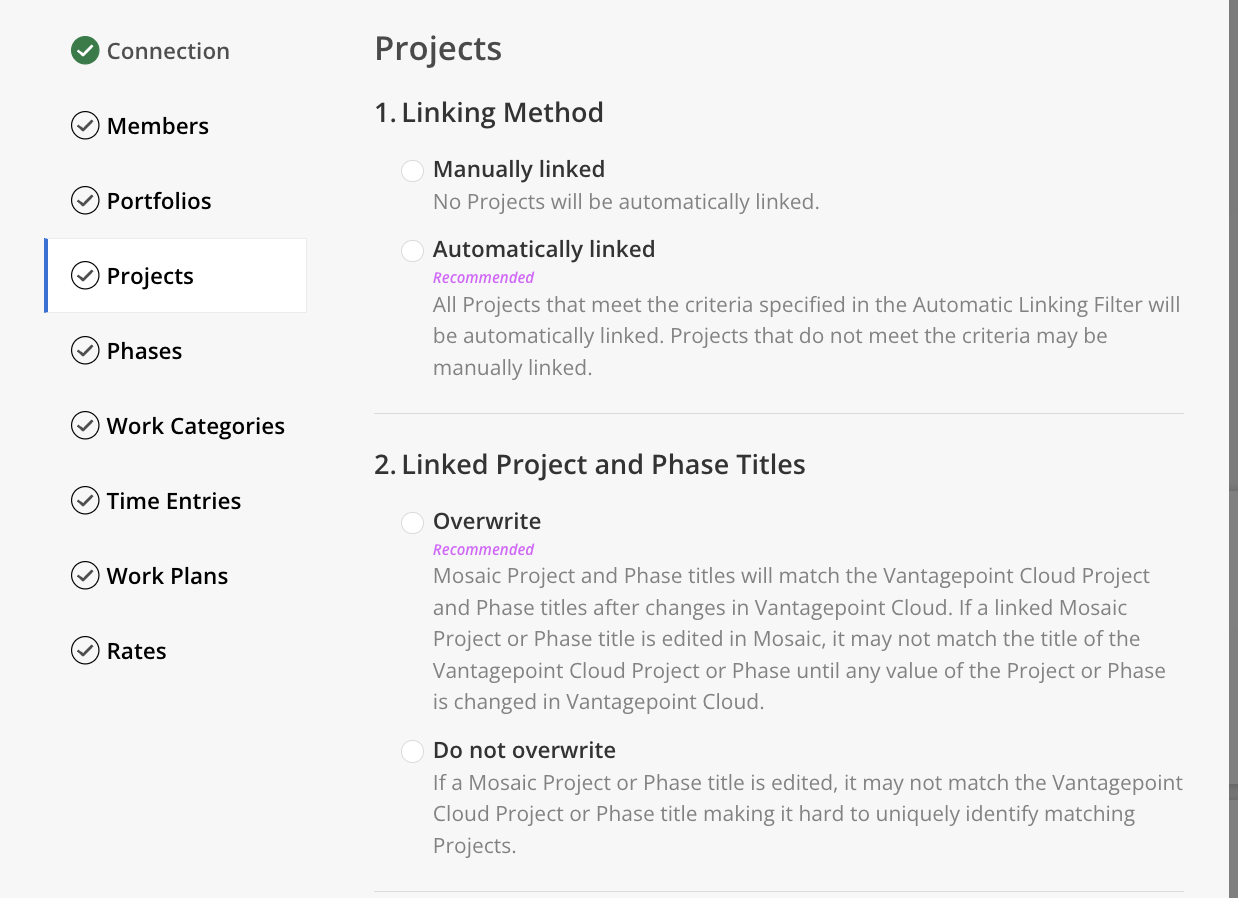
Definition
This setting controls whether Mosaic keeps project and phase titles in sync with Vantagepoint, or allows them to diverge after the initial link.
Settings Choices
- Overwrite (Recommended) — Mosaic Project and Phase titles will match the Vantagepoint Project and Phase titles after changes in Vantagepoint. If a linked Mosaic Project or Phase title is edited in Mosaic, it may not match the title in Vantagepoint until a change is made to any value of that Project or Phase in Vantagepoint, at which point the title will be overwritten back to match.
- Do not overwrite — Mosaic Project and Phase titles can be edited independently. If a title is changed in Mosaic, it may no longer match the Vantagepoint title, making it harder to uniquely identify matching projects across systems.
In Mosaic
When set to Overwrite, Vantagepoint is the source of truth for all project and phase titles. If your team edits a title in Mosaic, that edit will be overwritten the next time the project or phase syncs from Vantagepoint. Choose this if you want consistent naming across both systems.
When set to Do not overwrite, titles can be customized freely in Mosaic. This is useful if your team uses different naming conventions in Mosaic than in Vantagepoint, but be aware that mismatched titles can make it difficult to identify which Mosaic project corresponds to which Vantagepoint project.
If you choose Overwrite, ensure that team members do not edit project or phase titles directly in Mosaic, as those changes will be lost on the next sync.
3. Project and Phase Billable
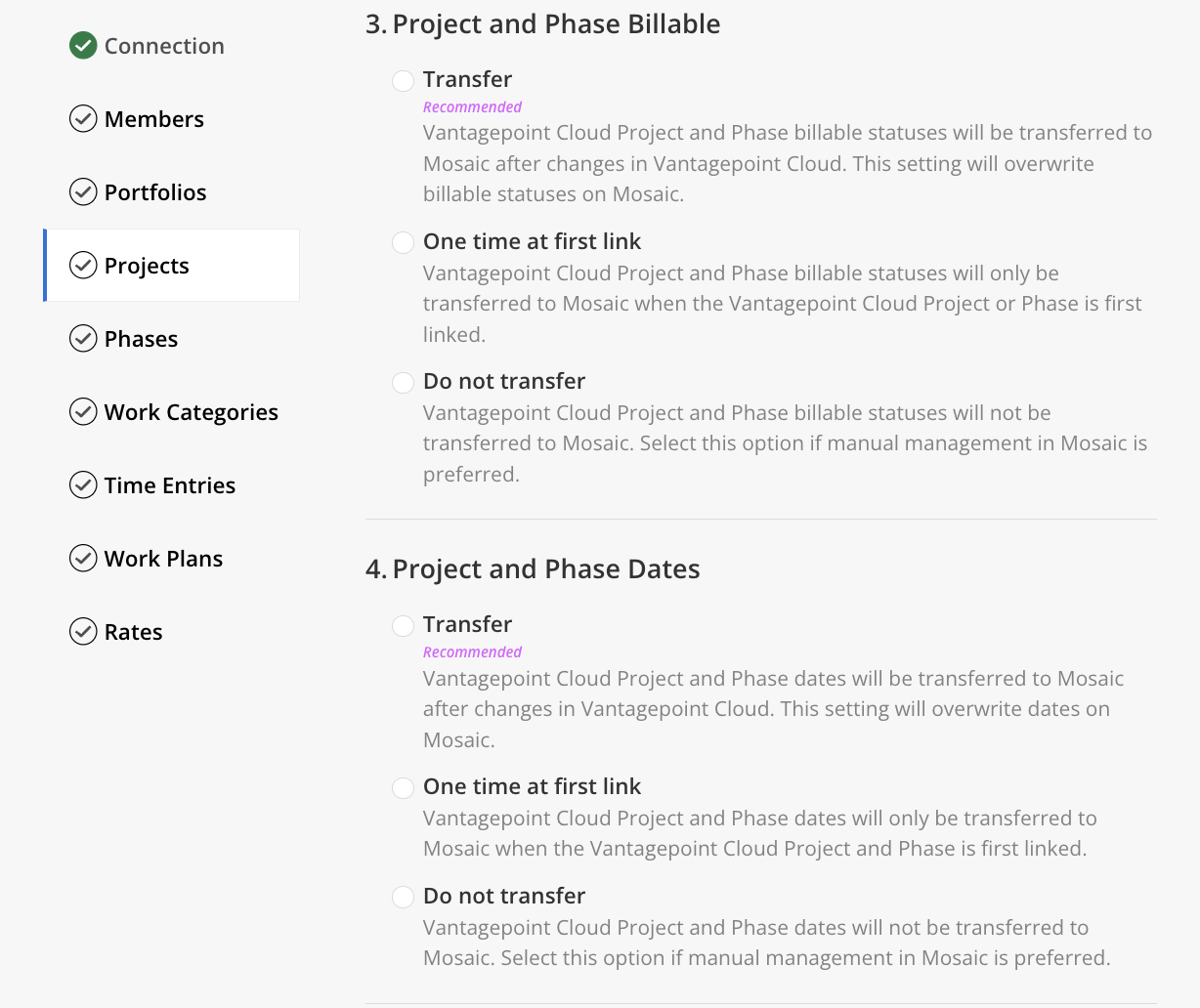
Definition
The billable status indicates whether a project or phase is charged to the client. This setting controls whether Vantagepoint billable statuses are transferred to Mosaic.
In Mosaic
When set to Transfer, billable statuses stay in sync — any time the billable flag changes in Vantagepoint, it will be updated in Mosaic on the next sync. This is the recommended approach to ensure financial reporting in Mosaic accurately reflects what is billable.
When set to Do not transfer, Mosaic is the source of truth for billable status. This is useful if your team categorizes billable work differently in Mosaic than in Vantagepoint.
4. Project and Phase Dates
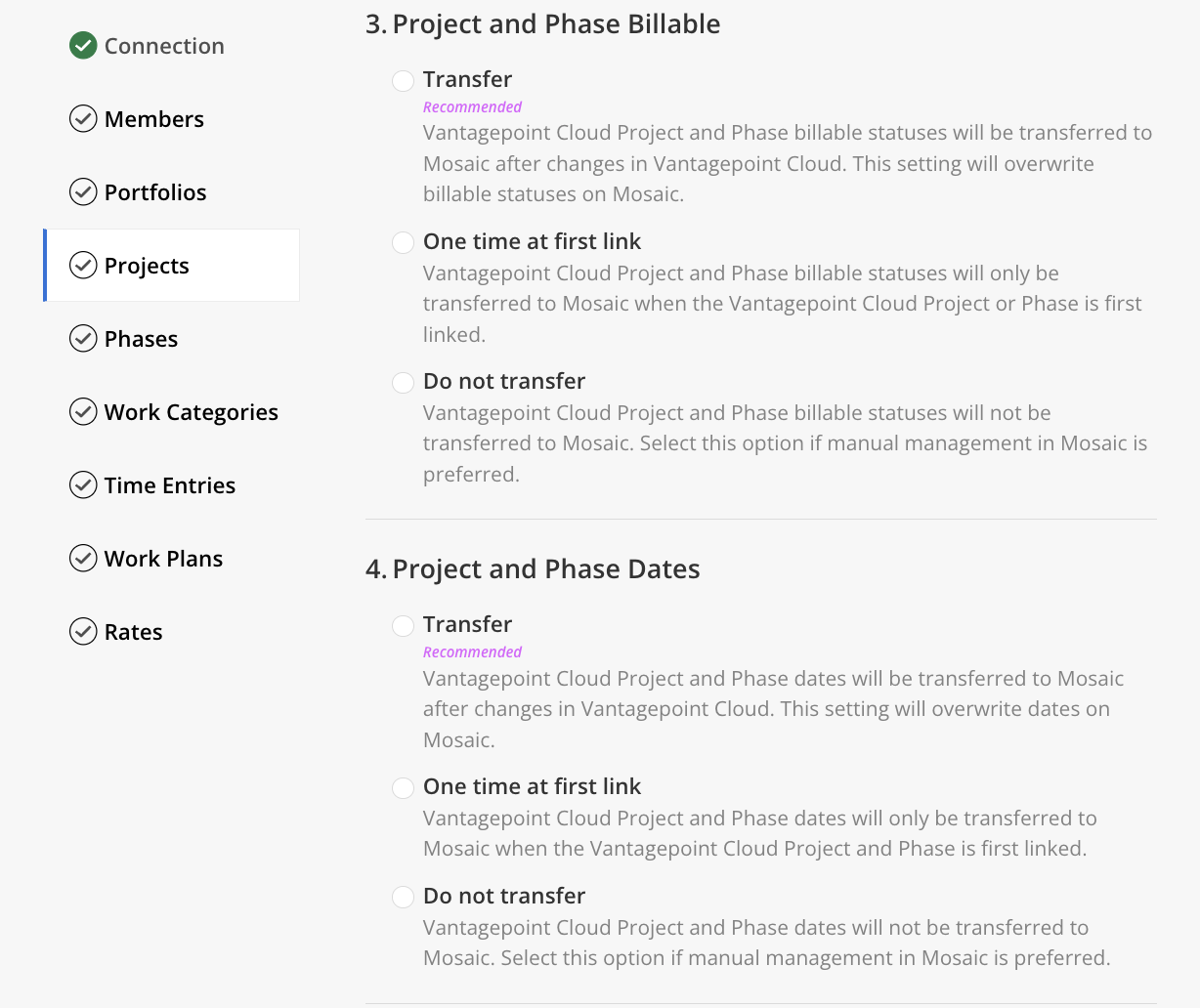
Definition
This setting controls whether project and phase start and end dates from Vantagepoint are transferred to Mosaic. Dates drive project timelines, scheduling, and resource planning in Mosaic.
In Mosaic
When set to Transfer, project and phase timelines in Mosaic stay in sync with Vantagepoint. If dates change in Vantagepoint, Mosaic schedules will update automatically. Choose this if Vantagepoint is your source of truth for project timelines.
When set to One time at first link, dates are imported during the initial link and can then be adjusted independently in Mosaic. This is useful if your team refines schedules in Mosaic after the initial import.
If you choose Transfer, avoid editing project or phase dates directly in Mosaic — those changes will be overwritten on the next sync from Vantagepoint.
5. Project and Phase Fee
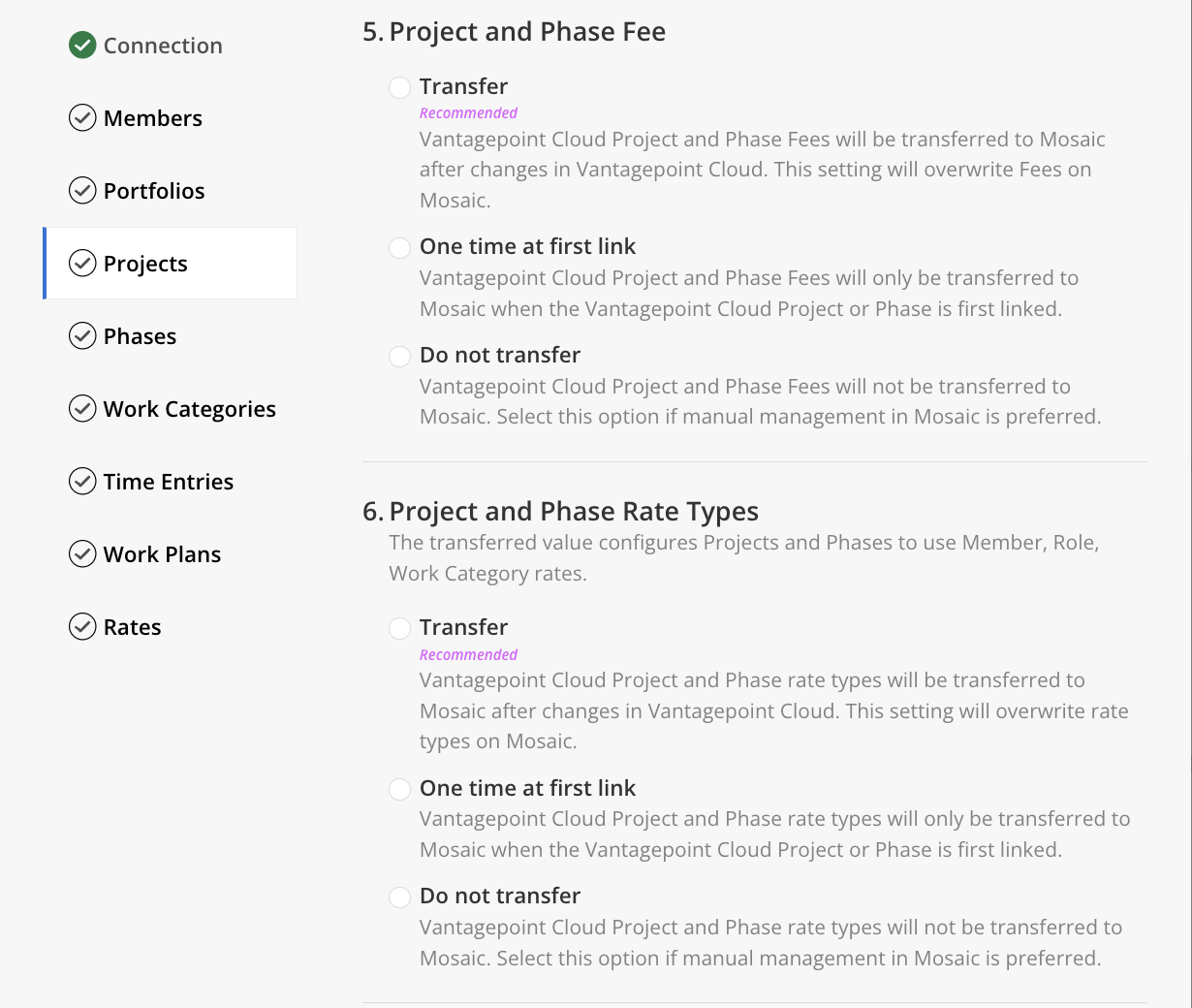
Definition
This setting controls whether project and phase fee amounts (budgets) from Vantagepoint are transferred to Mosaic. The fee represents the total amount you plan to bill for a project or the portion allocated to a specific phase.
In Mosaic
When set to Transfer, the fee (budget) for each project and phase stays in sync with Vantagepoint. Fee changes in Vantagepoint will overwrite the corresponding values in Mosaic on each sync. This is the recommended approach to ensure budget tracking in Mosaic accurately reflects the contract values in Vantagepoint.
When set to One time at first link, fees are imported during the initial link and can then be adjusted independently in Mosaic. This is useful if your team refines budgets within Mosaic after import.
The actual value transferred depends on the Project and Phase Fee Source setting, which determines which Vantagepoint field(s) are used to calculate the fee (e.g., Direct Labor Fee, Labor Budgets, Fee Billing Terms).
6. Project and Phase Rate Types
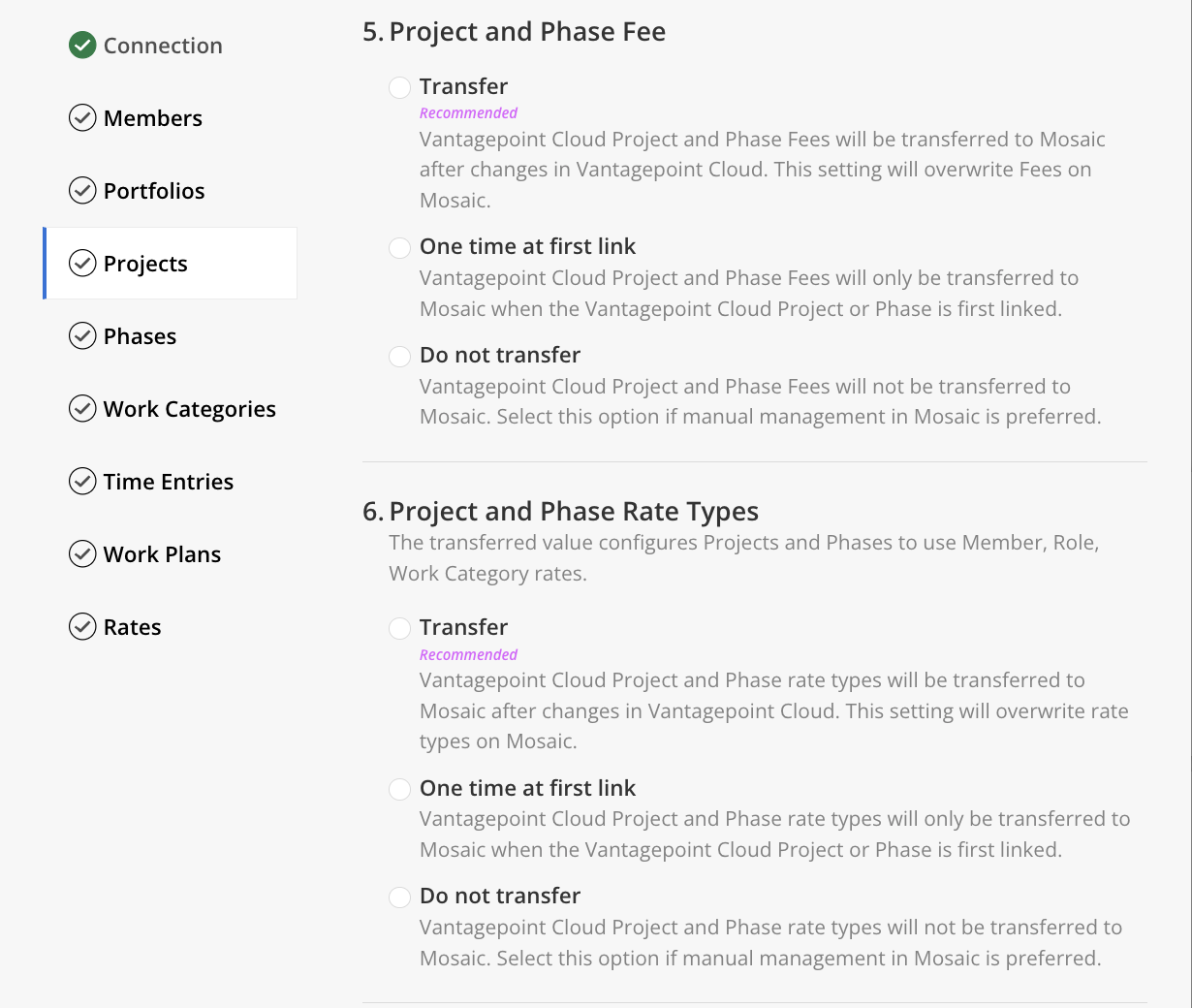
Definition
This setting controls whether project and phase rate types (billing types) from Vantagepoint are transferred to Mosaic. The rate type determines how time is billed on a project — by member rate, role rate, or work category rate.
The transferred value configures Projects and Phases to use Member, Role, or Work Category rates.
In Mosaic
Rate types determine how billing rates are calculated for time entries on a project:
- Member-based (Employee) — Uses the specific employee's individual bill rate.
- Role-based — Uses the rate assigned to the member's role on the project.
- Work Category-based (Activity) — Uses the rate associated with the work category or activity.
When set to Transfer, rate types stay in sync with Vantagepoint. This ensures that billing calculations in Mosaic match the billing method configured in Vantagepoint.
7. Project and Phase Rate Group
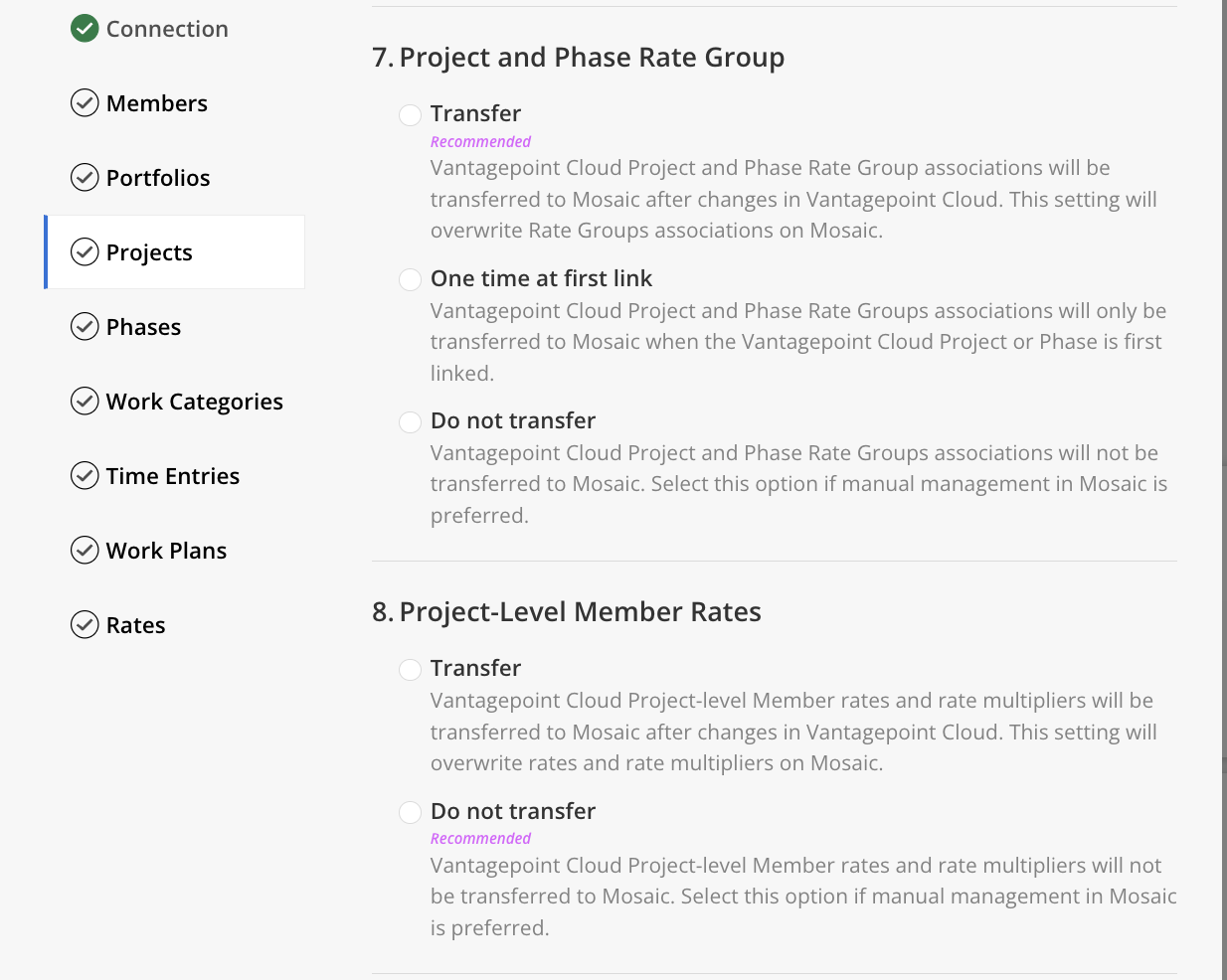
Definition
This setting controls whether the association between rate tables (rate groups) and specific projects and phases is transferred from Vantagepoint to Mosaic. Rate groups define which set of billing rates apply to a given project or phase.
In Mosaic
When set to Transfer, projects and phases in Mosaic will inherit the rate group assigned in Vantagepoint, and any changes to that assignment will be synced automatically. Projects with an associated role rate table will use those rates for billing calculations.
To access role rates in Mosaic, this setting (or "One time at first link") must be enabled alongside the rate group transfer settings in the Rates section.
8. Project-Level Member Rates
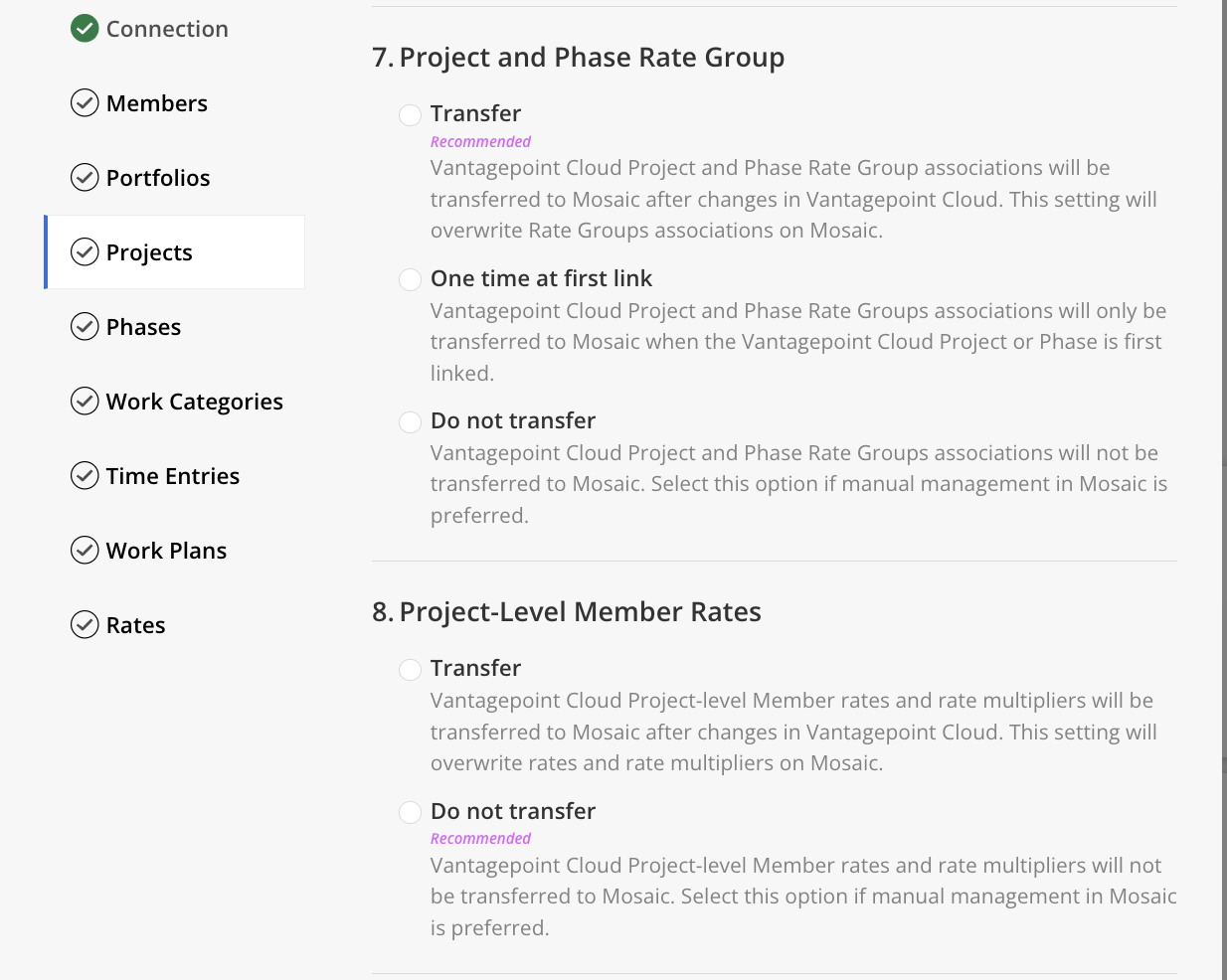
Definition
This setting controls whether project-level member rates and rate multipliers from Vantagepoint are transferred to Mosaic. These are the billing rates assigned to specific members on specific projects, as opposed to the member's default organization-wide rate.
In Mosaic
When set to Transfer, each member's project-specific bill rate and rate multiplier are kept in sync with Vantagepoint. Any changes to project-level rates in Vantagepoint will overwrite the corresponding values in Mosaic on each sync.
When set to Do not transfer, project-level member rates must be managed manually within Mosaic. Choose this if your team sets or adjusts project-level rates directly in Mosaic.
9. Bill Rate Source for Member Rates
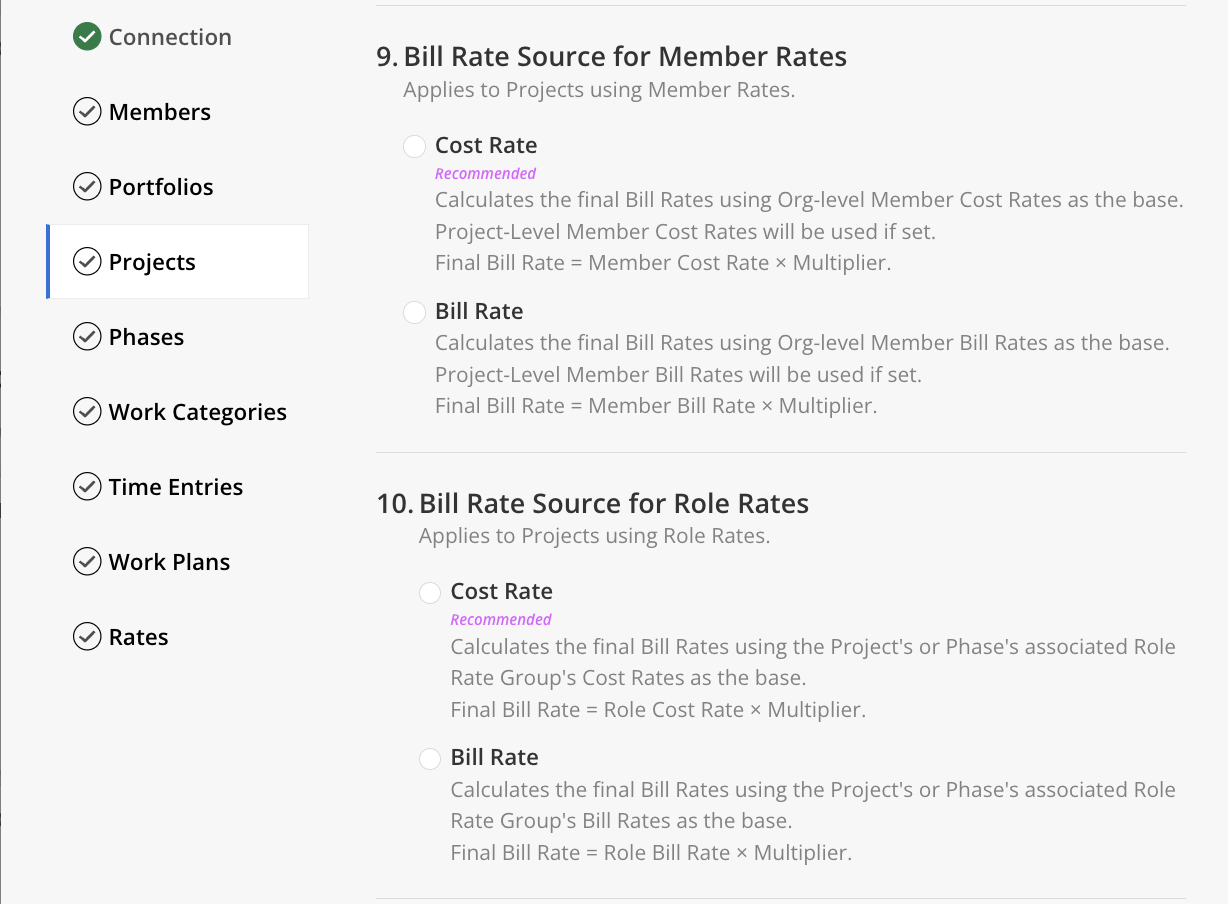
Definition
This setting determines which rate is used as the base when calculating bill rates on projects that use Member Rates (employee-based billing). It controls whether the cost rate or the bill rate is used in the final billing calculation.
Applies to Projects using Member Rates.
Settings Choices
- Cost Rate (Recommended) — Calculates the final Bill Rates using Org-level Member Cost Rates as the base. Project-Level Member Cost Rates will be used if set. Final Bill Rate = Member Cost Rate x Multiplier.
- Bill Rate — Calculates the final Bill Rates using Org-level Member Bill Rates as the base. Project-Level Member Bill Rates will be used if set. Final Bill Rate = Member Bill Rate x Multiplier.
In Mosaic
When set to Cost Rate, billing is derived from what the member costs the organization, multiplied by the project's rate multiplier. This is useful for firms that mark up internal costs to determine client billing.
When set to Bill Rate, billing is derived from the member's standard client-facing rate, multiplied by the project's rate multiplier. This is useful for firms that define explicit bill rates per member.
In both cases, if a project-level member rate has been set (see Project-Level Member Rates), it takes precedence over the organization-level default.
This setting does not source data from Vantagepoint — it controls how Mosaic calculates rates using the member rate data already in the system. Set member default bill rates in Organizational Settings > Members > Rate.
10. Bill Rate Source for Role Rates
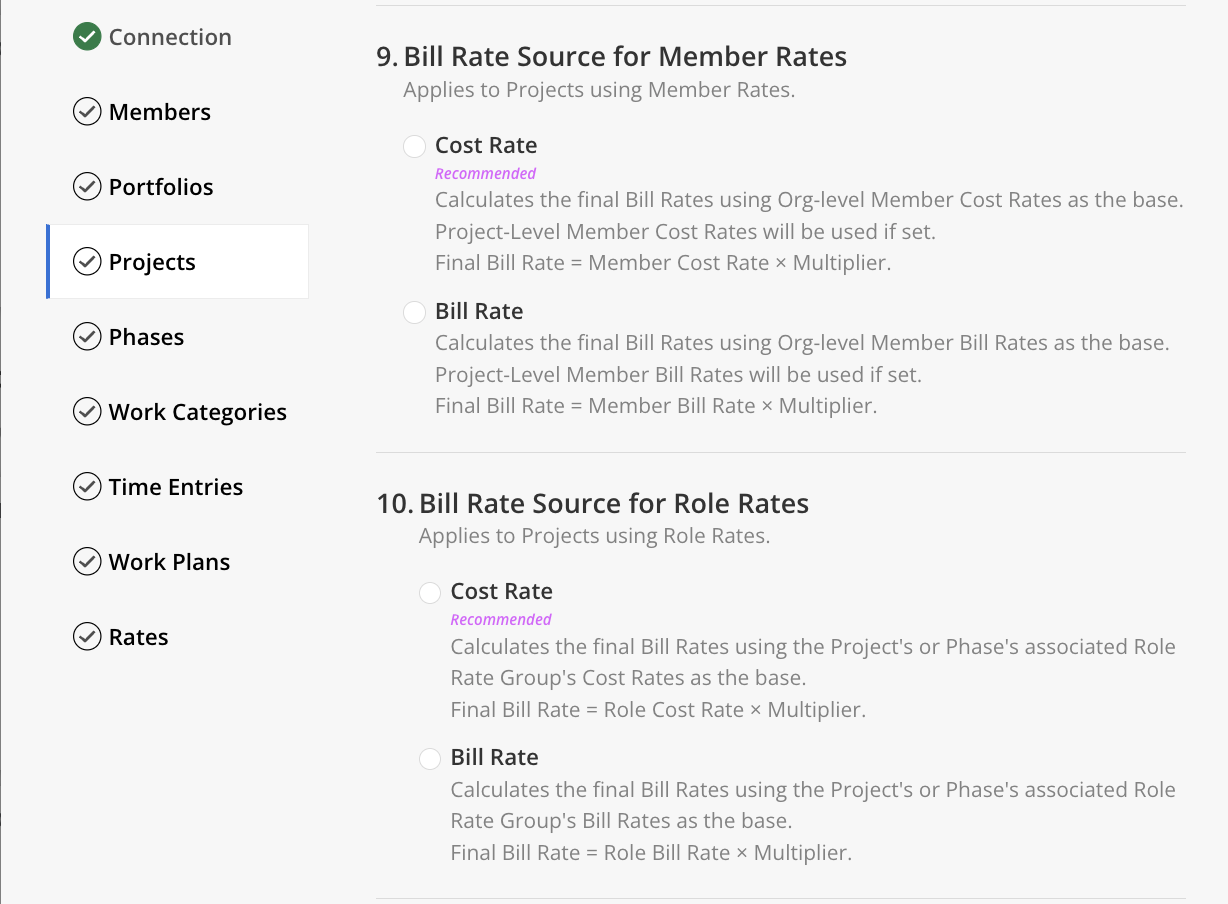
Definition
This setting determines which rate is used as the base when calculating bill rates on projects that use Role Rates (role-based billing). It controls whether the role's cost rate or bill rate from the associated Rate Group is used.
Applies to Projects using Role Rates.
Settings Choices
- Cost Rate (Recommended) — Calculates the final Bill Rates using the Project's or Phase's associated Role Rate Group's Cost Rates as the base. Final Bill Rate = Role Cost Rate x Multiplier.
- Bill Rate — Calculates the final Bill Rates using the Project's or Phase's associated Role Rate Group's Bill Rates as the base. Final Bill Rate = Role Bill Rate x Multiplier.
In Mosaic
When set to Cost Rate, billing is derived from the role's cost rate in the associated Rate Group, multiplied by the project's rate multiplier. This is useful for firms that mark up role-based costs for client billing.
When set to Bill Rate, billing is derived from the role's client-facing bill rate in the associated Rate Group, multiplied by the project's rate multiplier.
Manage role rates in Budgets > Rates > Role. The rates used come from the Rate Group associated with the project or phase (see Project and Phase Rate Group).
11. Bill Rate Source for Work Category Rates
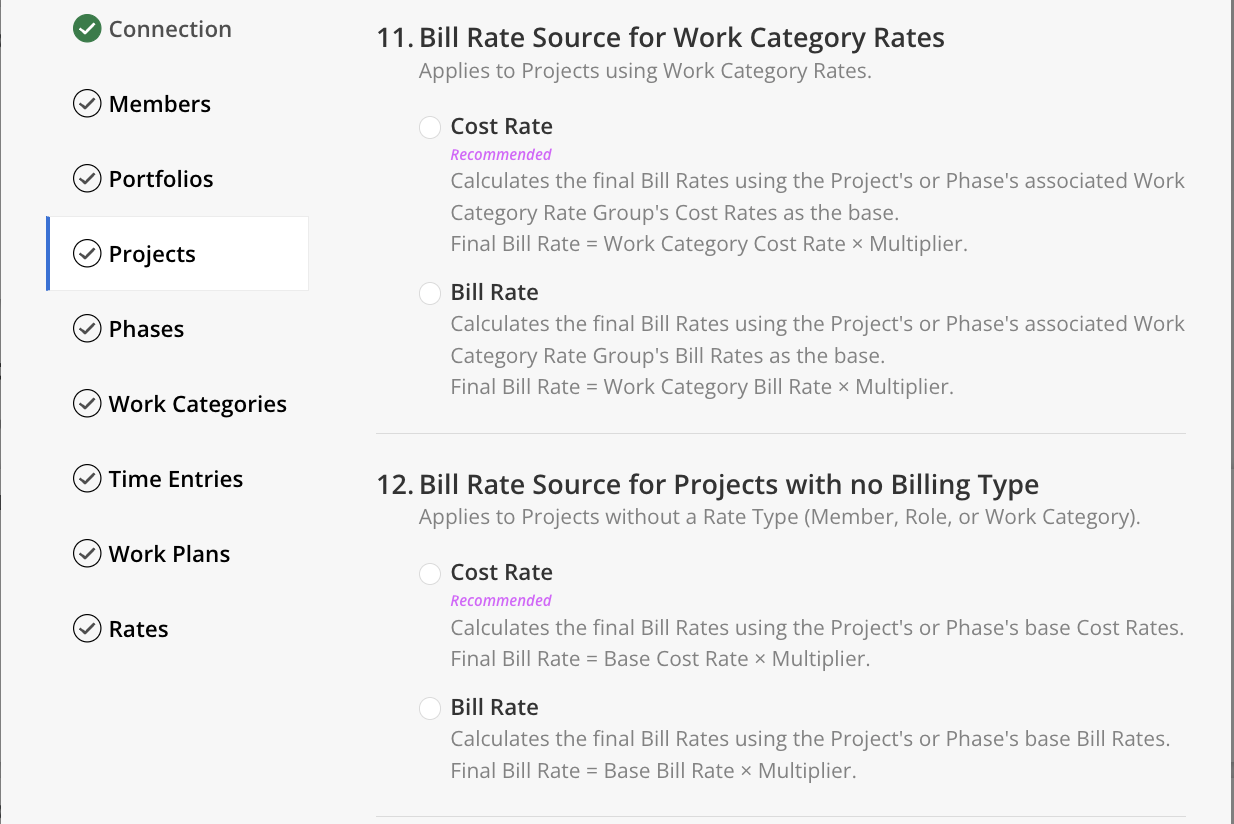
Definition
This setting determines which rate is used as the base when calculating bill rates on projects that use Work Category Rates (activity-based billing). It controls whether the work category's cost rate or bill rate from the associated Rate Group is used.
Applies to Projects using Work Category Rates.
Settings Choices
- Cost Rate (Recommended) — Calculates the final Bill Rates using the Project's or Phase's associated Work Category Rate Group's Cost Rates as the base. Final Bill Rate = Work Category Cost Rate x Multiplier.
- Bill Rate — Calculates the final Bill Rates using the Project's or Phase's associated Work Category Rate Group's Bill Rates as the base. Final Bill Rate = Work Category Bill Rate x Multiplier.
In Mosaic
When set to Cost Rate, billing is derived from the work category's cost rate in the associated Rate Group, multiplied by the project's rate multiplier.
When set to Bill Rate, billing is derived from the work category's client-facing bill rate in the associated Rate Group, multiplied by the project's rate multiplier.
Configure work category rates in Settings > Budget > Rates > Work Category tab. Organize them within Rate Groups and apply to projects as needed.
This setting does not source data from Vantagepoint — it controls how Mosaic calculates rates using the work category rate data already in the system.
12. Bill Rate Source for Projects with no Billing Type
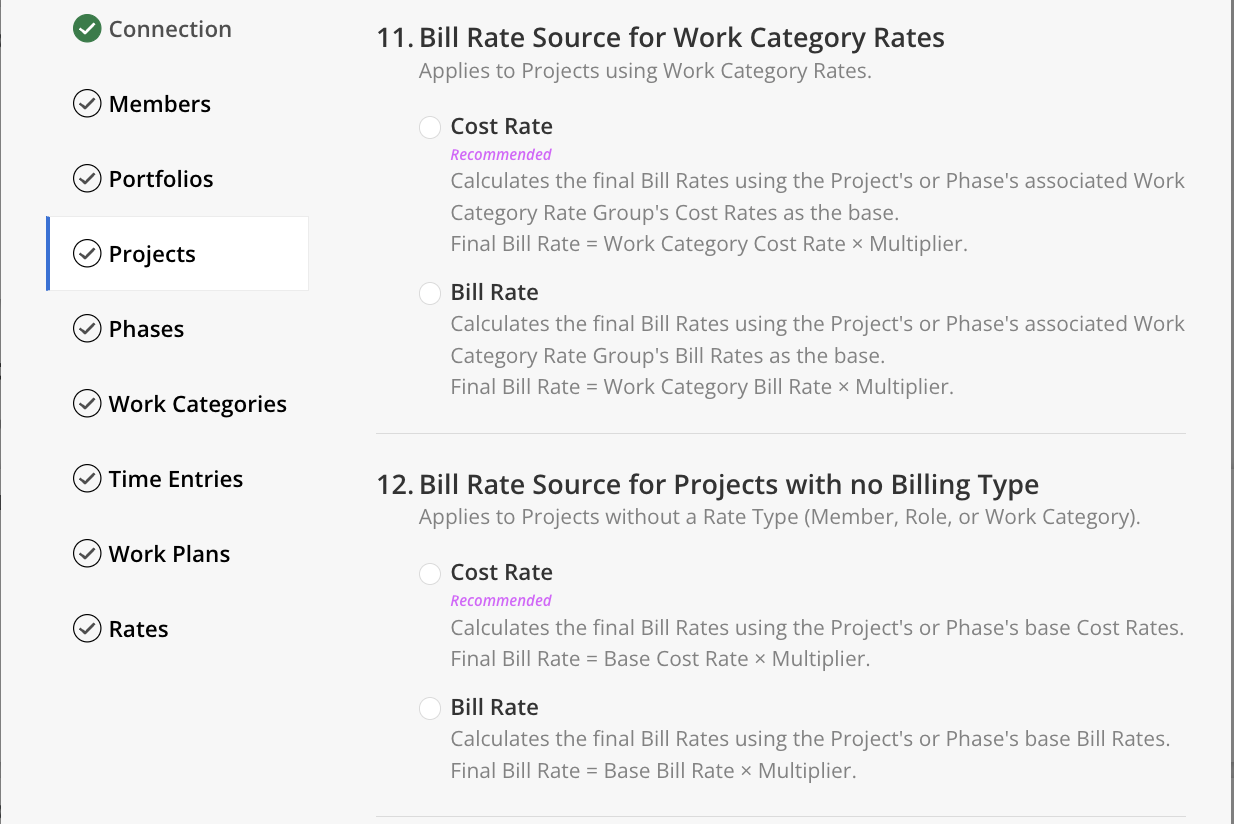
Definition
This setting determines which rate is used as the base when calculating bill rates on projects that do not have a Rate Type (billing type) assigned — i.e., projects where the billing type is blank (not Member, Role, or Work Category).
Applies to Projects without a Rate Type (Member, Role, or Work Category).
Settings Choices
- Cost Rate (Recommended) — Calculates the final Bill Rates using the Project's or Phase's base Cost Rates. Final Bill Rate = Base Cost Rate x Multiplier.
- Bill Rate — Calculates the final Bill Rates using the Project's or Phase's base Bill Rates. Final Bill Rate = Base Bill Rate x Multiplier.
In Mosaic
When set to Cost Rate, billing for projects without an assigned billing type is derived from the base cost rate, multiplied by the project's rate multiplier.
When set to Bill Rate, billing is derived from the base bill rate, multiplied by the project's rate multiplier.
This setting does not source data from Vantagepoint — it controls how Mosaic calculates rates for projects that have no billing type defined. To avoid relying on this fallback, ensure your projects have a Rate Type assigned via the Project and Phase Rate Types setting.
13. Project Managers
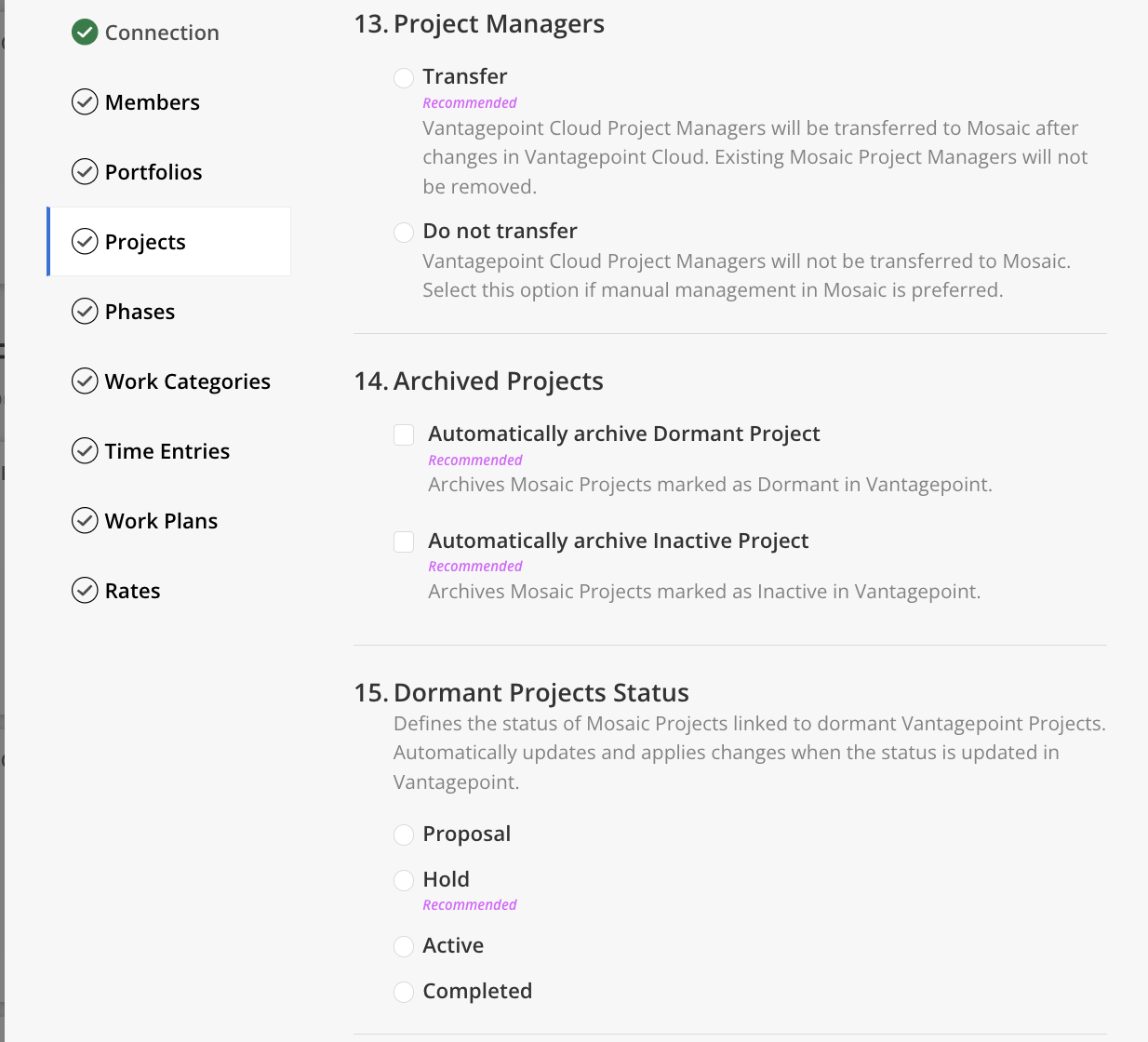
Definition
This setting controls whether Project Manager assignments from Vantagepoint are transferred to Mosaic. When enabled, members designated as Project Managers in Vantagepoint will be assigned the Project Manager role within their linked Mosaic projects.
Existing Mosaic Project Managers will not be removed — the Vantagepoint assignment is additive.
In Mosaic
When set to Transfer, project manager assignments are synced from Vantagepoint. This is additive — if a project already has managers assigned in Mosaic, those will be preserved, and the Vantagepoint manager will be added alongside them.
Assigned managers appear in the project's member list and can be accessed via the person icon in the project's top-right corner.
14. Archived Projects
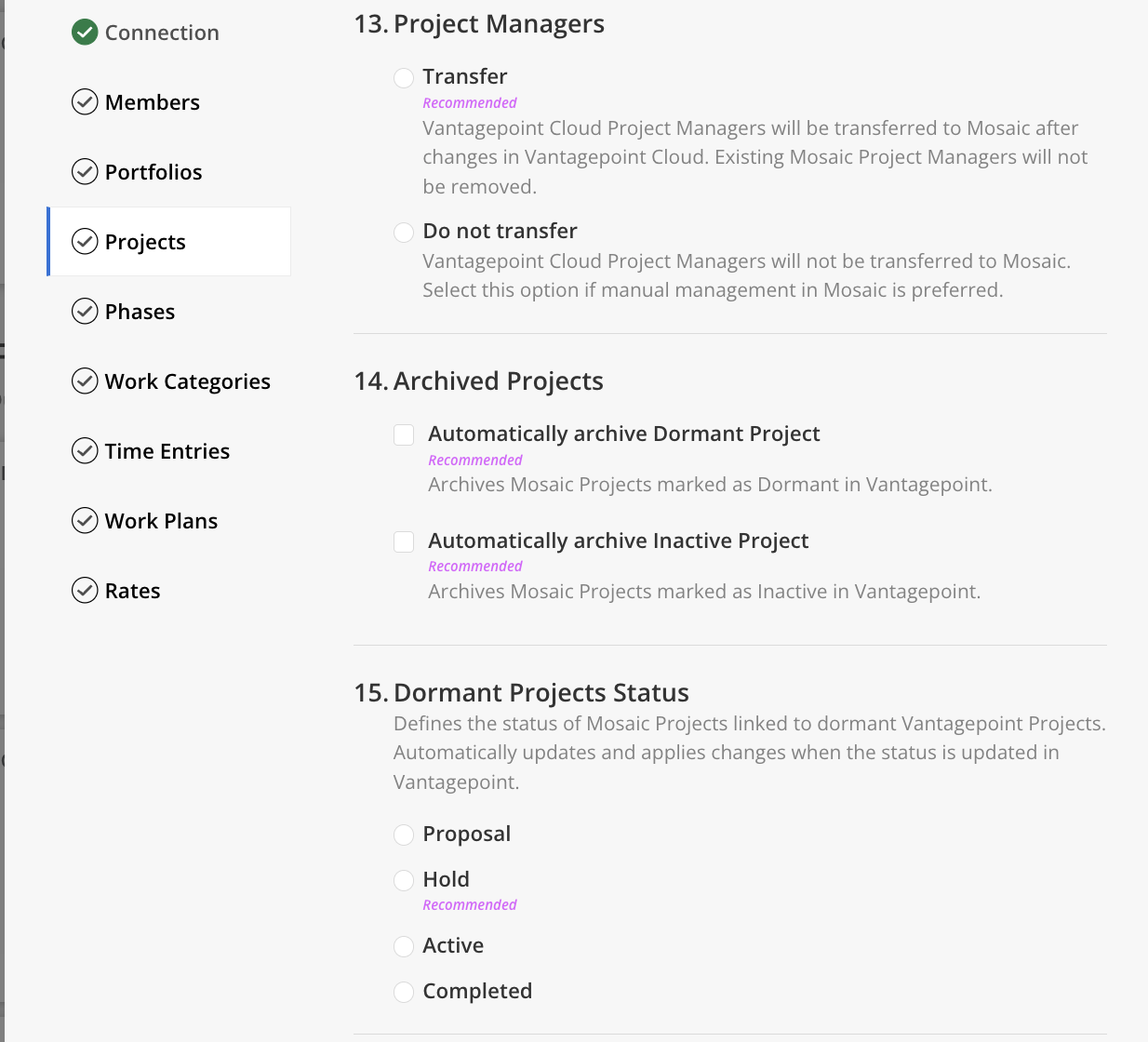
Definition
Configures which Vantagepoint Project statuses should automatically trigger archiving in Mosaic.
Settings Choices
- Automatically archive Dormant Projects (Recommended) — Archives Mosaic Projects marked as Dormant in Vantagepoint.
- Automatically archive Inactive Projects (Recommended) — Archives Mosaic Projects marked as Inactive in Vantagepoint.
You can select both, one, or neither option.
In Mosaic
Archived Projects are hidden from active views and also archive any related Work Plans. The change takes effect when the status is updated in Vantagepoint.
Archiving is a significant action. Archived projects are removed from active planning views. Review your status matching strategy before enabling.
15. Project Status Matching
| Vantagepoint | Mosaic |
|---|---|
| Active (A) | Active |
| Inactive (I) | Proposal |
| Dormant (D) | Complete |
In Mosaic
Maps each Vantagepoint project status to a corresponding Mosaic Project status. The mapping is applied any time a project's status changes in Vantagepoint.
Default Mapping
| Vantagepoint Status | Mosaic Status |
|---|---|
| Active (A) | Active |
| Inactive (I) | Proposal |
| Dormant (D) | Complete |
For each Vantagepoint status, select the Mosaic Project status that should be applied. The change is applied when the status is updated in Vantagepoint.
How it works
- Each Vantagepoint status is matched to a Mosaic status. The list of source statuses comes from your connected tool, so you'll need a tested connection before you can edit.
- Unmapped statuses sync as Active — if a status isn't listed, Mosaic sets the project or phase to Active.
- Click Reset to default at any time to restore Mosaic's recommended mapping for this integration.
- Changes apply on Save (the button reads Done when there are no changes). Updates affect future syncs; already-synced records keep their current status until they next change in Vantagepoint.
For a full walkthrough of the mapping editor, see Project & Phase Status Matching.
Previously (before Status Matching): Dormant Projects Status & Inactive Projects Status
Dormant Projects Status
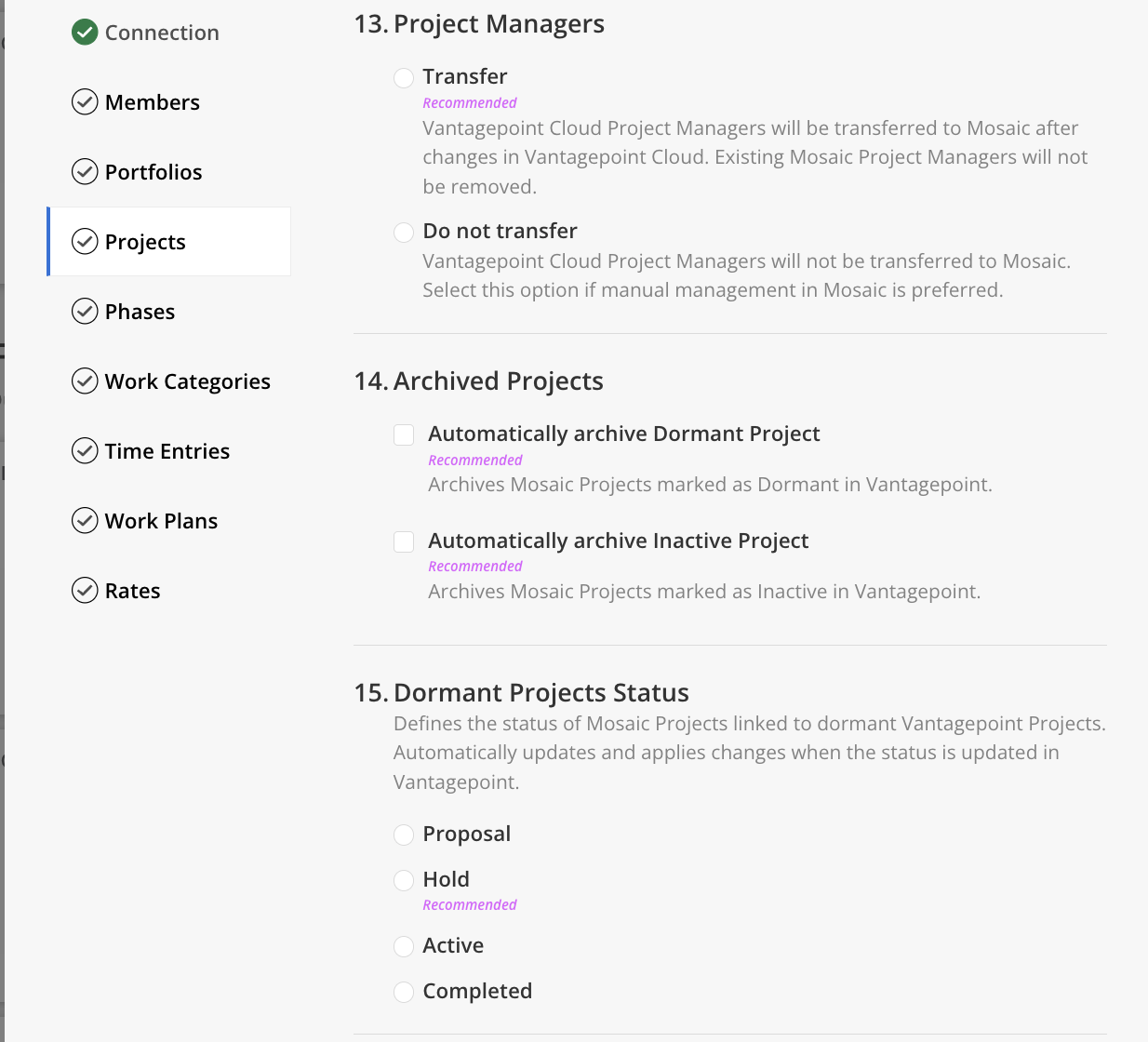
Definition
Maps the Vantagepoint "Dormant" project status to a corresponding Mosaic Project status.
In Mosaic
When a Vantagepoint Project is marked as Dormant, the linked Mosaic Project will automatically update to the selected status. The change applies when the status is updated in Vantagepoint.
Inactive Projects Status
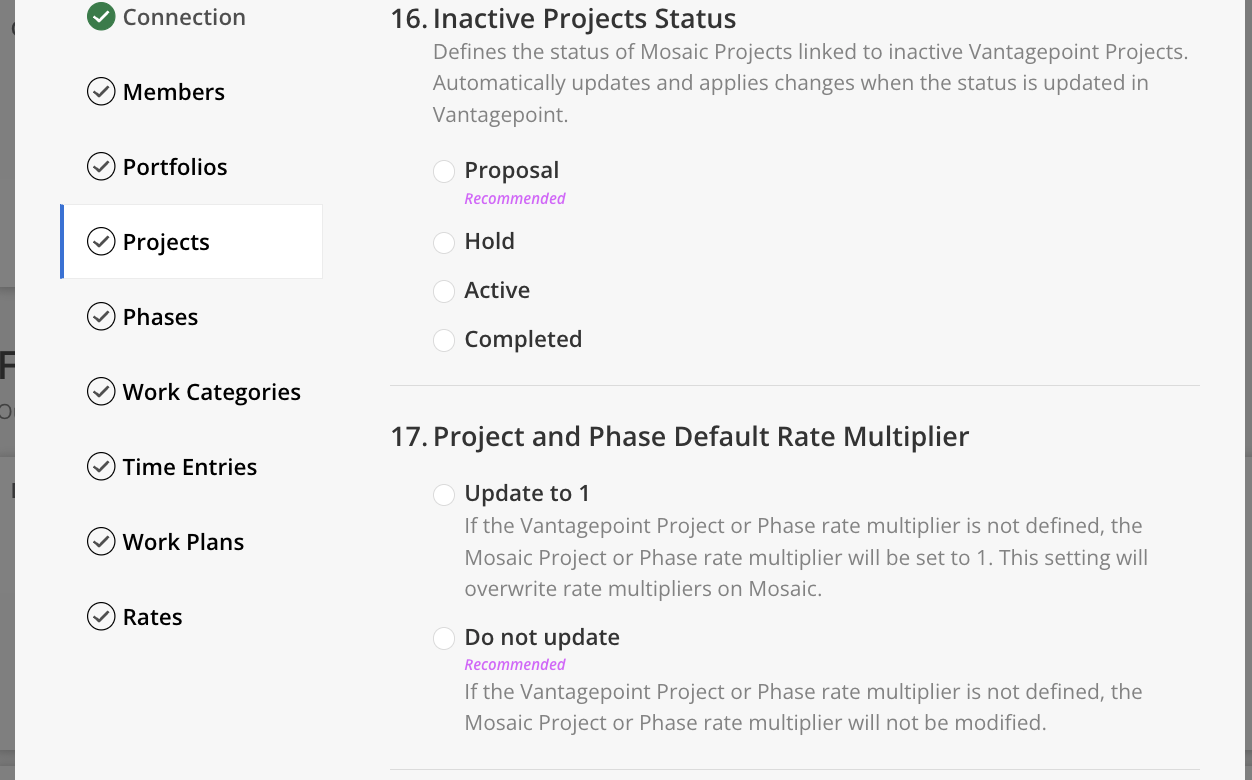
Definition
Maps the Vantagepoint "Inactive" project status to a corresponding Mosaic Project status.
In Mosaic
When a Vantagepoint Project is marked as Inactive, the linked Mosaic Project will automatically update to the selected status. The change applies when the status is updated in Vantagepoint.
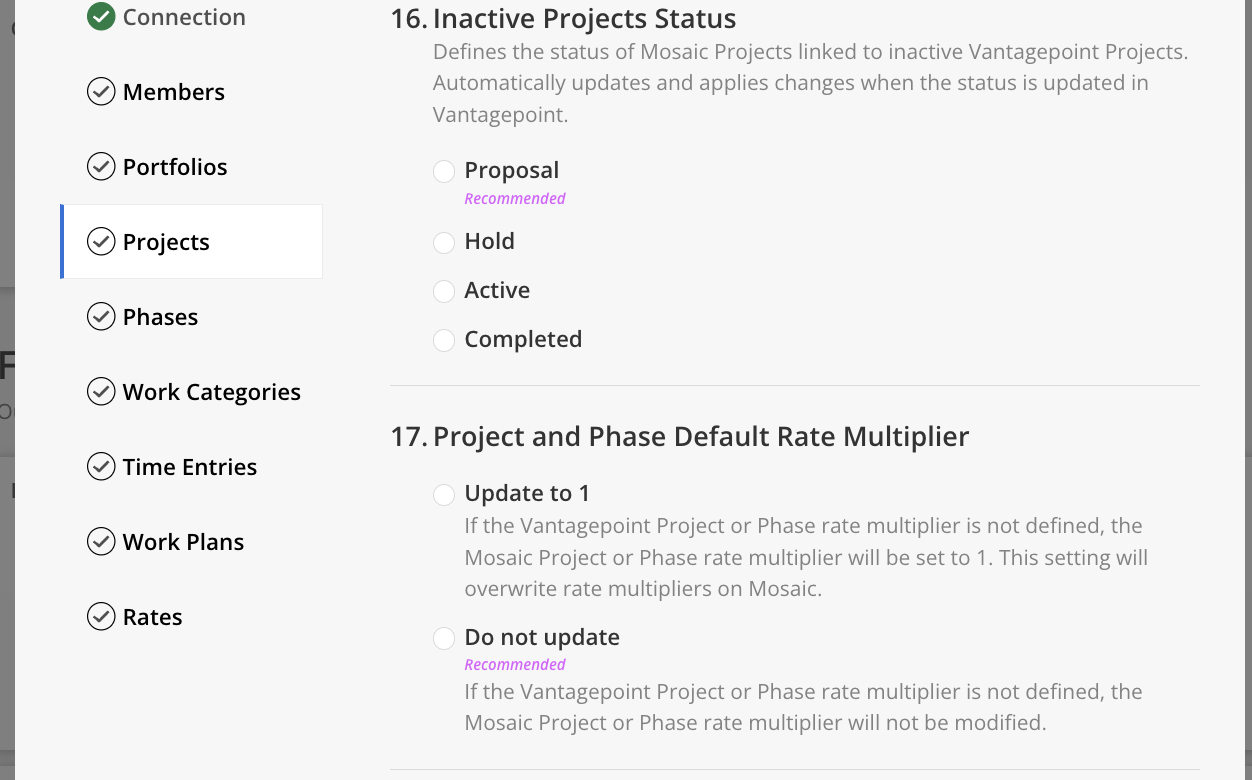
16. Project and Phase Default Rate Multiplier
Definition
Controls what happens to the Mosaic rate multiplier when a Vantagepoint Project or Phase does not have a rate multiplier defined.
Settings Choices
- Update to 1 — If the Vantagepoint Project or Phase rate multiplier is not defined, the Mosaic Project or Phase rate multiplier will be set to 1. This setting will overwrite rate multipliers on Mosaic.
- Do not update (Recommended) — If the Vantagepoint Project or Phase rate multiplier is not defined, the Mosaic Project or Phase rate multiplier will not be modified.
In Mosaic
This setting only applies when a rate multiplier is not defined in Vantagepoint. Projects and Phases with explicitly set multipliers are always synced.
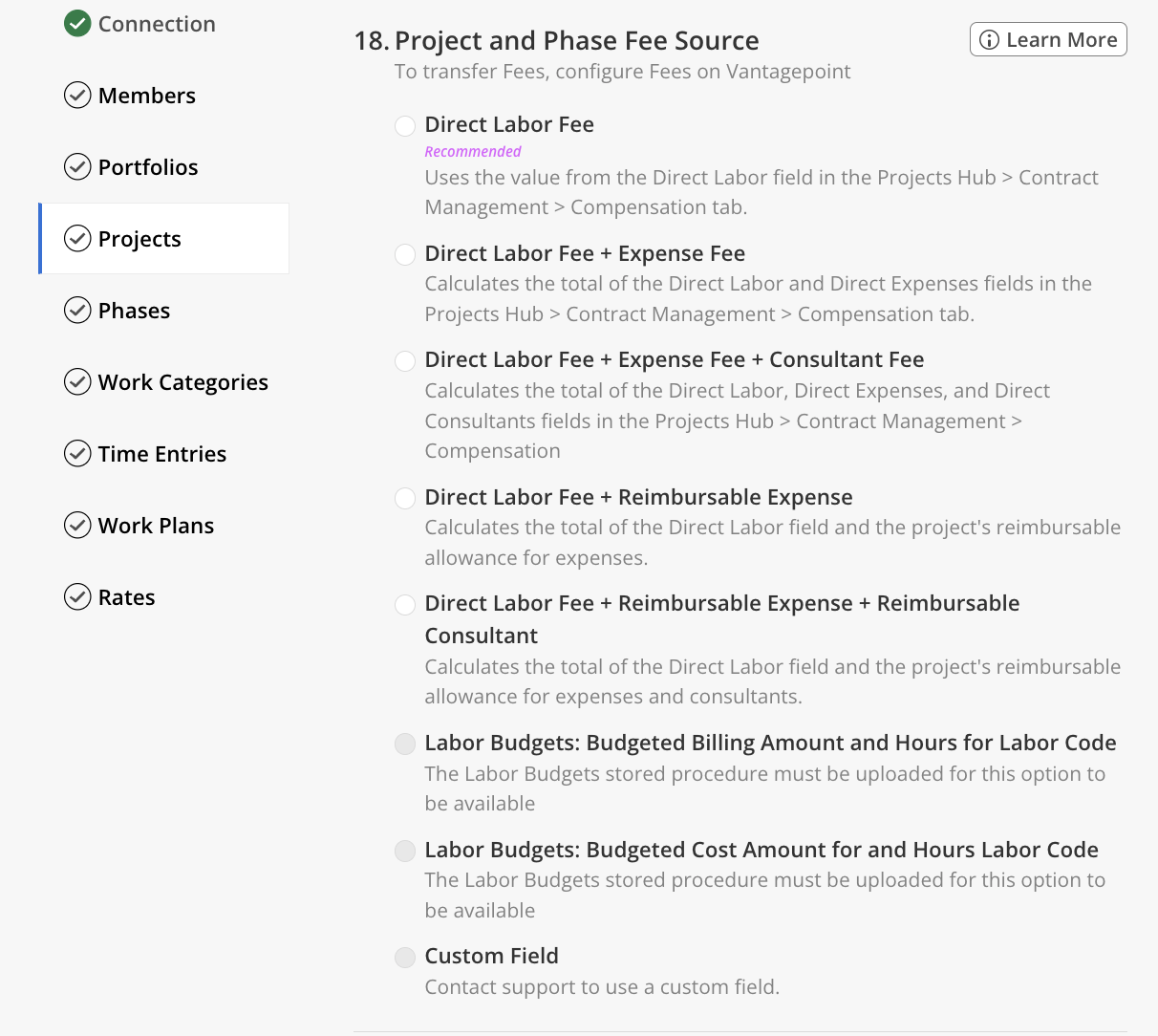
17. Project and Phase Fee Source
Definition
Determines which Vantagepoint field(s) are used to calculate the Fee (budget) for Projects and Phases in Mosaic.
Settings Choices
- Direct Labor Fee (Recommended) — Uses the value from the Direct Labor field in the Projects Hub > Contract Management > Compensation tab.
- Direct Labor Fee + Expense Fee — Calculates the total of the Direct Labor and Direct Expenses fields in the Projects Hub > Contract Management > Compensation tab.
- Direct Labor Fee + Expense Fee + Consultant Fee — Calculates the total of the Direct Labor, Direct Expenses, and Direct Consultants fields in the Projects Hub > Contract Management > Compensation tab.
- Direct Labor Fee + Reimbursable Expense — Calculates the total of the Direct Labor field and the project's reimbursable allowance for expenses.
- Direct Labor Fee + Reimbursable Expense + Reimbursable Consultant — Calculates the total of the Direct Labor field and the project's reimbursable allowance for expenses and consultants.
- Labor Budgets: Budgeted Billing Amount and Hours for Labor Code — Pulls the budgeted billing amount and hours for labor from the Labor Tab of the Budget Form. Requires the Labor Budgets stored procedure.
- Labor Budgets: Budgeted Cost Amount and Hours for Labor Code — Pulls the budgeted cost amount and hours for labor from the Labor Tab of the Budget Form. Requires the Labor Budgets stored procedure.
- Fee Billing Terms — Pulls the fee from the Billing Terms Fee (BTF) table. Available for Cloud (requires stored procedure) and On-Premise.
- Custom Field — Contact support to use a custom field. This option is configured by the Mosaic Solutions team and is not self-service.
In Mosaic
The selected fee source populates the Fee field on Projects and Phases. The change takes effect on any project/phase/task modified in Vantagepoint after the setting is updated.
For On-Premise: If selecting a fee source other than Direct Labor options, make sure the required tables exist in your replica database before enabling.
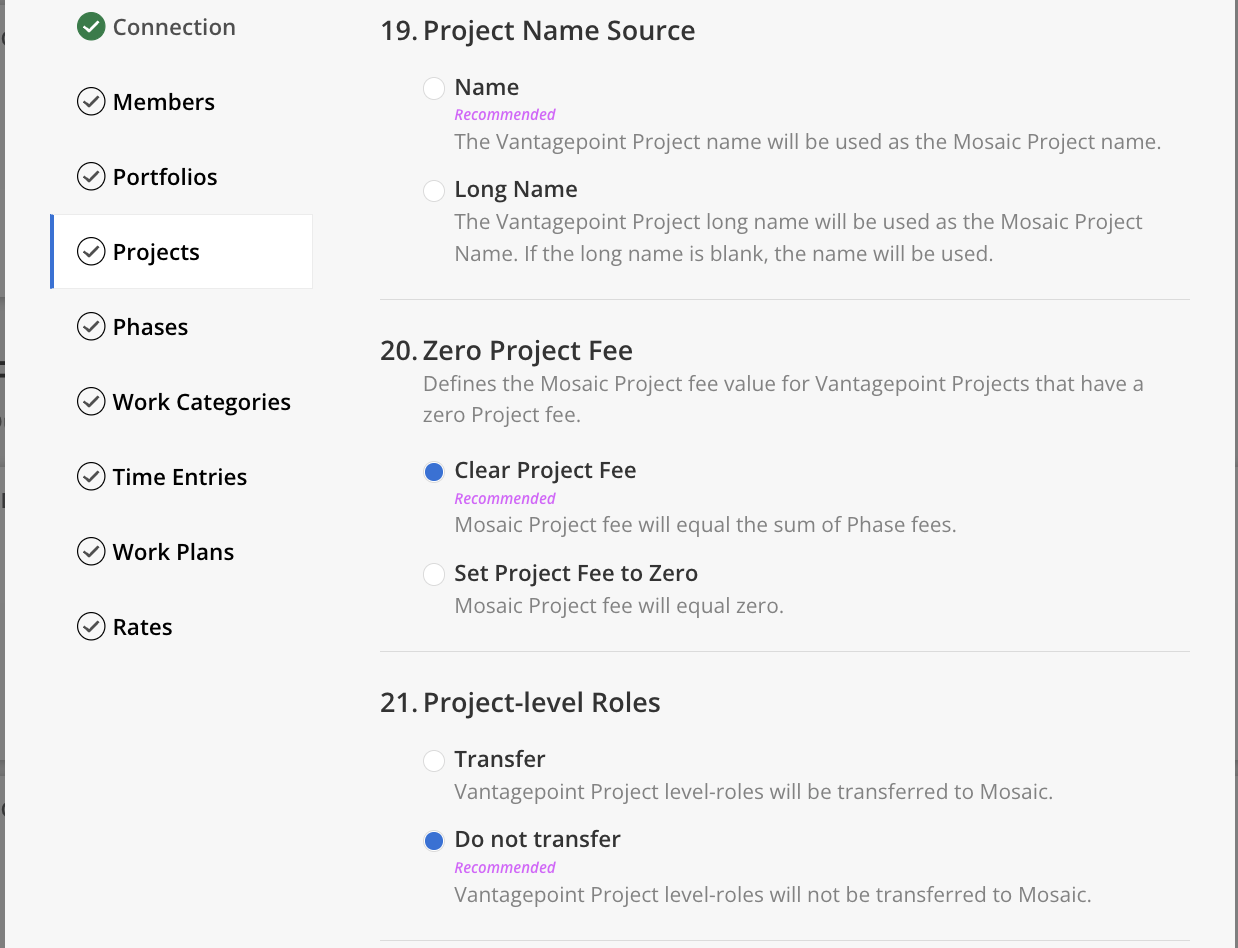
18. Project Name Source
Definition
Determines which Vantagepoint Project name field is used as the Project name in Mosaic.
Settings Choices
- Name (Recommended) — The Vantagepoint Project name will be used as the Mosaic Project name.
- Long Name — The Vantagepoint Project long name will be used as the Mosaic Project name. If the long name is blank, the short name will be used as a fallback.
In Mosaic
The selected name source populates the Project Title in Mosaic. If you switch from Name to Long Name (or vice versa), titles will update on the next sync for any modified projects.
19. Zero Project Fee
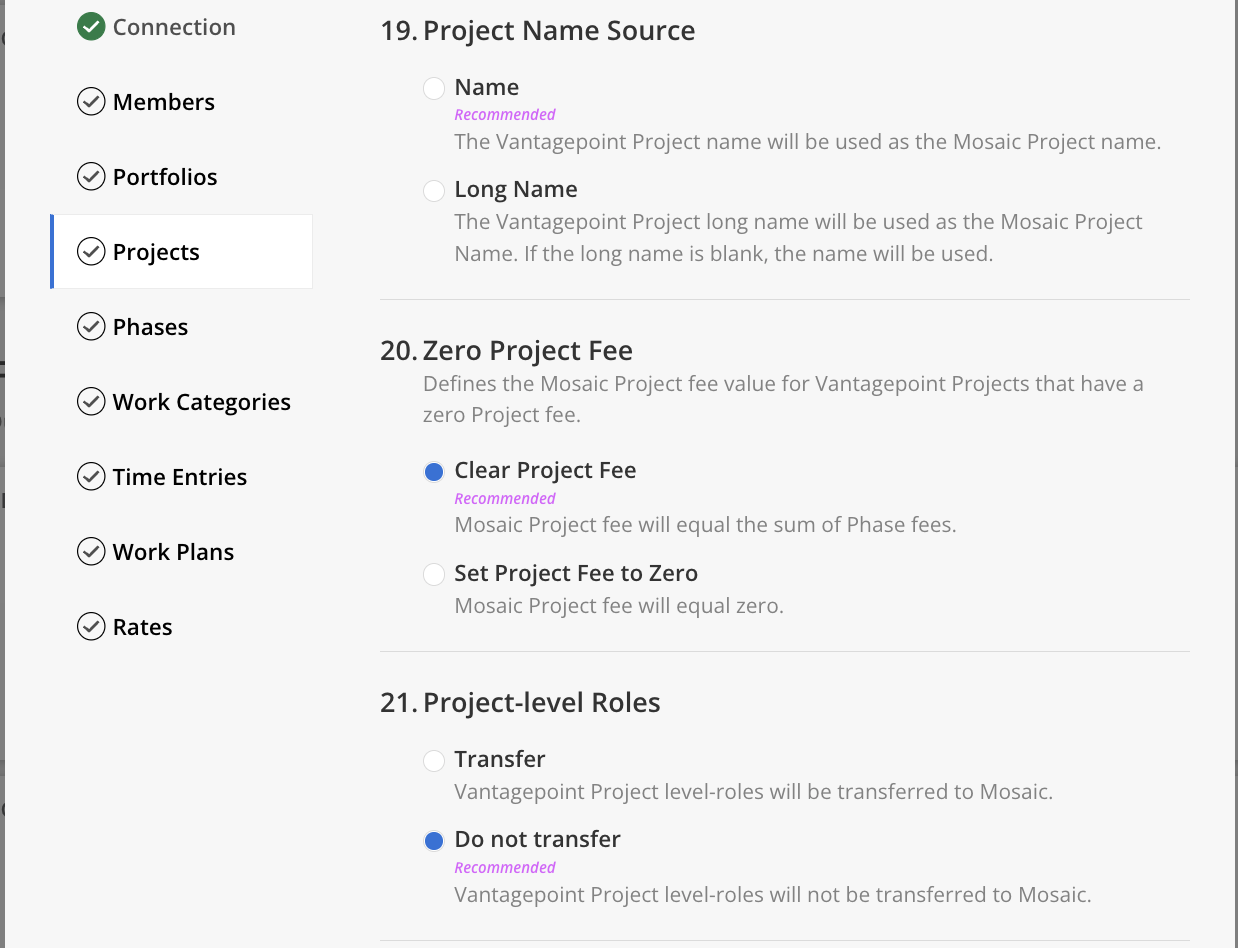
Definition
Defines how Mosaic handles Vantagepoint Projects that have a fee value of zero.
Settings Choices
- Clear Project Fee (Recommended) — Mosaic Project fee will equal the sum of Phase fees. The zero value from Vantagepoint is treated as "no fee set," allowing Phase fees to roll up.
- Set Project Fee to Zero — Mosaic Project fee will equal zero. Use this if zero-fee Projects are intentional in your workflow.
In Mosaic
This setting affects how the Fee field displays on Projects with a zero value in Vantagepoint. It does not affect Projects with non-zero fees.
20. Project-level Roles
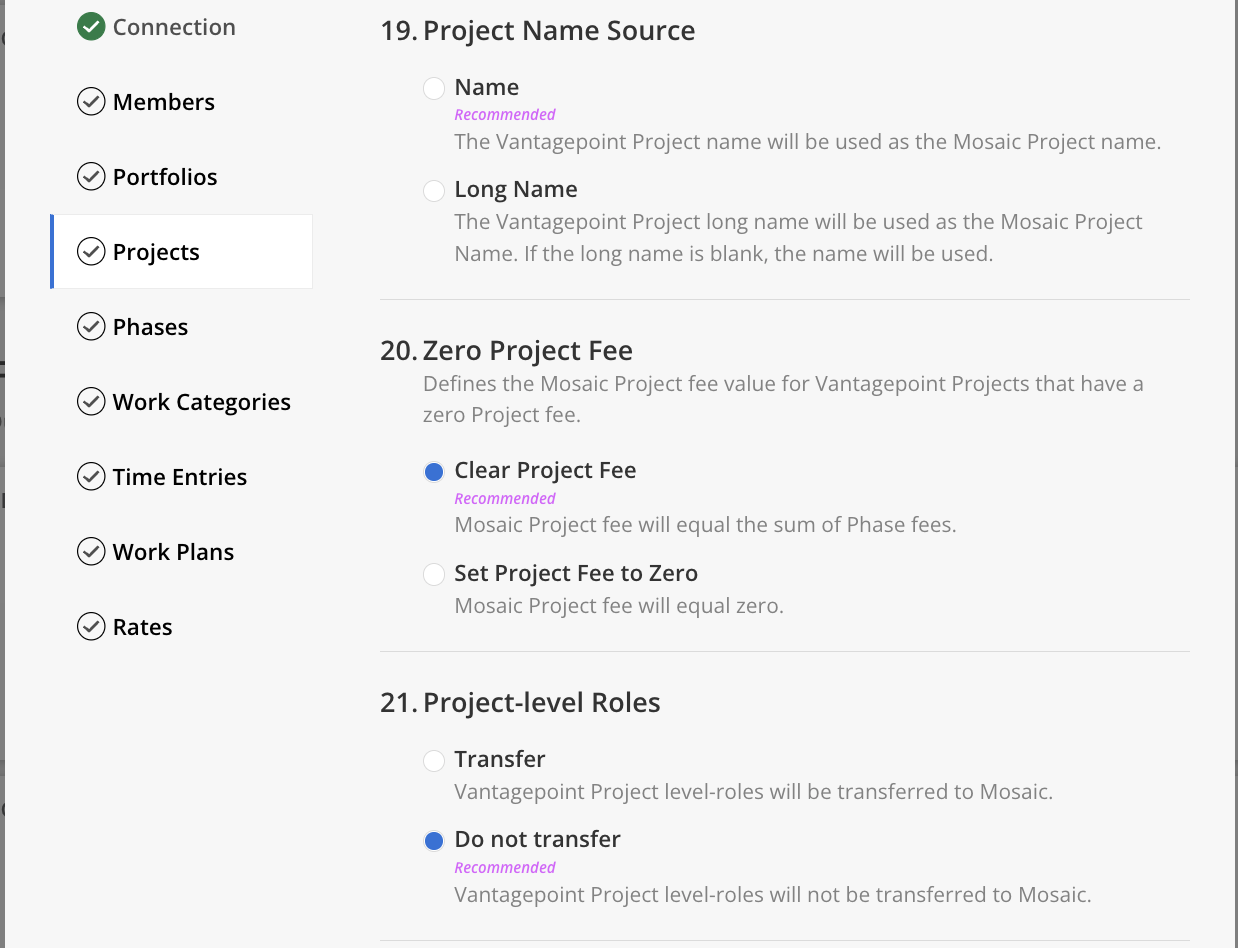
Definition
Controls whether Vantagepoint project-level role assignments are transferred to Mosaic.
In Mosaic
When enabled, member role assignments at the project level in Vantagepoint will overwrite the corresponding assignments in Mosaic on each sync.
21. Role Source for Role Rate Projects
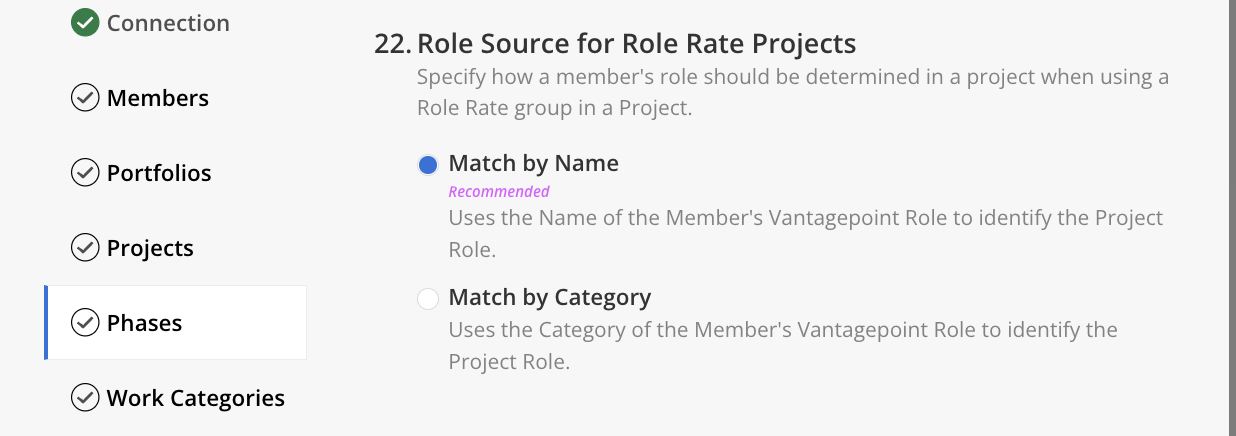
Definition
Specifies how a member's role is determined in a project when using a Role Rate group.
Settings Choices
- Match by Name (Recommended) — Uses the Name of the Member's Vantagepoint Role to identify the Project Role.
- Match by Category — Uses the Category of the Member's Vantagepoint Role to identify the Project Role.
In Mosaic
This setting affects how members are matched to roles within Role Rate group projects. It determines whether the matching logic uses role names or rate group categories.
1. Linking Method
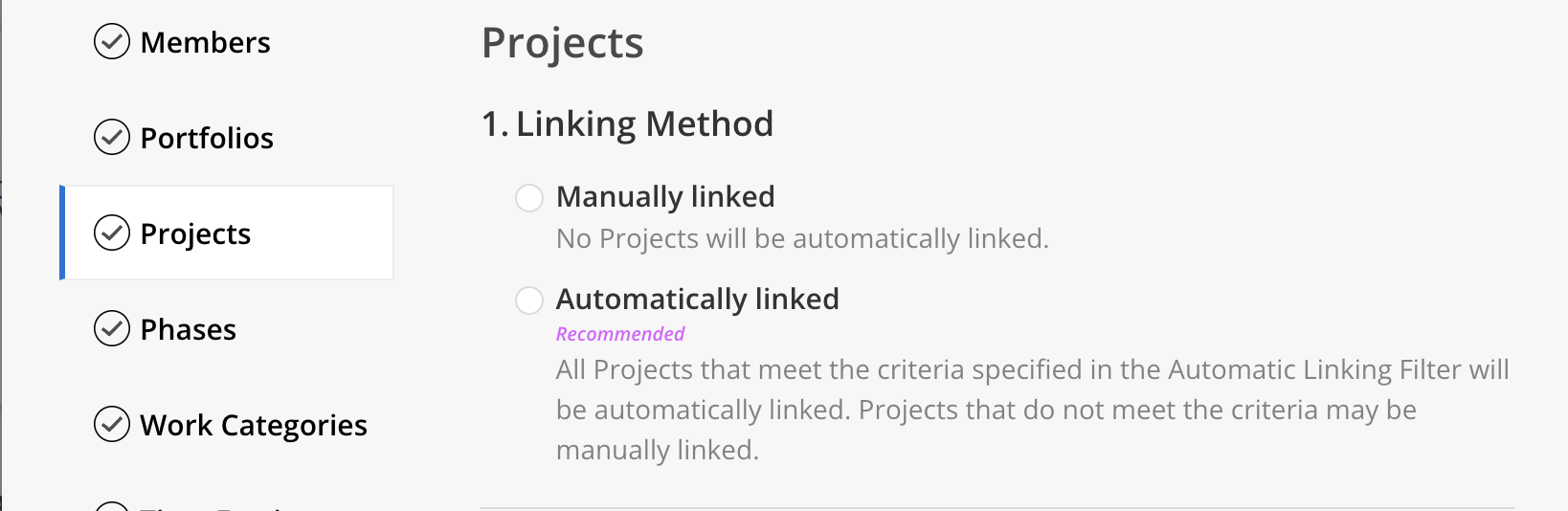
Definition
This setting determines how Vantagepoint projects are connected to Mosaic. Importing means bringing a project from Vantagepoint into Mosaic for the first time. Linking means establishing an ongoing connection so that changes in Vantagepoint are synced to Mosaic automatically.
Settings Choices
- Manually linked — No projects will be automatically linked. You choose which Vantagepoint projects to import and link to Mosaic on a project-by-project basis.
- Automatically linked (Recommended) — All projects that meet the criteria specified in the Automatic Linking Filter will be automatically linked. Projects that do not meet the criteria may be manually linked.
In Mosaic
When set to Manually linked, new Vantagepoint projects will not appear in Mosaic until you explicitly import them from the integration linking screen. This gives you full control over which projects exist in Mosaic, but requires ongoing manual effort as new projects are created in Vantagepoint.
When set to Automatically linked, projects that match your filter criteria are imported and linked as soon as they are detected. This is the recommended approach for most firms, as it ensures Mosaic stays up to date without manual intervention. Projects that do not match the filter criteria can still be linked manually if needed.
Imported data includes: billable status, project status, start/end dates, client information, project fees, archived status, project number, and project title.
2. Linked Project and Phase Titles
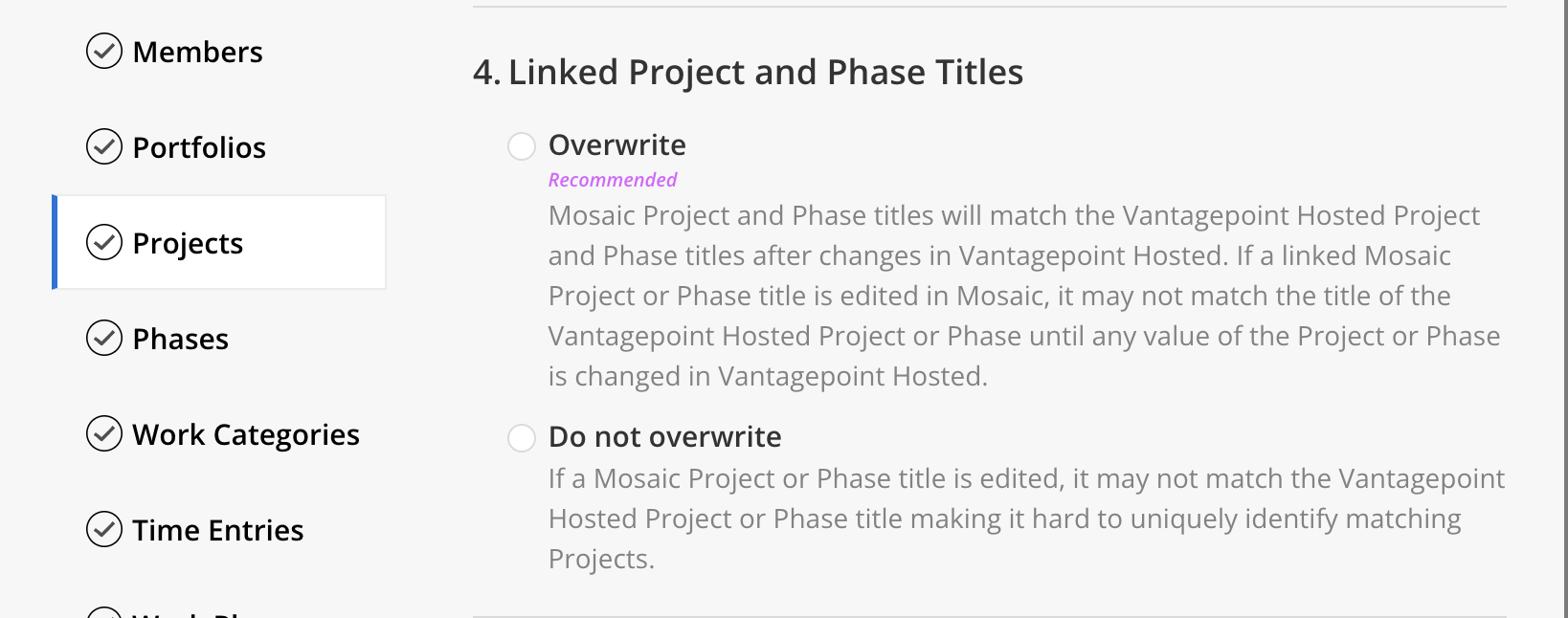
Definition
This setting controls whether Mosaic keeps project and phase titles in sync with Vantagepoint, or allows them to diverge after the initial link.
Settings Choices
- Overwrite (Recommended) — Mosaic Project and Phase titles will match the Vantagepoint Project and Phase titles after changes in Vantagepoint. If a linked Mosaic Project or Phase title is edited in Mosaic, it may not match the title in Vantagepoint until a change is made to any value of that Project or Phase in Vantagepoint, at which point the title will be overwritten back to match.
- Do not overwrite — Mosaic Project and Phase titles can be edited independently. If a title is changed in Mosaic, it may no longer match the Vantagepoint title, making it harder to uniquely identify matching projects across systems.
In Mosaic
When set to Overwrite, Vantagepoint is the source of truth for all project and phase titles. If your team edits a title in Mosaic, that edit will be overwritten the next time the project or phase syncs from Vantagepoint. Choose this if you want consistent naming across both systems.
When set to Do not overwrite, titles can be customized freely in Mosaic. This is useful if your team uses different naming conventions in Mosaic than in Vantagepoint, but be aware that mismatched titles can make it difficult to identify which Mosaic project corresponds to which Vantagepoint project.
If you choose Overwrite, ensure that team members do not edit project or phase titles directly in Mosaic, as those changes will be lost on the next sync.
3. Project and Phase Billable
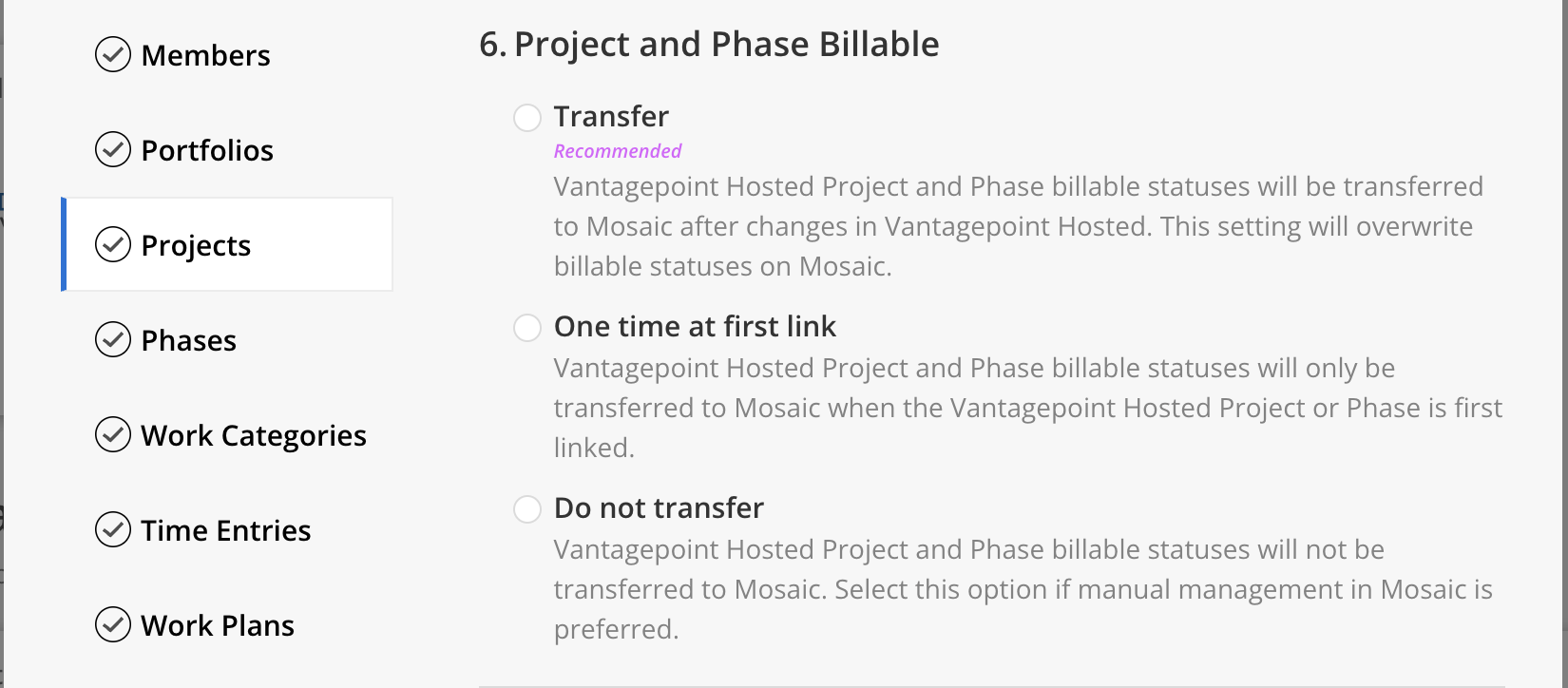
Definition
The billable status indicates whether a project or phase is charged to the client. This setting controls whether Vantagepoint billable statuses are transferred to Mosaic.
In Mosaic
When set to Transfer, billable statuses stay in sync — any time the billable flag changes in Vantagepoint, it will be updated in Mosaic on the next sync. This is the recommended approach to ensure financial reporting in Mosaic accurately reflects what is billable.
When set to Do not transfer, Mosaic is the source of truth for billable status. This is useful if your team categorizes billable work differently in Mosaic than in Vantagepoint.
4. Project and Phase Dates
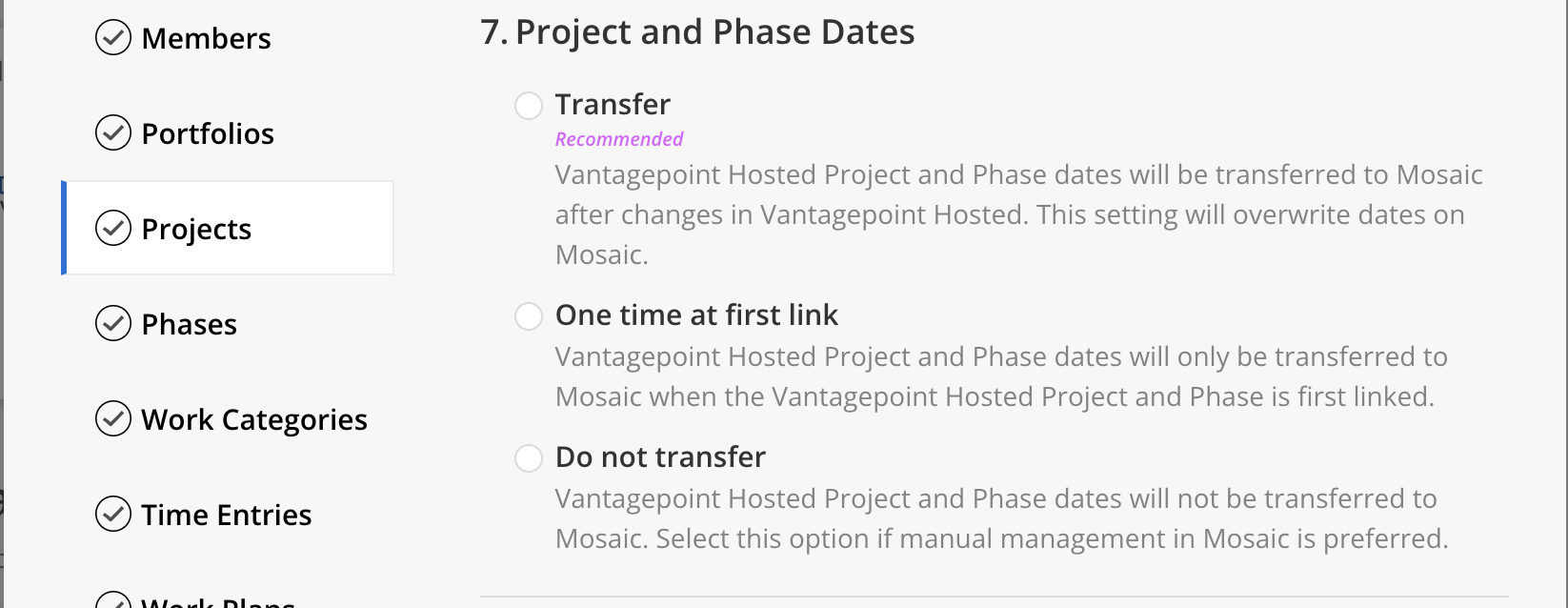
Definition
This setting controls whether project and phase start and end dates from Vantagepoint are transferred to Mosaic. Dates drive project timelines, scheduling, and resource planning in Mosaic.
In Mosaic
When set to Transfer, project and phase timelines in Mosaic stay in sync with Vantagepoint. If dates change in Vantagepoint, Mosaic schedules will update automatically. Choose this if Vantagepoint is your source of truth for project timelines.
When set to One time at first link, dates are imported during the initial link and can then be adjusted independently in Mosaic. This is useful if your team refines schedules in Mosaic after the initial import.
If you choose Transfer, avoid editing project or phase dates directly in Mosaic — those changes will be overwritten on the next sync from Vantagepoint.
5. Project and Phase Fee
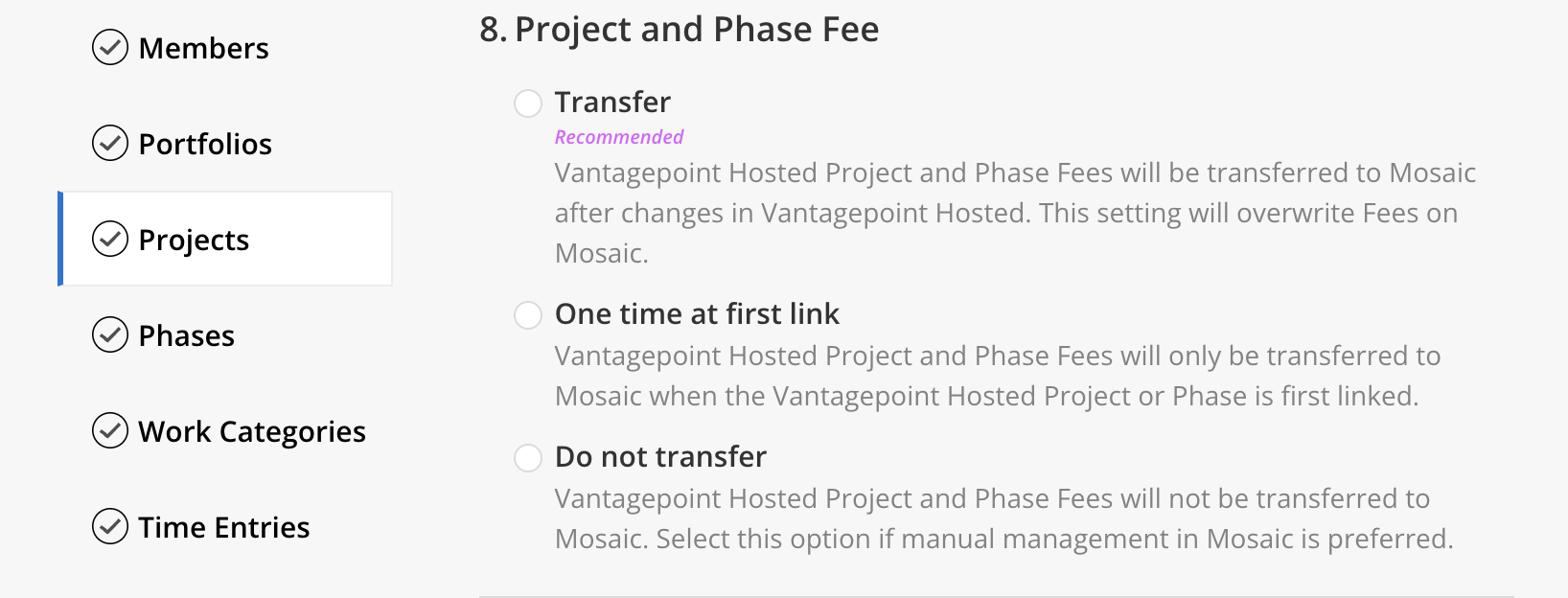
Definition
This setting controls whether project and phase fee amounts (budgets) from Vantagepoint are transferred to Mosaic. The fee represents the total amount you plan to bill for a project or the portion allocated to a specific phase.
In Mosaic
When set to Transfer, the fee (budget) for each project and phase stays in sync with Vantagepoint. Fee changes in Vantagepoint will overwrite the corresponding values in Mosaic on each sync. This is the recommended approach to ensure budget tracking in Mosaic accurately reflects the contract values in Vantagepoint.
When set to One time at first link, fees are imported during the initial link and can then be adjusted independently in Mosaic. This is useful if your team refines budgets within Mosaic after import.
The actual value transferred depends on the Project and Phase Fee Source setting, which determines which Vantagepoint field(s) are used to calculate the fee (e.g., Direct Labor Fee, Labor Budgets, Fee Billing Terms).
6. Project and Phase Rate Types
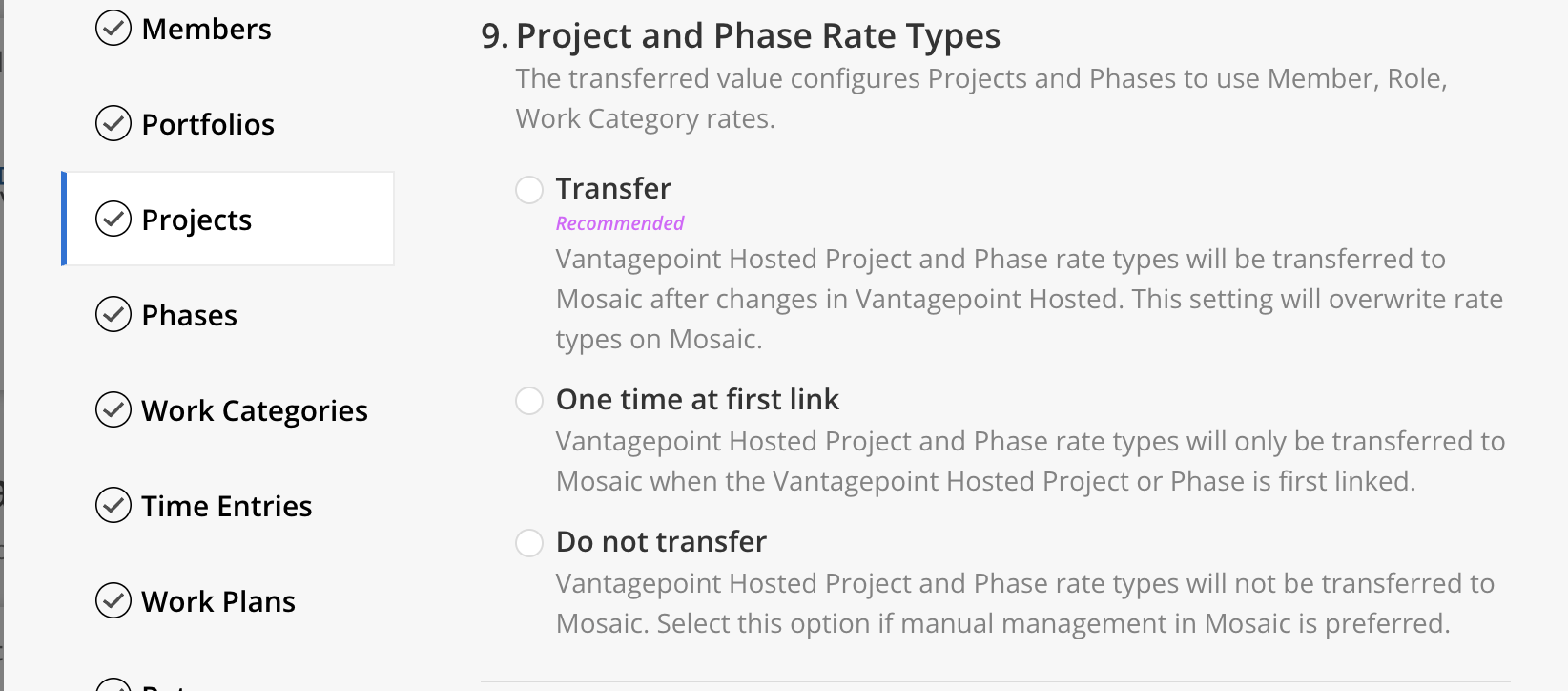
Definition
This setting controls whether project and phase rate types (billing types) from Vantagepoint are transferred to Mosaic. The rate type determines how time is billed on a project — by member rate, role rate, or work category rate.
The transferred value configures Projects and Phases to use Member, Role, or Work Category rates.
In Mosaic
Rate types determine how billing rates are calculated for time entries on a project:
- Member-based (Employee) — Uses the specific employee's individual bill rate.
- Role-based — Uses the rate assigned to the member's role on the project.
- Work Category-based (Activity) — Uses the rate associated with the work category or activity.
When set to Transfer, rate types stay in sync with Vantagepoint. This ensures that billing calculations in Mosaic match the billing method configured in Vantagepoint.
7. Project and Phase Rate Group
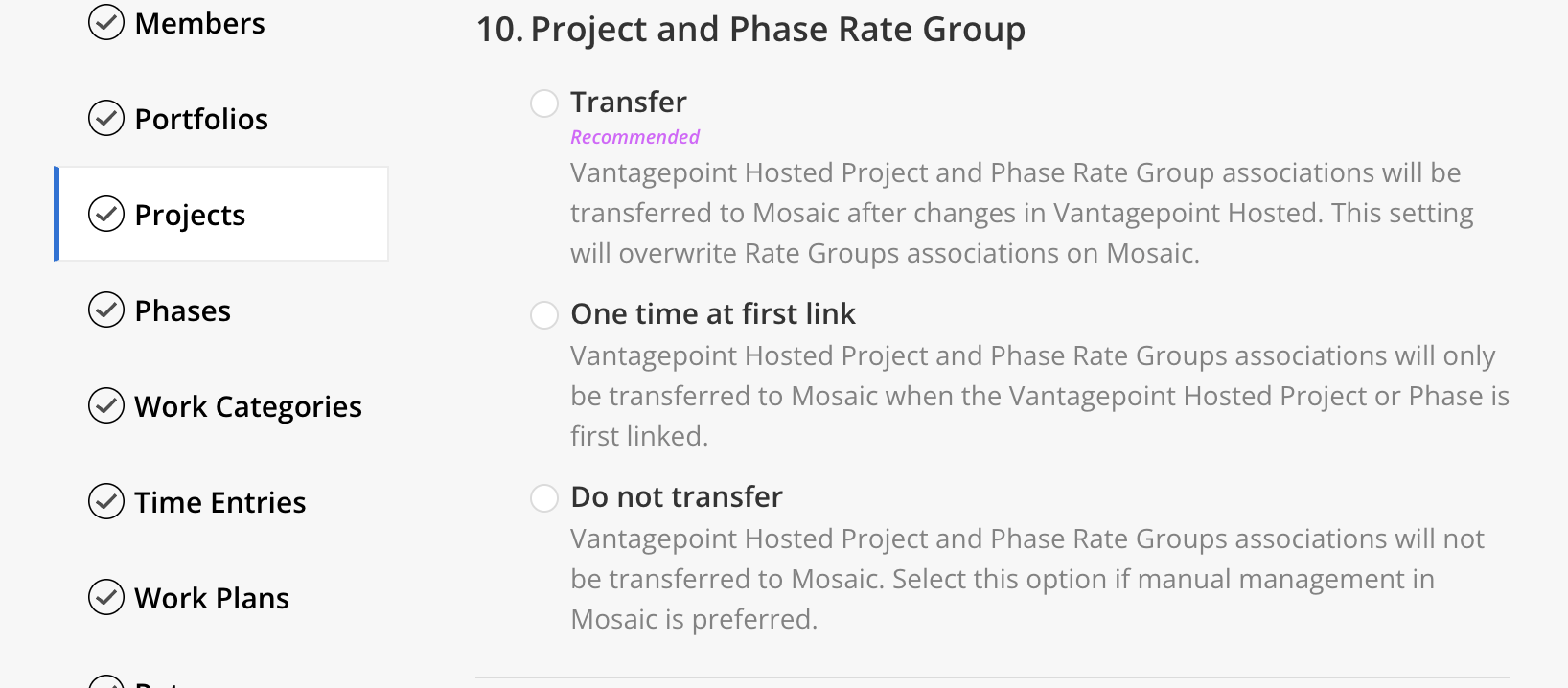
Definition
This setting controls whether the association between rate tables (rate groups) and specific projects and phases is transferred from Vantagepoint to Mosaic. Rate groups define which set of billing rates apply to a given project or phase.
In Mosaic
When set to Transfer, projects and phases in Mosaic will inherit the rate group assigned in Vantagepoint, and any changes to that assignment will be synced automatically. Projects with an associated role rate table will use those rates for billing calculations.
To access role rates in Mosaic, this setting (or "One time at first link") must be enabled alongside the rate group transfer settings in the Rates section.
8. Bill Rate Source for Member Rates
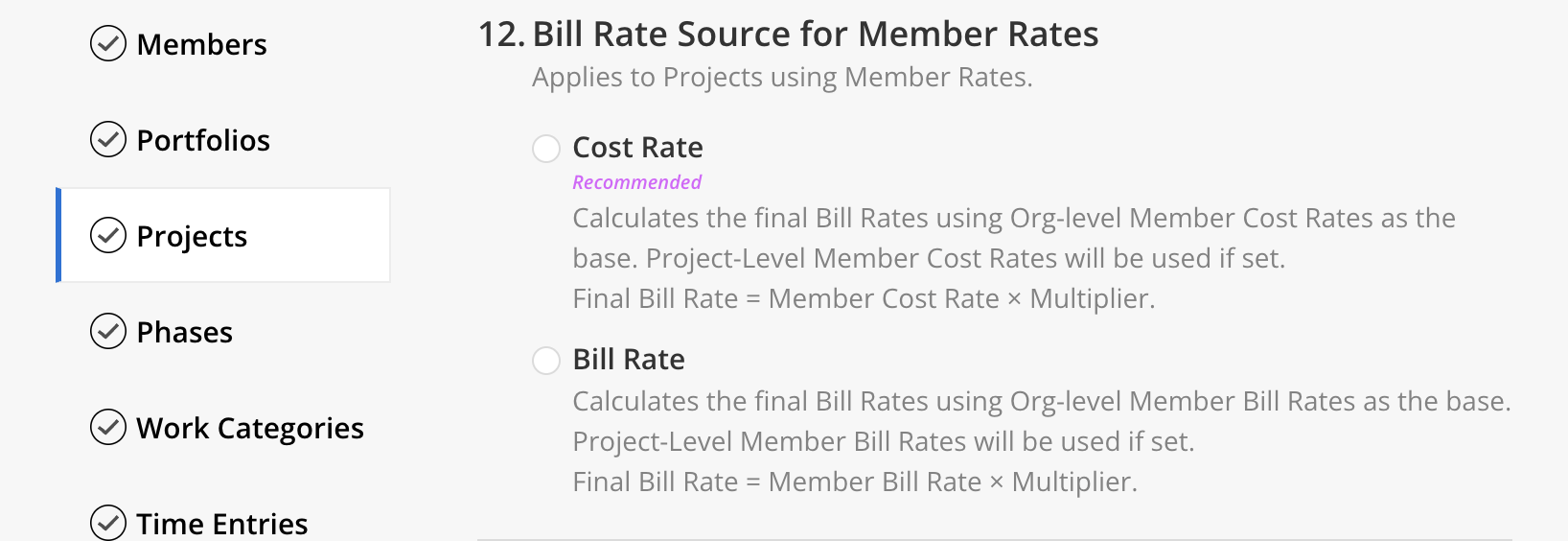
Definition
This setting determines which rate is used as the base when calculating bill rates on projects that use Member Rates (employee-based billing). It controls whether the cost rate or the bill rate is used in the final billing calculation.
Applies to Projects using Member Rates.
Settings Choices
- Cost Rate (Recommended) — Calculates the final Bill Rates using Org-level Member Cost Rates as the base. Project-Level Member Cost Rates will be used if set. Final Bill Rate = Member Cost Rate x Multiplier.
- Bill Rate — Calculates the final Bill Rates using Org-level Member Bill Rates as the base. Project-Level Member Bill Rates will be used if set. Final Bill Rate = Member Bill Rate x Multiplier.
In Mosaic
When set to Cost Rate, billing is derived from what the member costs the organization, multiplied by the project's rate multiplier. This is useful for firms that mark up internal costs to determine client billing.
When set to Bill Rate, billing is derived from the member's standard client-facing rate, multiplied by the project's rate multiplier. This is useful for firms that define explicit bill rates per member.
In both cases, if a project-level member rate has been set (see Project-Level Member Rates), it takes precedence over the organization-level default.
This setting does not source data from Vantagepoint — it controls how Mosaic calculates rates using the member rate data already in the system. Set member default bill rates in Organizational Settings > Members > Rate.
9. Bill Rate Source for Role Rates
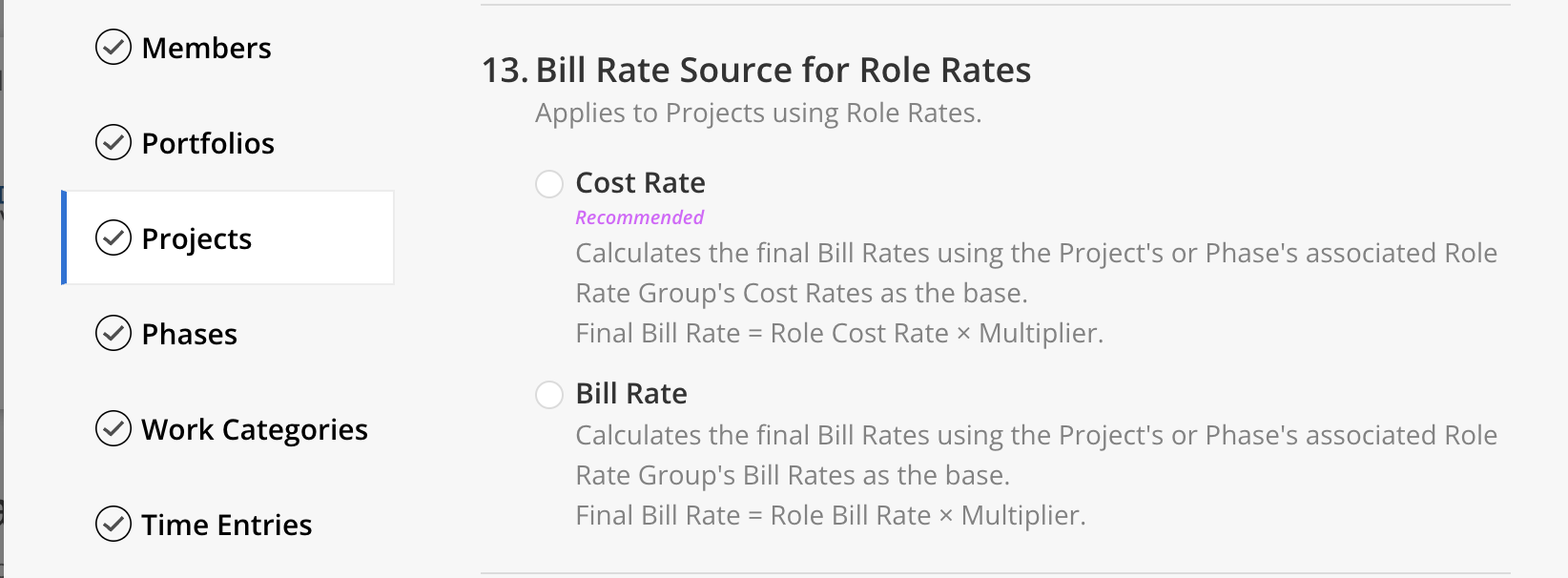
Definition
This setting determines which rate is used as the base when calculating bill rates on projects that use Role Rates (role-based billing). It controls whether the role's cost rate or bill rate from the associated Rate Group is used.
Applies to Projects using Role Rates.
Settings Choices
- Cost Rate (Recommended) — Calculates the final Bill Rates using the Project's or Phase's associated Role Rate Group's Cost Rates as the base. Final Bill Rate = Role Cost Rate x Multiplier.
- Bill Rate — Calculates the final Bill Rates using the Project's or Phase's associated Role Rate Group's Bill Rates as the base. Final Bill Rate = Role Bill Rate x Multiplier.
In Mosaic
When set to Cost Rate, billing is derived from the role's cost rate in the associated Rate Group, multiplied by the project's rate multiplier. This is useful for firms that mark up role-based costs for client billing.
When set to Bill Rate, billing is derived from the role's client-facing bill rate in the associated Rate Group, multiplied by the project's rate multiplier.
Manage role rates in Budgets > Rates > Role. The rates used come from the Rate Group associated with the project or phase (see Project and Phase Rate Group).
10. Bill Rate Source for Work Category Rates
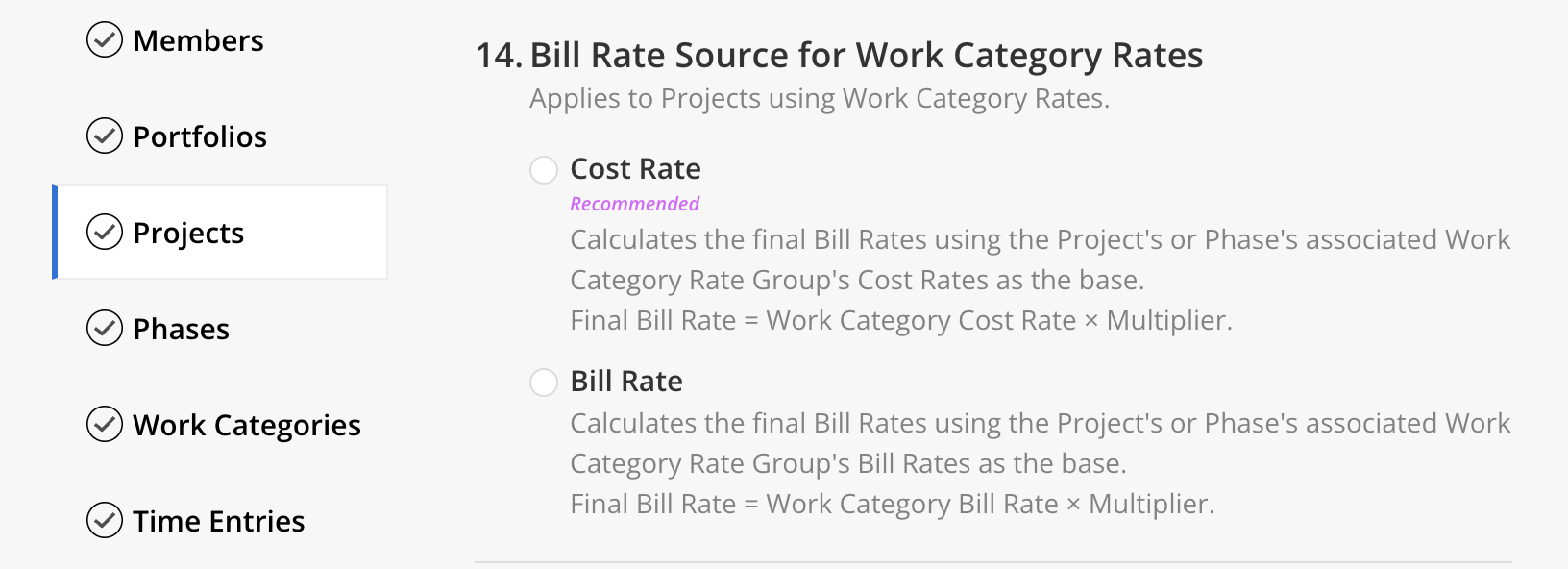
Definition
This setting determines which rate is used as the base when calculating bill rates on projects that use Work Category Rates (activity-based billing). It controls whether the work category's cost rate or bill rate from the associated Rate Group is used.
Applies to Projects using Work Category Rates.
Settings Choices
- Cost Rate (Recommended) — Calculates the final Bill Rates using the Project's or Phase's associated Work Category Rate Group's Cost Rates as the base. Final Bill Rate = Work Category Cost Rate x Multiplier.
- Bill Rate — Calculates the final Bill Rates using the Project's or Phase's associated Work Category Rate Group's Bill Rates as the base. Final Bill Rate = Work Category Bill Rate x Multiplier.
In Mosaic
When set to Cost Rate, billing is derived from the work category's cost rate in the associated Rate Group, multiplied by the project's rate multiplier.
When set to Bill Rate, billing is derived from the work category's client-facing bill rate in the associated Rate Group, multiplied by the project's rate multiplier.
Configure work category rates in Settings > Budget > Rates > Work Category tab. Organize them within Rate Groups and apply to projects as needed.
This setting does not source data from Vantagepoint — it controls how Mosaic calculates rates using the work category rate data already in the system.
11. Bill Rate Source for Projects with no Billing Type
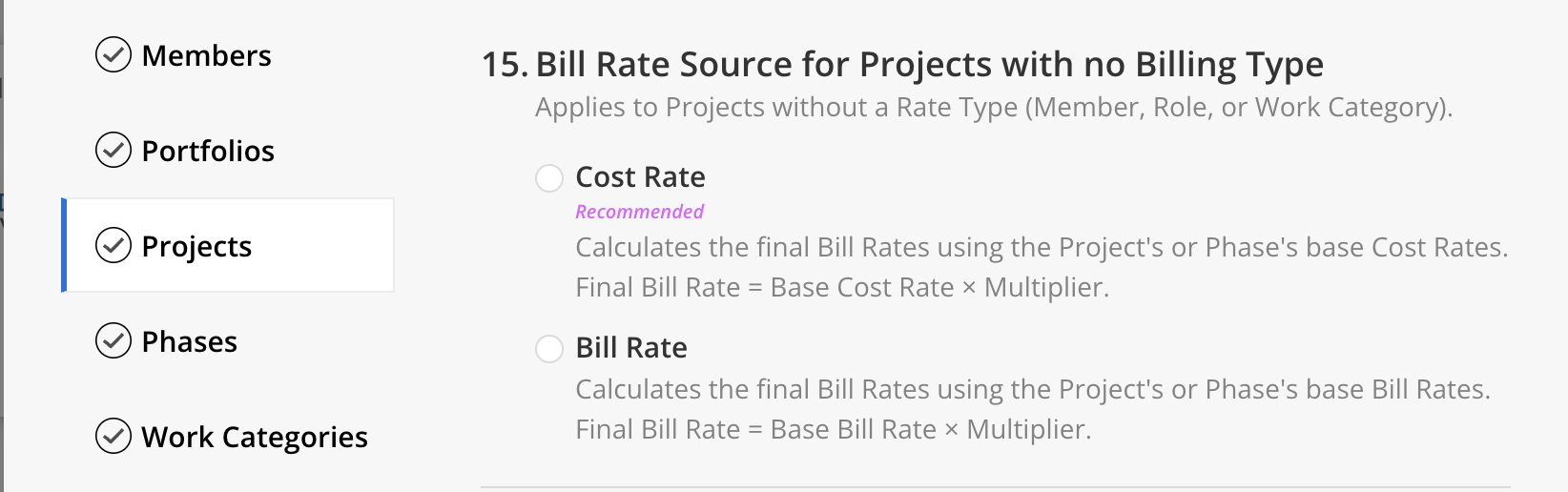
Definition
This setting determines which rate is used as the base when calculating bill rates on projects that do not have a Rate Type (billing type) assigned — i.e., projects where the billing type is blank (not Member, Role, or Work Category).
Applies to Projects without a Rate Type (Member, Role, or Work Category).
Settings Choices
- Cost Rate (Recommended) — Calculates the final Bill Rates using the Project's or Phase's base Cost Rates. Final Bill Rate = Base Cost Rate x Multiplier.
- Bill Rate — Calculates the final Bill Rates using the Project's or Phase's base Bill Rates. Final Bill Rate = Base Bill Rate x Multiplier.
In Mosaic
When set to Cost Rate, billing for projects without an assigned billing type is derived from the base cost rate, multiplied by the project's rate multiplier.
When set to Bill Rate, billing is derived from the base bill rate, multiplied by the project's rate multiplier.
This setting does not source data from Vantagepoint — it controls how Mosaic calculates rates for projects that have no billing type defined. To avoid relying on this fallback, ensure your projects have a Rate Type assigned via the Project and Phase Rate Types setting.
12. Project Managers
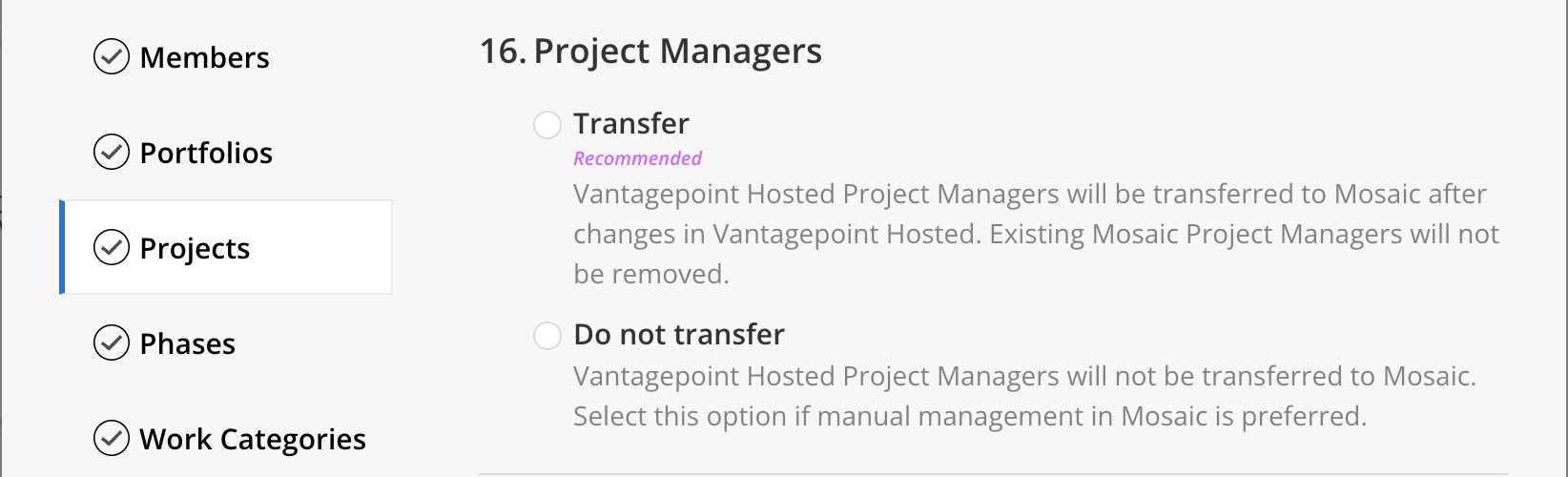
Definition
This setting controls whether Project Manager assignments from Vantagepoint are transferred to Mosaic. When enabled, members designated as Project Managers in Vantagepoint will be assigned the Project Manager role within their linked Mosaic projects.
Existing Mosaic Project Managers will not be removed — the Vantagepoint assignment is additive.
In Mosaic
When set to Transfer, project manager assignments are synced from Vantagepoint. This is additive — if a project already has managers assigned in Mosaic, those will be preserved, and the Vantagepoint manager will be added alongside them.
Assigned managers appear in the project's member list and can be accessed via the person icon in the project's top-right corner.
13. Archived Projects
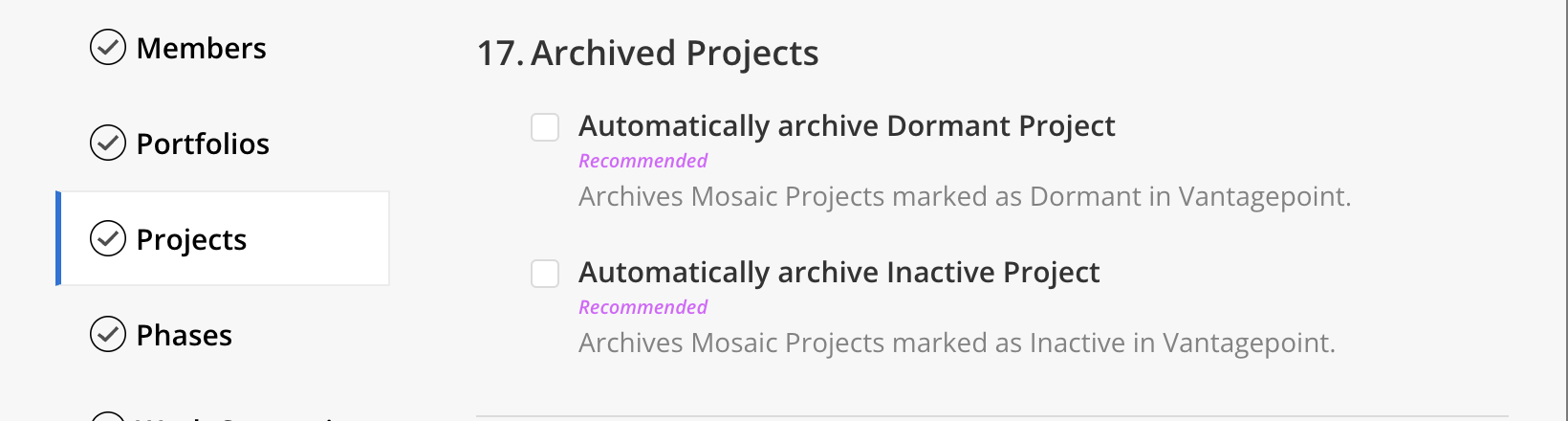
Definition
Configures which Vantagepoint Project statuses should automatically trigger archiving in Mosaic.
Settings Choices
- Automatically archive Dormant Projects (Recommended) — Archives Mosaic Projects marked as Dormant in Vantagepoint.
- Automatically archive Inactive Projects (Recommended) — Archives Mosaic Projects marked as Inactive in Vantagepoint.
You can select both, one, or neither option.
In Mosaic
Archived Projects are hidden from active views and also archive any related Work Plans. The change takes effect when the status is updated in Vantagepoint.
Archiving is a significant action. Archived projects are removed from active planning views. Review your status matching strategy before enabling.
14. Project Status Matching
| Vantagepoint | Mosaic |
|---|---|
| Active (A) | Active |
| Inactive (I) | Proposal |
| Dormant (D) | Complete |
In Mosaic
Maps each Vantagepoint project status to a corresponding Mosaic Project status. The mapping is applied any time a project's status changes in Vantagepoint.
Default Mapping
| Vantagepoint Status | Mosaic Status |
|---|---|
| Active (A) | Active |
| Inactive (I) | Proposal |
| Dormant (D) | Complete |
For each Vantagepoint status, select the Mosaic Project status that should be applied. The change is applied when the status is updated in Vantagepoint.
How it works
- Each Vantagepoint status is matched to a Mosaic status. The list of source statuses comes from your connected tool, so you'll need a tested connection before you can edit.
- Unmapped statuses sync as Active — if a status isn't listed, Mosaic sets the project or phase to Active.
- Click Reset to default at any time to restore Mosaic's recommended mapping for this integration.
- Changes apply on Save (the button reads Done when there are no changes). Updates affect future syncs; already-synced records keep their current status until they next change in Vantagepoint.
For a full walkthrough of the mapping editor, see Project & Phase Status Matching.
Previously (before Status Matching): Dormant Projects Status & Inactive Projects Status
Dormant Projects Status
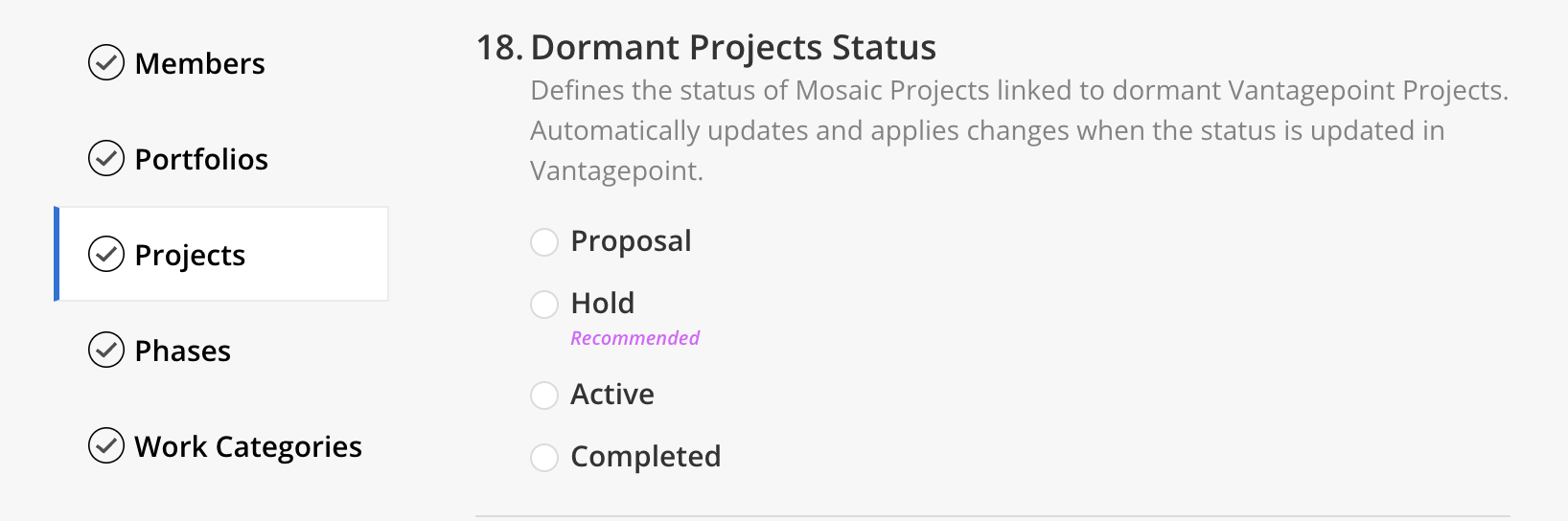
Definition
Maps the Vantagepoint "Dormant" project status to a corresponding Mosaic Project status.
In Mosaic
When a Vantagepoint Project is marked as Dormant, the linked Mosaic Project will automatically update to the selected status. The change applies when the status is updated in Vantagepoint.
Inactive Projects Status
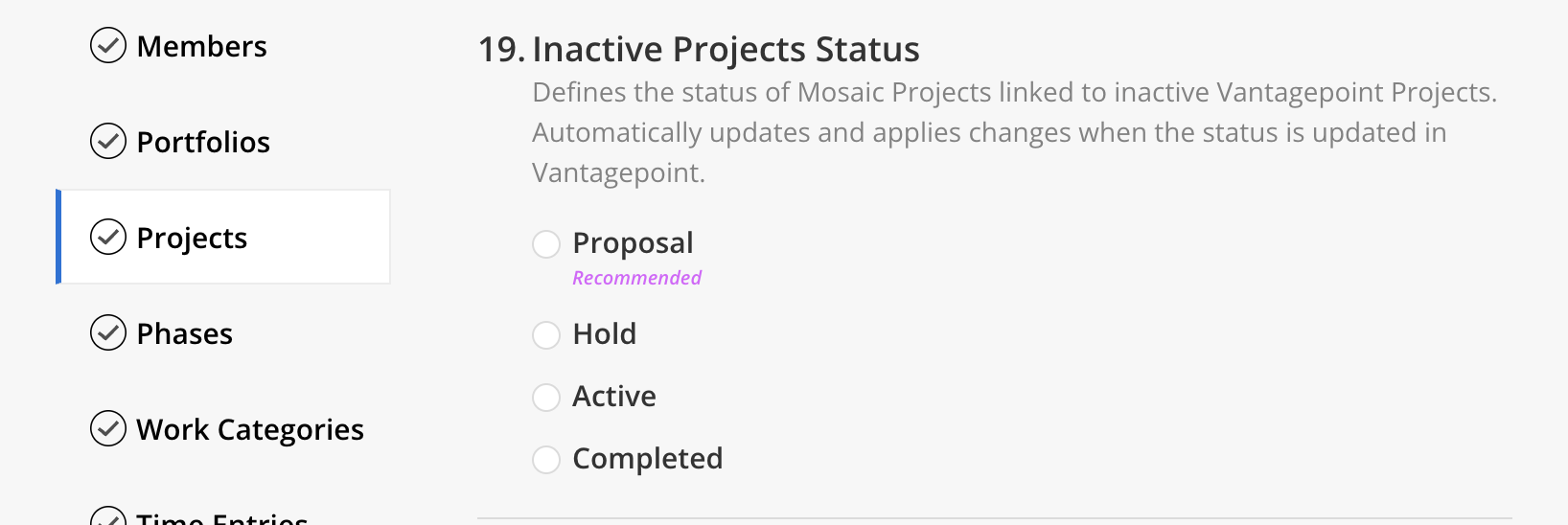
Definition
Maps the Vantagepoint "Inactive" project status to a corresponding Mosaic Project status.
In Mosaic
When a Vantagepoint Project is marked as Inactive, the linked Mosaic Project will automatically update to the selected status. The change applies when the status is updated in Vantagepoint.
15. Project and Phase Dates Source

Definition
Determines which Vantagepoint date fields are used for Project and Phase start and end dates in Mosaic.
Settings Choices
- Start and Estimated Completion Dates (Recommended) — Vantagepoint start and estimated completion dates will be transferred to Mosaic start and end dates.
- Project Plan Dates — Vantagepoint Project Plan dates will be transferred to Mosaic start and end dates.
In Mosaic
Vantagepoint dates are transferred to Mosaic after changes in Vantagepoint. If a Project does not have Phases, dates will be transferred to the Project Schedule.
16. Project, Phase, and Time Entry Overhead
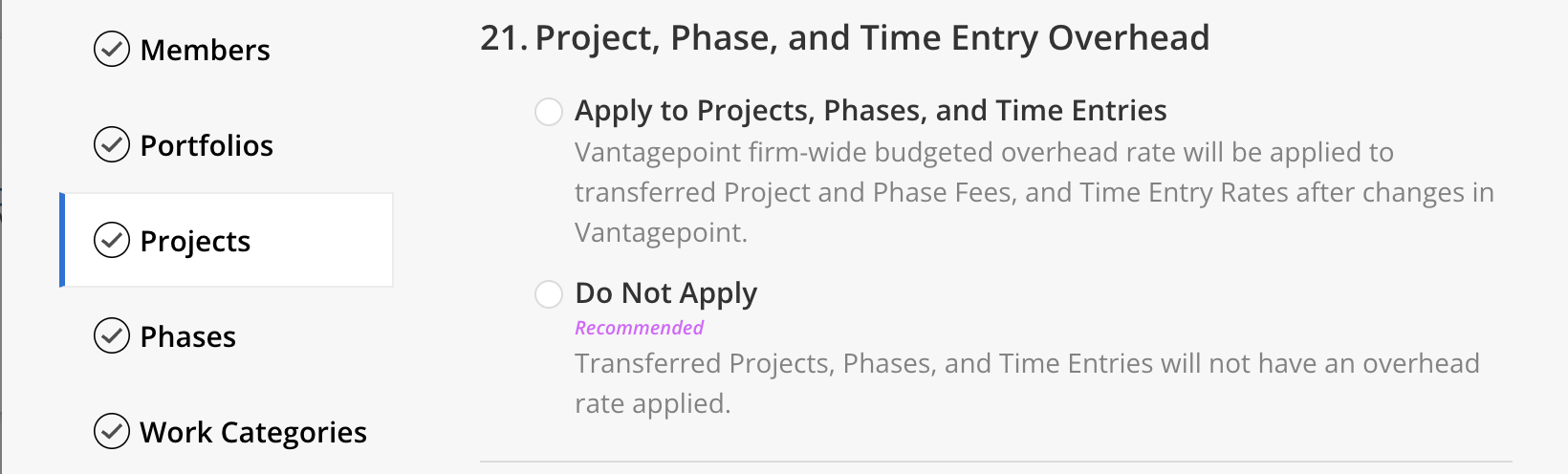
Definition
Controls whether the Vantagepoint firm-wide budgeted overhead rate is applied to transferred Project fees, Phase fees, and Time Entry rates.
Settings Choices
- Apply to Projects, Phases, and Time Entries — Vantagepoint firm-wide budgeted overhead rate will be applied to transferred Project and Phase Fees, and Time Entry Rates after changes in Vantagepoint.
- Do Not Apply (Recommended) — Transferred Projects, Phases, and Time Entries will not have an overhead rate applied.
In Mosaic
When enabled, the overhead rate is multiplied into:
- Project and Phase fees — Overhead is added to the fee amount.
- Time Entry rates — Overhead is multiplied into the base time entry fee.
17. Project and Phase Default Rate Multiplier
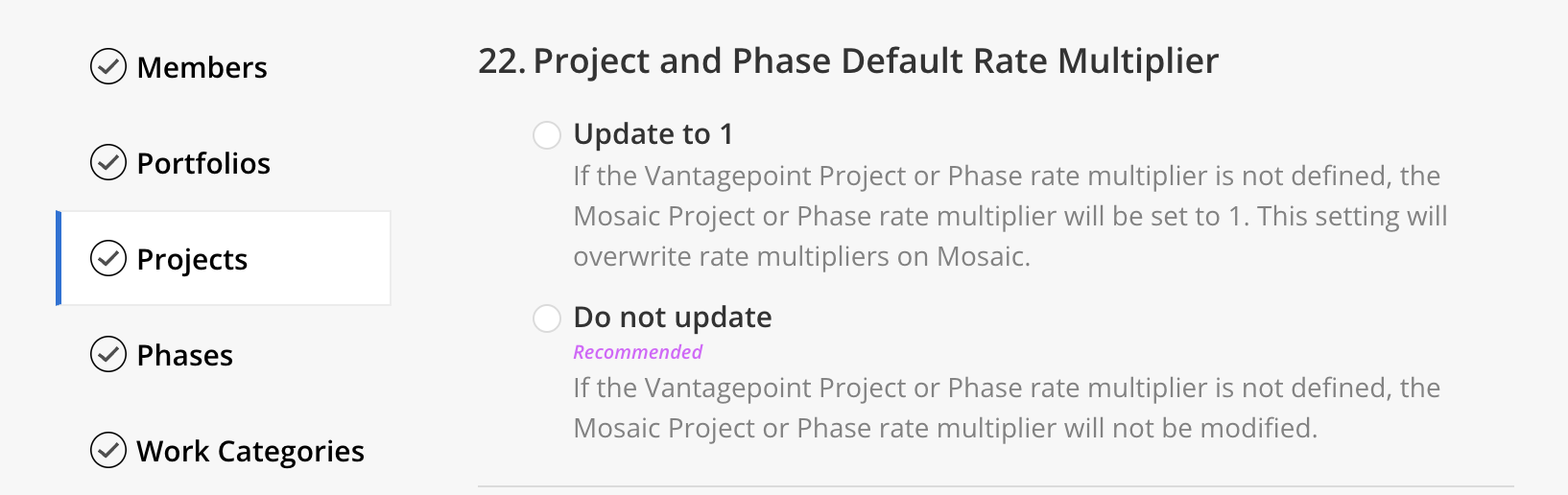
Definition
Controls what happens to the Mosaic rate multiplier when a Vantagepoint Project or Phase does not have a rate multiplier defined.
Settings Choices
- Update to 1 — If the Vantagepoint Project or Phase rate multiplier is not defined, the Mosaic Project or Phase rate multiplier will be set to 1. This setting will overwrite rate multipliers on Mosaic.
- Do not update (Recommended) — If the Vantagepoint Project or Phase rate multiplier is not defined, the Mosaic Project or Phase rate multiplier will not be modified.
In Mosaic
This setting only applies when a rate multiplier is not defined in Vantagepoint. Projects and Phases with explicitly set multipliers are always synced.
18. Project and Phase Fee Source
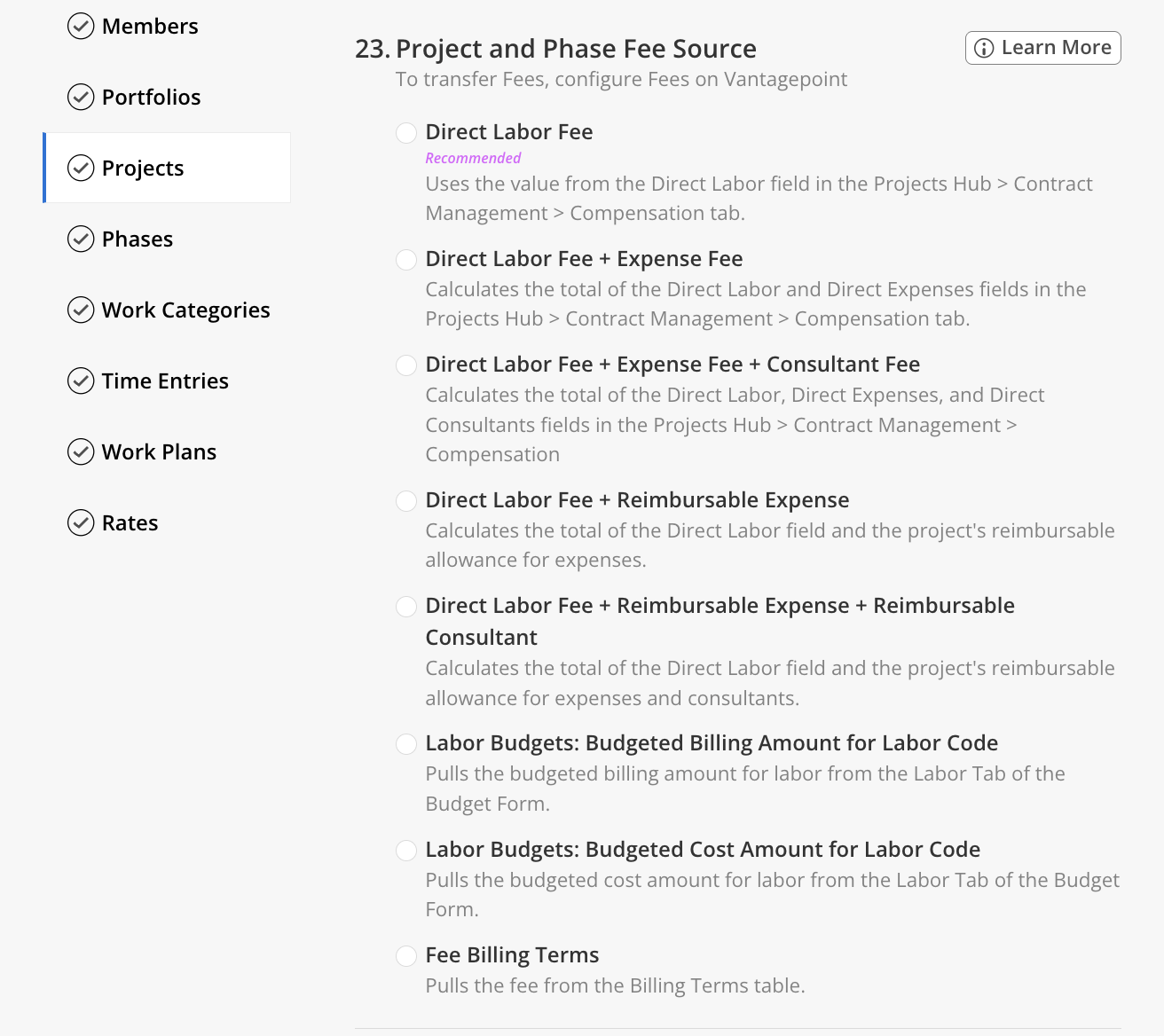
Definition
Determines which Vantagepoint field(s) are used to calculate the Fee (budget) for Projects and Phases in Mosaic.
Settings Choices
- Direct Labor Fee (Recommended) — Uses the value from the Direct Labor field in the Projects Hub > Contract Management > Compensation tab.
- Direct Labor Fee + Expense Fee — Calculates the total of the Direct Labor and Direct Expenses fields in the Projects Hub > Contract Management > Compensation tab.
- Direct Labor Fee + Expense Fee + Consultant Fee — Calculates the total of the Direct Labor, Direct Expenses, and Direct Consultants fields in the Projects Hub > Contract Management > Compensation tab.
- Direct Labor Fee + Reimbursable Expense — Calculates the total of the Direct Labor field and the project's reimbursable allowance for expenses.
- Direct Labor Fee + Reimbursable Expense + Reimbursable Consultant — Calculates the total of the Direct Labor field and the project's reimbursable allowance for expenses and consultants.
- Labor Budgets: Budgeted Billing Amount for Labor Code — Pulls the budgeted billing amount for labor from the Labor Tab of the Budget Form.
- Labor Budgets: Budgeted Cost Amount for Labor Code — Pulls the budgeted cost amount for labor from the Labor Tab of the Budget Form.
- Fee Billing Terms — Pulls the fee from the Billing Terms Fee (BTF) table. Available for Cloud (requires stored procedure) and On-Premise.
In Mosaic
The selected fee source populates the Fee field on Projects and Phases. The change takes effect on any project/phase/task modified in Vantagepoint after the setting is updated.
If selecting a fee source other than Direct Labor options, make sure the required tables exist in your replica database before enabling.
19. Project Name Source
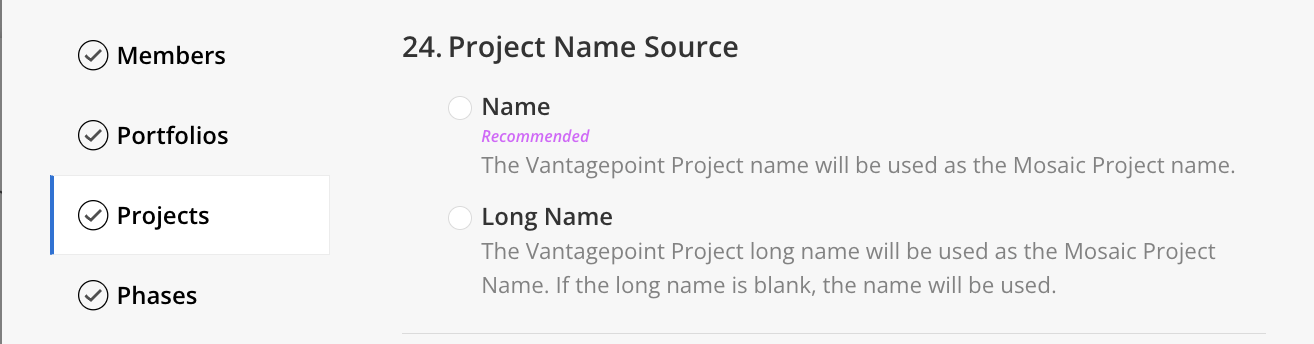
Definition
Determines which Vantagepoint Project name field is used as the Project name in Mosaic.
Settings Choices
- Name (Recommended) — The Vantagepoint Project name will be used as the Mosaic Project name.
- Long Name — The Vantagepoint Project long name will be used as the Mosaic Project name. If the long name is blank, the short name will be used as a fallback.
In Mosaic
The selected name source populates the Project Title in Mosaic. If you switch from Name to Long Name (or vice versa), titles will update on the next sync for any modified projects.
20. Zero Project Fee
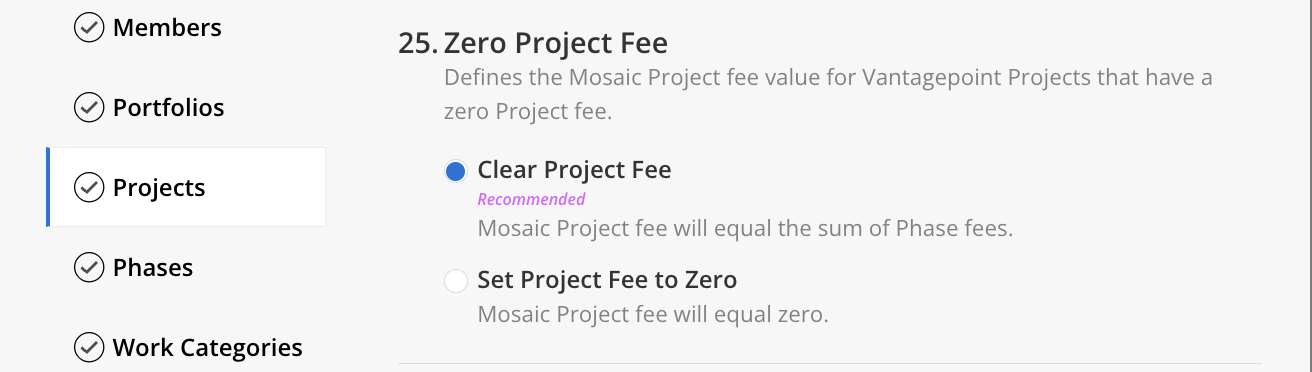
Definition
Defines how Mosaic handles Vantagepoint Projects that have a fee value of zero.
Settings Choices
- Clear Project Fee (Recommended) — Mosaic Project fee will equal the sum of Phase fees. The zero value from Vantagepoint is treated as "no fee set," allowing Phase fees to roll up.
- Set Project Fee to Zero — Mosaic Project fee will equal zero. Use this if zero-fee Projects are intentional in your workflow.
In Mosaic
This setting affects how the Fee field displays on Projects with a zero value in Vantagepoint. It does not affect Projects with non-zero fees.
21. Project-level Roles
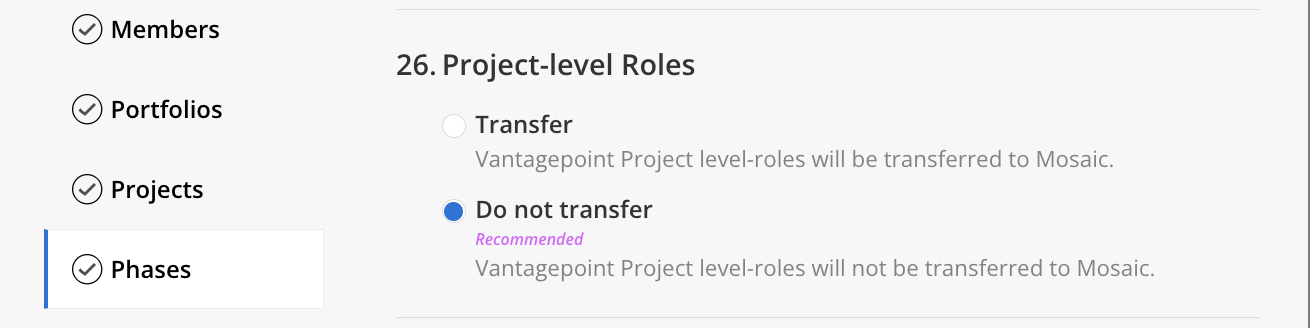
Definition
Controls whether Vantagepoint project-level role assignments are transferred to Mosaic.
In Mosaic
When enabled, member role assignments at the project level in Vantagepoint will overwrite the corresponding assignments in Mosaic on each sync.
22. Role Source for Role Rate Projects
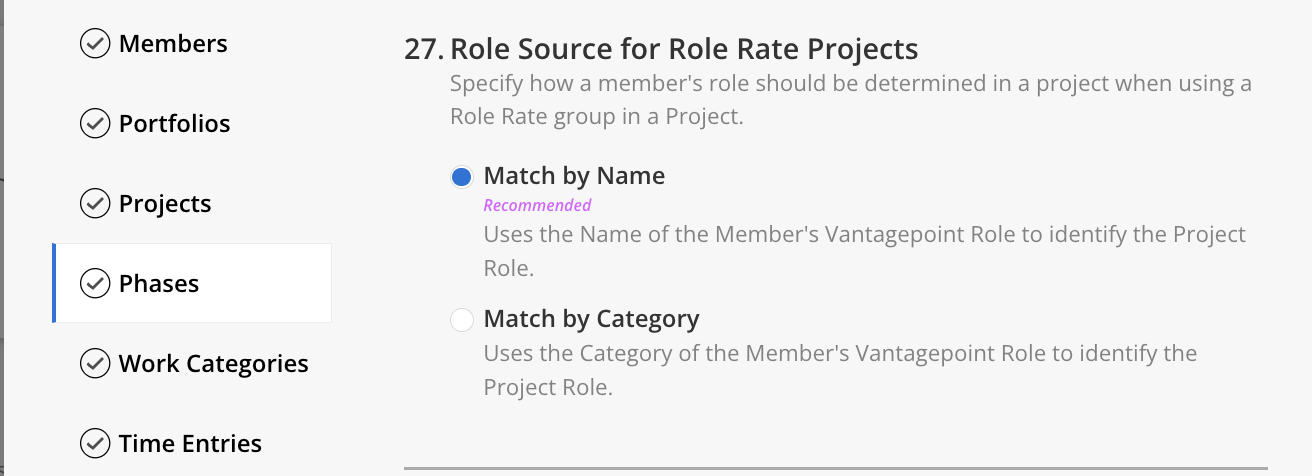
Definition
Specifies how a member's role is determined in a project when using a Role Rate group.
Settings Choices
- Match by Name (Recommended) — Uses the Name of the Member's Vantagepoint Role to identify the Project Role.
- Match by Category — Uses the Category of the Member's Vantagepoint Role to identify the Project Role.
In Mosaic
This setting affects how members are matched to roles within Role Rate group projects. It determines whether the matching logic uses role names or rate group categories.
Phases
1. Linking Method
Definition
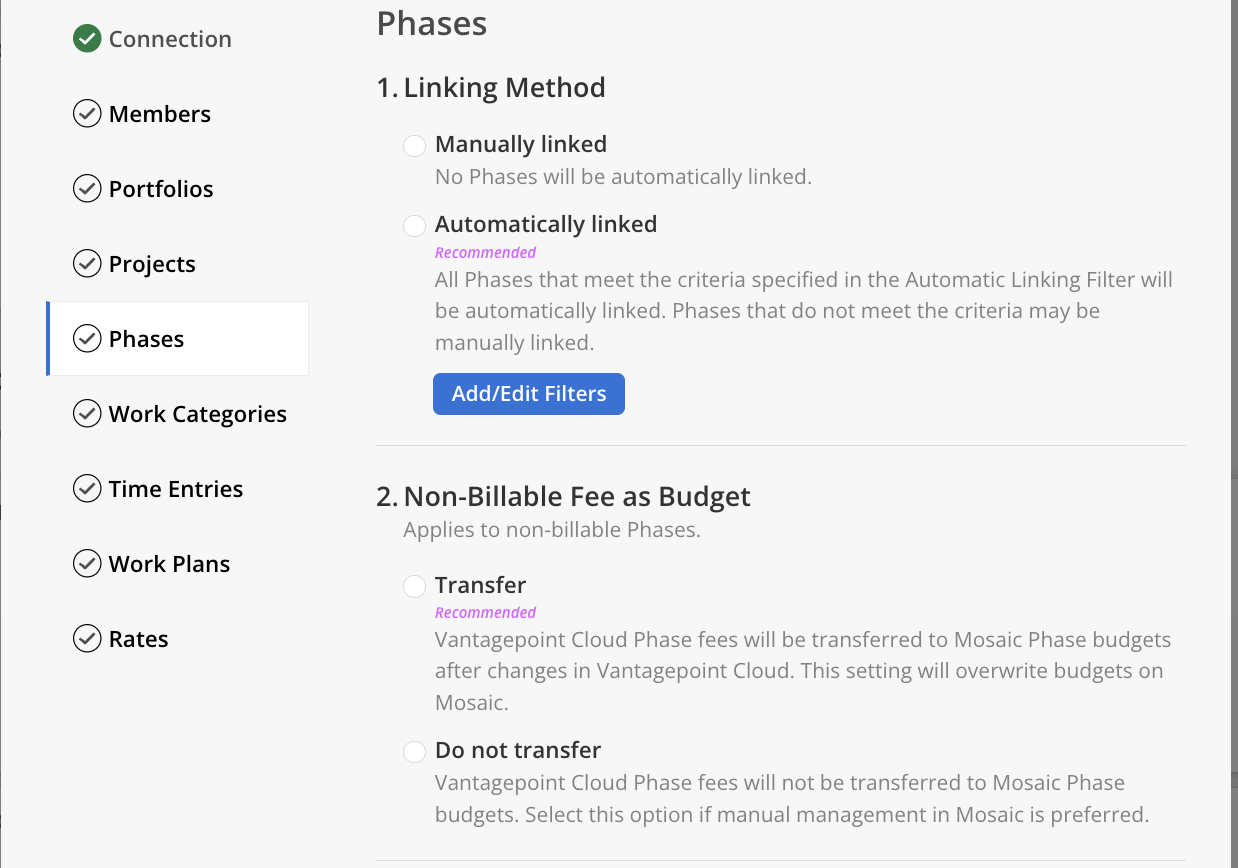
This setting determines how Vantagepoint phases are connected to Mosaic. A phase is a distinct stage within a project's lifecycle, with its own date range, fee, and status. Importing means bringing a phase from Vantagepoint into Mosaic for the first time. Linking means establishing an ongoing connection so that changes sync automatically.
Settings Choices
- Manually linked — No phases will be automatically linked. You choose which Vantagepoint phases to import and link on a phase-by-phase basis.
- Automatically linked (Recommended) — All phases that meet the criteria specified in the Automatic Linking Filter will be automatically linked. Phases that do not meet the criteria may be manually linked.
When Automatically linked is selected, an Add/Edit Filters button appears, allowing you to configure filter criteria for which phases should be auto-linked.
In Mosaic
When set to Manually linked, new Vantagepoint phases will not appear in Mosaic until you explicitly import them. This gives you control over which phases exist in Mosaic but requires ongoing manual effort.
When set to Automatically linked, phases matching your filter criteria are imported and linked as soon as they are detected. This is the recommended approach for most firms.
2. Non-Billable Fee as Budget
Definition
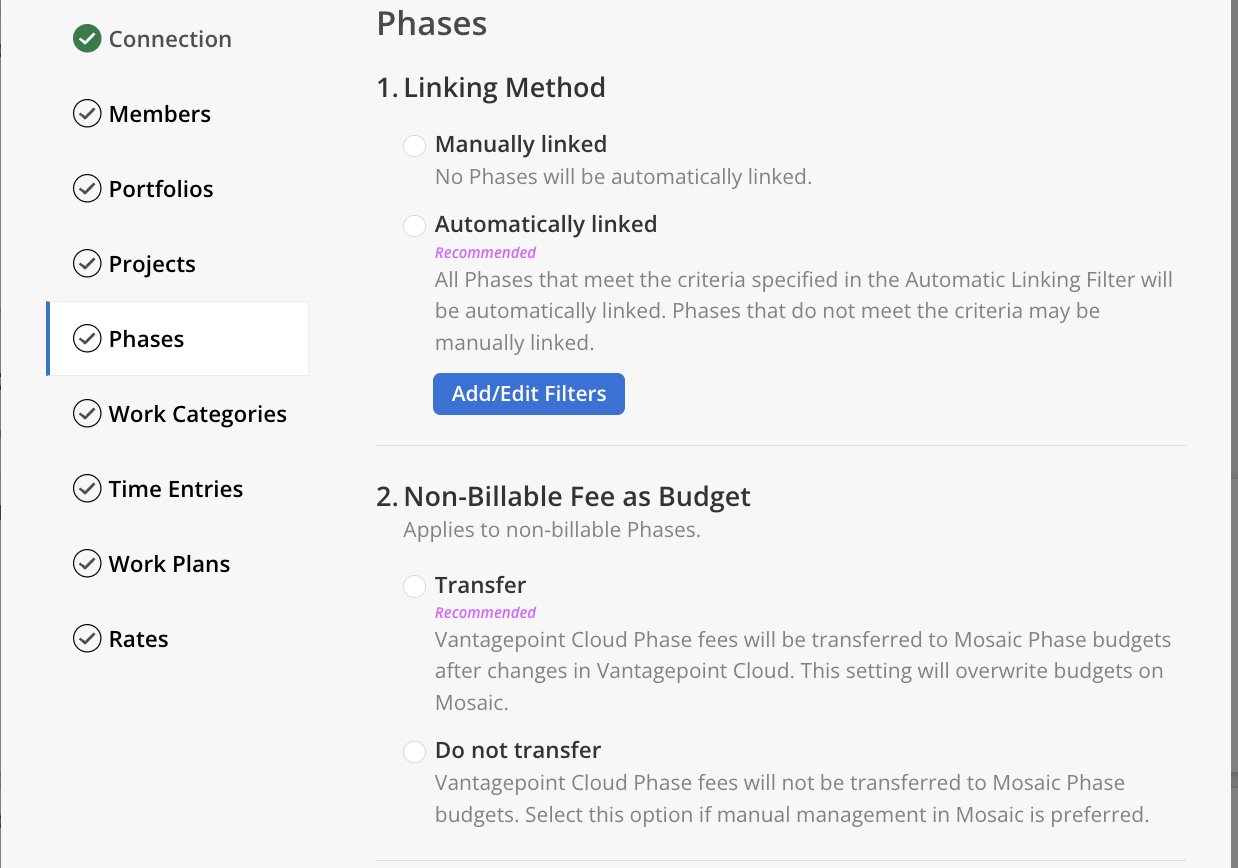
This setting controls whether Vantagepoint phase fees for non-billable phases are transferred to Mosaic as phase budgets. By default, fees are only meaningful for billable phases — this setting extends fee transfer to non-billable phases as well.
Applies to non-billable Phases.
In Mosaic
When set to Transfer, the ERP "Fee" value for non-billable phases is used to populate the Budget field in Mosaic. This is useful for firms that track budgets on internal or non-billable phases for resource planning and cost tracking purposes.
3. Order
Definition
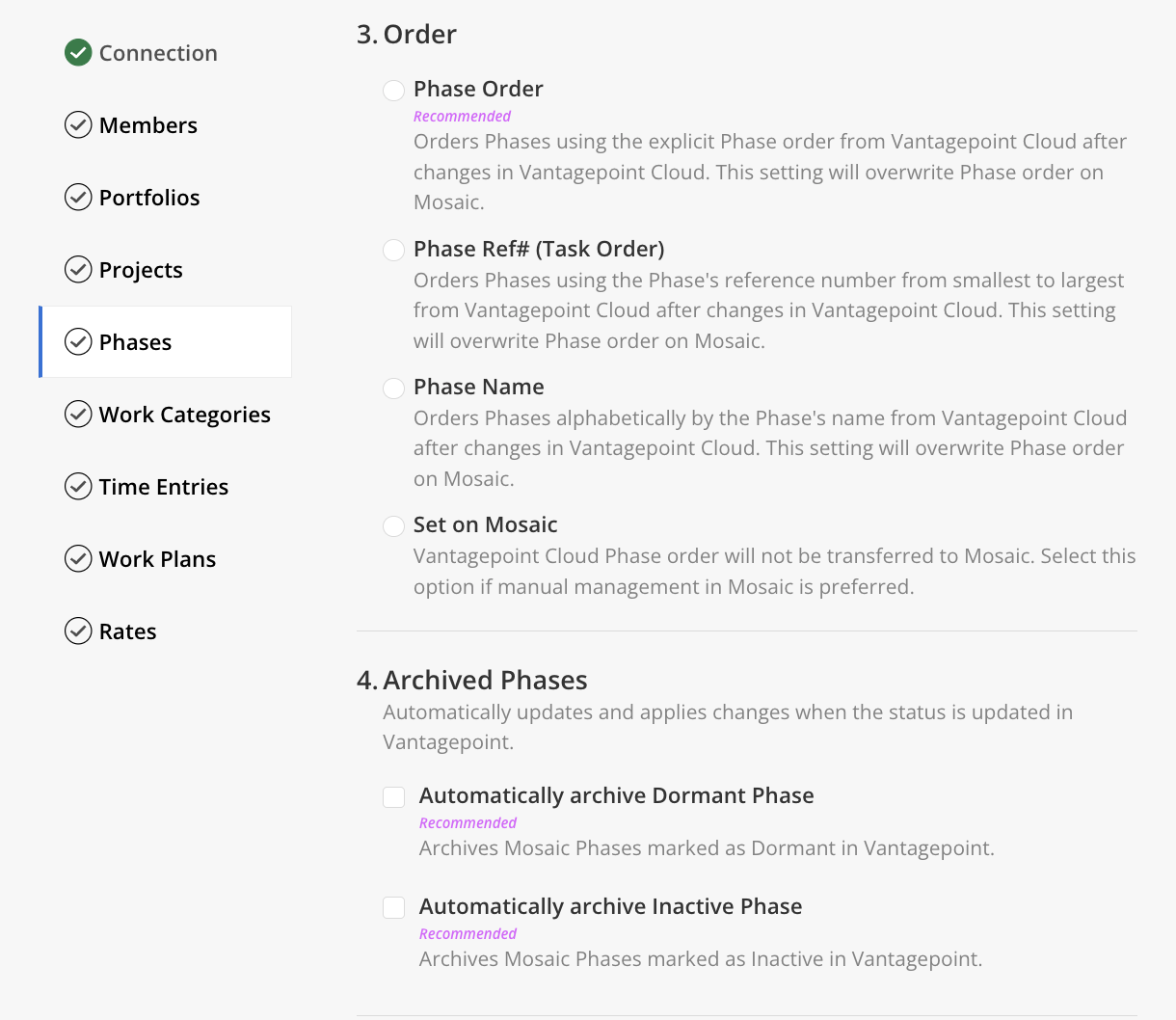
This setting controls how phases within a project are ordered in Mosaic. You can choose to sync the phase order from Vantagepoint or manage it manually in Mosaic.
Settings Choices
- Phase Order (Recommended) — Orders Phases using the explicit Phase order from Vantagepoint after changes in Vantagepoint. This setting will overwrite Phase order on Mosaic.
- Phase Ref# (Task Order) — Orders Phases using the Phase's reference number from smallest to largest from Vantagepoint after changes in Vantagepoint. This setting will overwrite Phase order on Mosaic.
- Phase Name — Orders Phases alphabetically by the Phase's name from Vantagepoint after changes in Vantagepoint. This setting will overwrite Phase order on Mosaic.
- Set on Mosaic — Vantagepoint Phase order will not be transferred to Mosaic. Select this option if manual management in Mosaic is preferred.
In Mosaic
The first three options all sync ordering from Vantagepoint and will overwrite any manual reordering done in Mosaic. Choose the method that best matches how your firm organizes phases in Vantagepoint.
When set to Set on Mosaic, phase order is managed entirely within Mosaic. This is useful if your team prefers a different ordering in Mosaic than in Vantagepoint.
Maintain a single source of truth for ordering consistency. If you choose a Vantagepoint-synced option, avoid reordering phases manually in Mosaic. If you create phases in both systems, ordering conflicts may arise.
4. Archived Phases
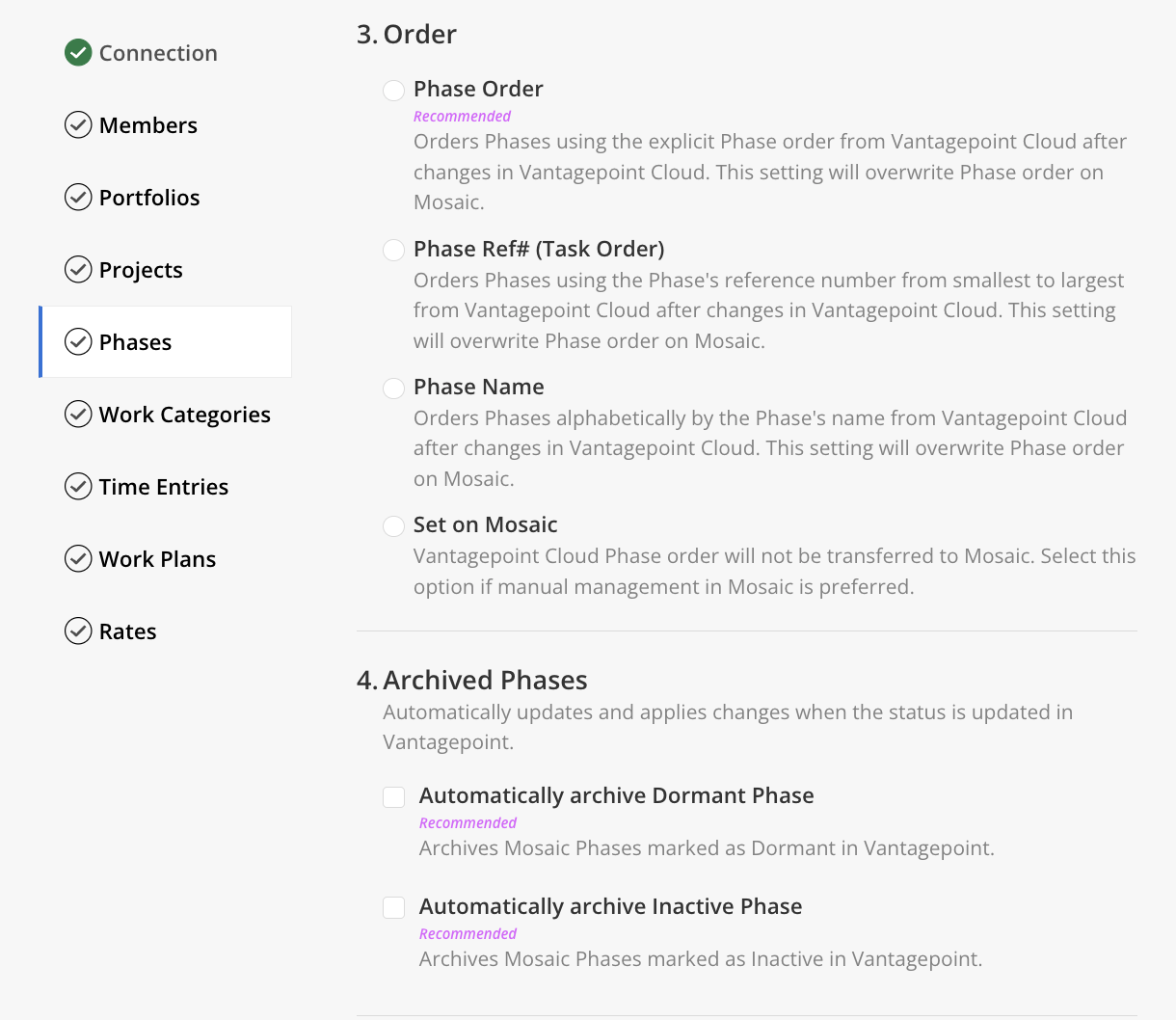
Definition
Configures which Vantagepoint Phase statuses should automatically trigger archiving in Mosaic.
Settings Choices
- Automatically archive Dormant Phases (Recommended) — Archives Mosaic Phases marked as Dormant in Vantagepoint.
- Automatically archive Inactive Phases (Recommended) — Archives Mosaic Phases marked as Inactive in Vantagepoint.
You can select both, one, or neither option.
In Mosaic
Archived Phases are hidden from active views and also archive related Work Plans. The change takes effect when the status is updated in Vantagepoint.
5. Phase Status Matching
| Vantagepoint | Mosaic |
|---|---|
| Active (A) | Active |
| Inactive (I) | Not Started |
| Dormant (D) | Hold |
In Mosaic
Maps each Vantagepoint phase status to a corresponding Mosaic Phase status. The mapping is applied any time a phase's status changes in Vantagepoint.
Default Mapping
| Vantagepoint Status | Mosaic Status |
|---|---|
| Active (A) | Active |
| Inactive (I) | Not Started |
| Dormant (D) | Hold |
For each Vantagepoint status, select the Mosaic Phase status that should be applied. The change is applied when the status is updated in Vantagepoint.
How it works
- Each Vantagepoint status is matched to a Mosaic status. The list of source statuses comes from your connected tool, so you'll need a tested connection before you can edit.
- Unmapped statuses sync as Active — if a status isn't listed, Mosaic sets the project or phase to Active.
- Click Reset to default at any time to restore Mosaic's recommended mapping for this integration.
- Changes apply on Save (the button reads Done when there are no changes). Updates affect future syncs; already-synced records keep their current status until they next change in Vantagepoint.
For a full walkthrough of the mapping editor, see Project & Phase Status Matching.
Previously (before Status Matching): Dormant Phases Status & Inactive Phases Status
Dormant Phases Status
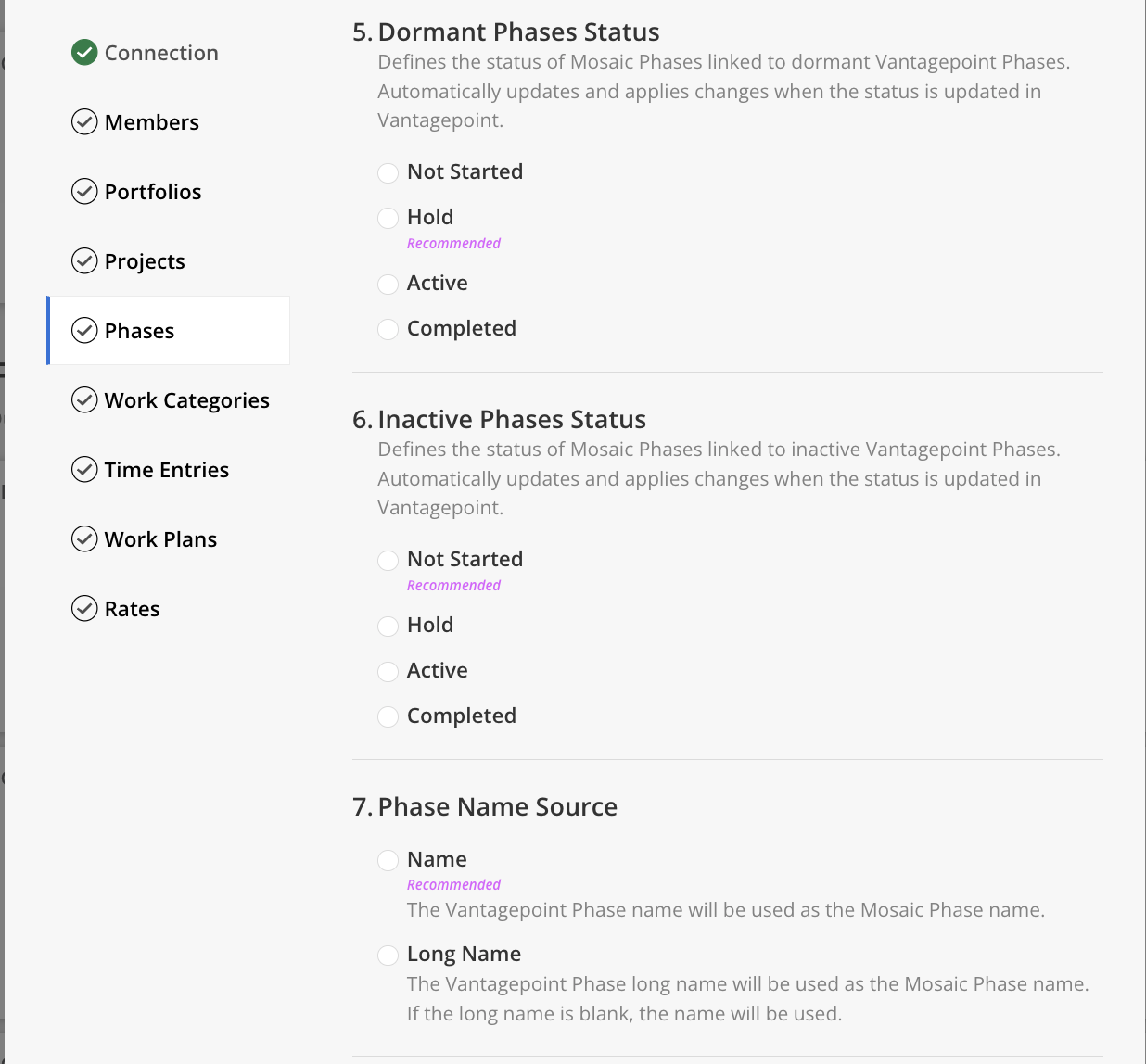
Definition
Maps the Vantagepoint "Dormant" phase status to a corresponding Mosaic Phase status.
In Mosaic
When a Vantagepoint Phase is marked as Dormant, the linked Mosaic Phase will automatically update to the selected status. The change applies when the status is updated in Vantagepoint.
Inactive Phases Status
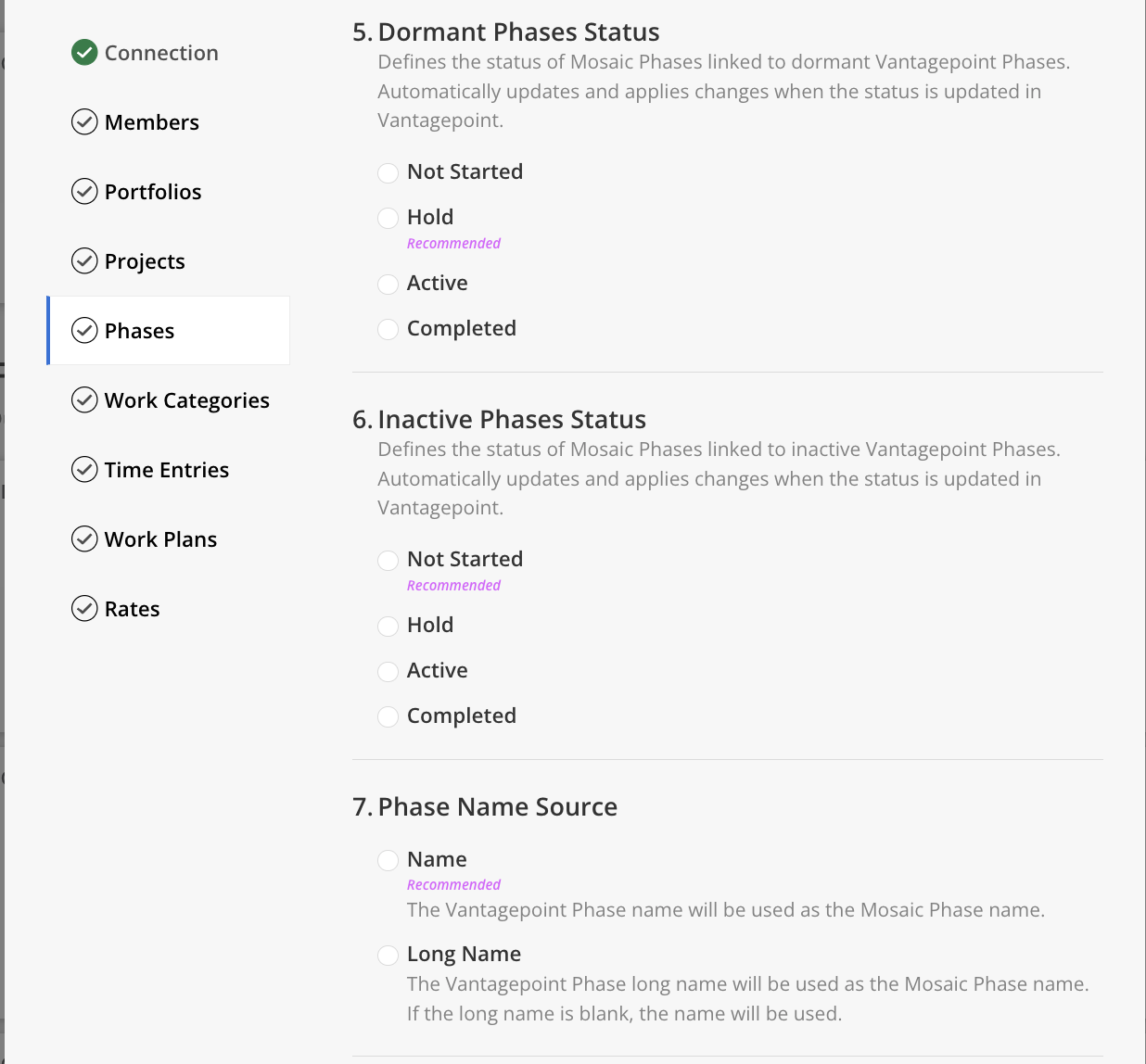
Definition
Maps the Vantagepoint "Inactive" phase status to a corresponding Mosaic Phase status.
In Mosaic
When a Vantagepoint Phase is marked as Inactive, the linked Mosaic Phase will automatically update to the selected status. The change applies when the status is updated in Vantagepoint.
6. Phase Name Source
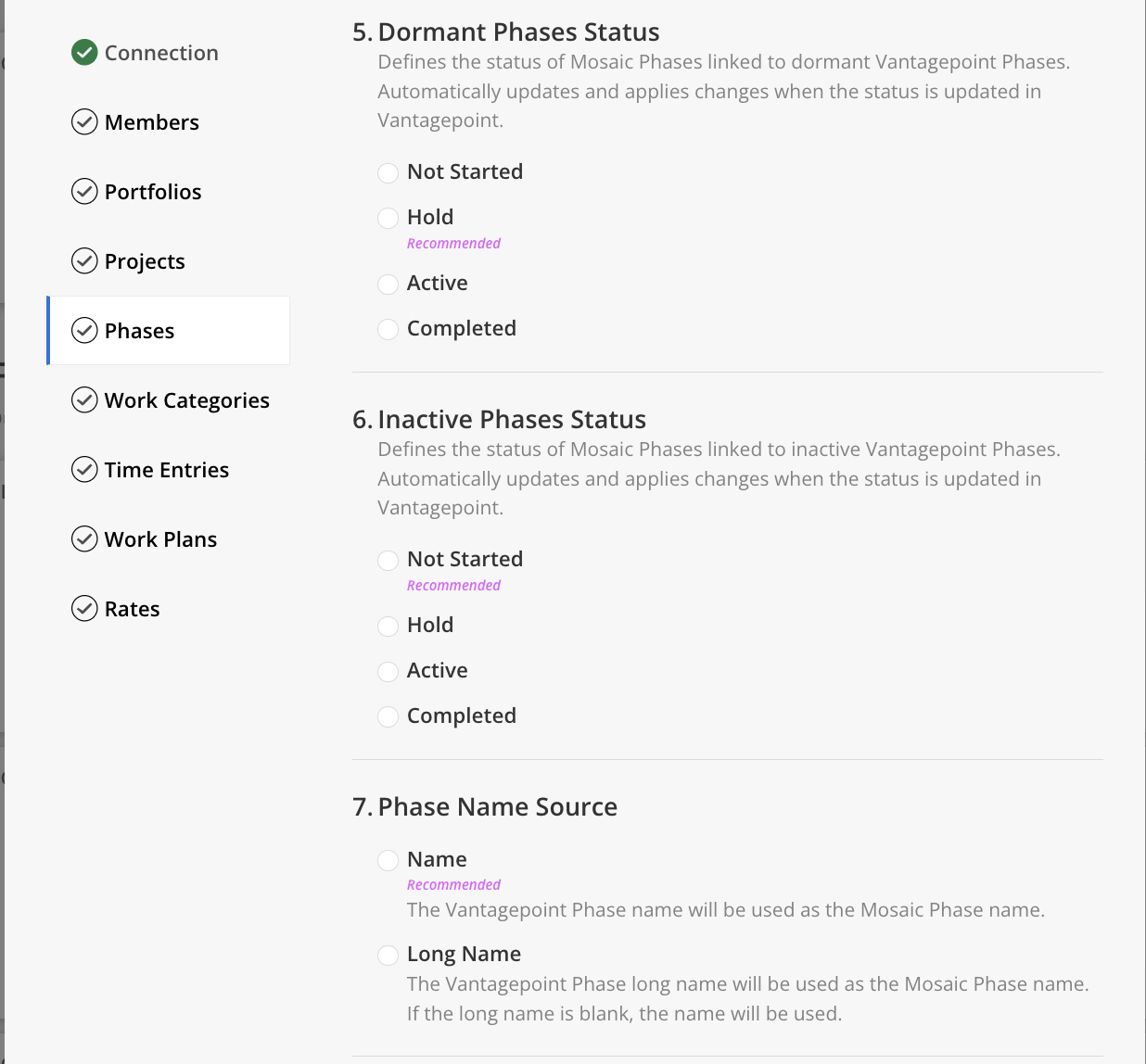
Definition
Determines which Vantagepoint Phase name field is used as the Phase name in Mosaic.
Settings Choices
- Name (Recommended) — The Vantagepoint Phase name will be used as the Mosaic Phase name.
- Long Name — The Vantagepoint Phase long name will be used as the Mosaic Phase name. If the long name is blank, the short name will be used as a fallback.
In Mosaic
The selected name source populates the Phase Name in Mosaic.
7. Phase Profit Center Name Source
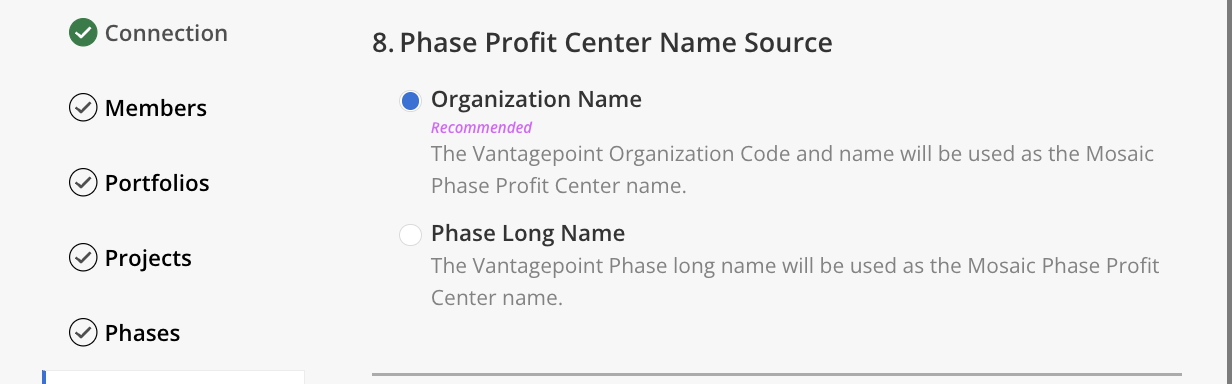
Definition
Determines which Vantagepoint field is used as the Phase Profit Center name in Mosaic.
Settings Choices
- Organization Name (Recommended) — The Vantagepoint Organization Code and Name will be used as the Mosaic Phase Profit Center name.
- Phase Long Name — The Vantagepoint Phase long name will be used as the Mosaic Phase Profit Center name.
In Mosaic
The Profit Center is a label used to associate Phases with organizational units. This setting controls the display name only.
1. Linking Method
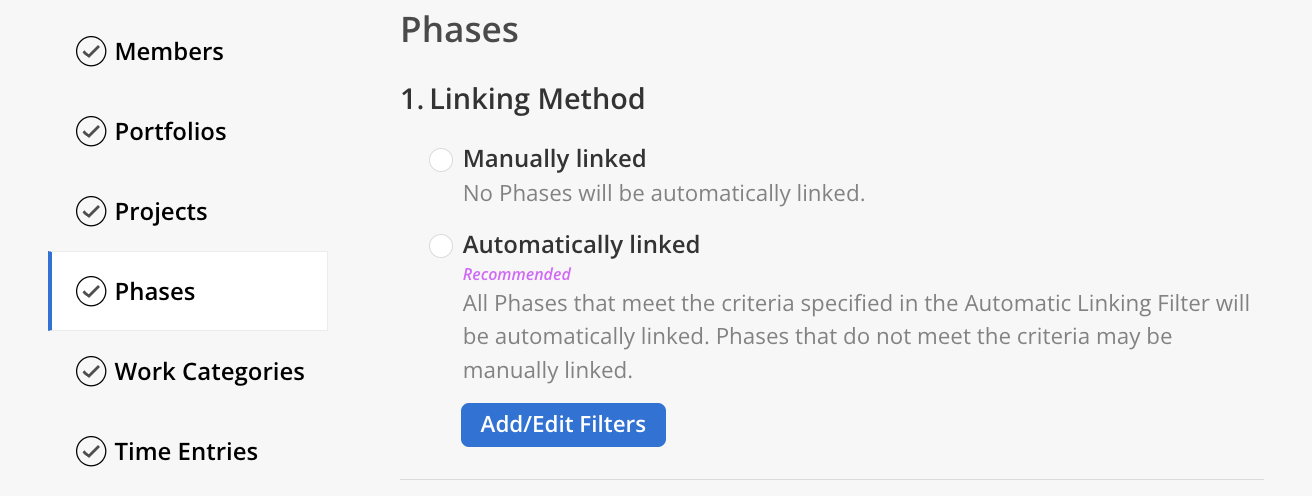
Definition
This setting determines how Vantagepoint phases are connected to Mosaic. A phase is a distinct stage within a project's lifecycle, with its own date range, fee, and status. Importing means bringing a phase from Vantagepoint into Mosaic for the first time. Linking means establishing an ongoing connection so that changes sync automatically.
Settings Choices
- Manually linked — No phases will be automatically linked. You choose which Vantagepoint phases to import and link on a phase-by-phase basis.
- Automatically linked (Recommended) — All phases that meet the criteria specified in the Automatic Linking Filter will be automatically linked. Phases that do not meet the criteria may be manually linked.
When Automatically linked is selected, an Add/Edit Filters button appears, allowing you to configure filter criteria for which phases should be auto-linked.
In Mosaic
When set to Manually linked, new Vantagepoint phases will not appear in Mosaic until you explicitly import them. This gives you control over which phases exist in Mosaic but requires ongoing manual effort.
When set to Automatically linked, phases matching your filter criteria are imported and linked as soon as they are detected. This is the recommended approach for most firms.
2. Non-Billable Fee as Budget
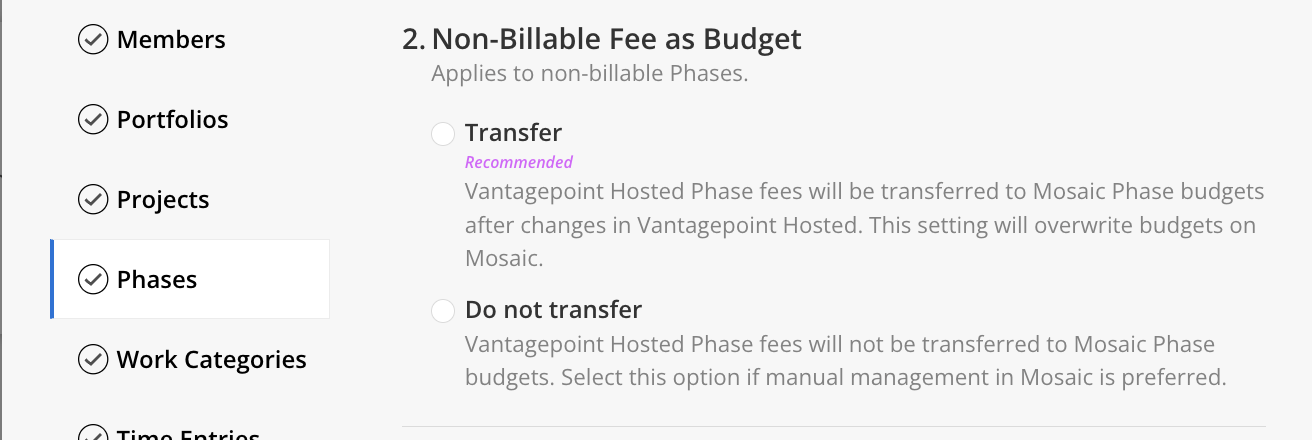
Definition
This setting controls whether Vantagepoint phase fees for non-billable phases are transferred to Mosaic as phase budgets. By default, fees are only meaningful for billable phases — this setting extends fee transfer to non-billable phases as well.
Applies to non-billable Phases.
In Mosaic
When set to Transfer, the ERP "Fee" value for non-billable phases is used to populate the Budget field in Mosaic. This is useful for firms that track budgets on internal or non-billable phases for resource planning and cost tracking purposes.
3. Order
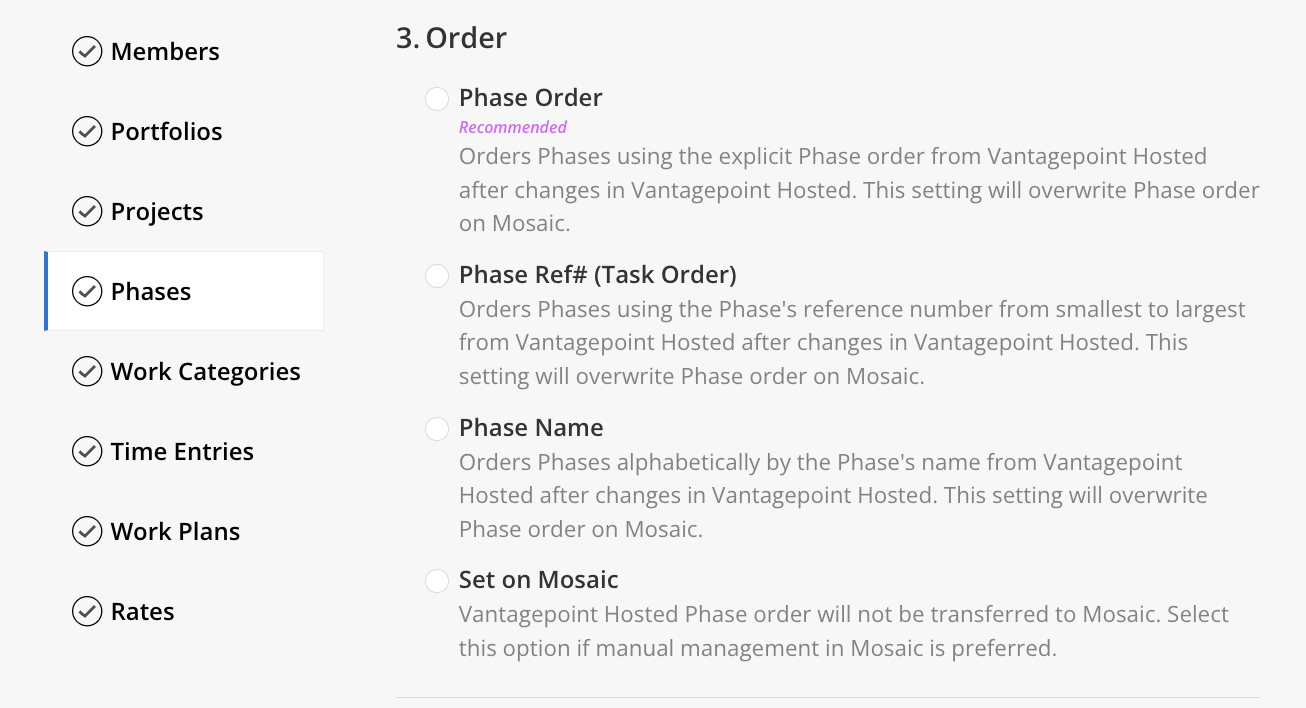
Definition
This setting controls how phases within a project are ordered in Mosaic. You can choose to sync the phase order from Vantagepoint or manage it manually in Mosaic.
Settings Choices
- Phase Order (Recommended) — Orders Phases using the explicit Phase order from Vantagepoint after changes in Vantagepoint. This setting will overwrite Phase order on Mosaic.
- Phase Ref# (Task Order) — Orders Phases using the Phase's reference number from smallest to largest from Vantagepoint after changes in Vantagepoint. This setting will overwrite Phase order on Mosaic.
- Phase Name — Orders Phases alphabetically by the Phase's name from Vantagepoint after changes in Vantagepoint. This setting will overwrite Phase order on Mosaic.
- Set on Mosaic — Vantagepoint Phase order will not be transferred to Mosaic. Select this option if manual management in Mosaic is preferred.
In Mosaic
The first three options all sync ordering from Vantagepoint and will overwrite any manual reordering done in Mosaic. Choose the method that best matches how your firm organizes phases in Vantagepoint.
When set to Set on Mosaic, phase order is managed entirely within Mosaic. This is useful if your team prefers a different ordering in Mosaic than in Vantagepoint.
Maintain a single source of truth for ordering consistency. If you choose a Vantagepoint-synced option, avoid reordering phases manually in Mosaic. If you create phases in both systems, ordering conflicts may arise.
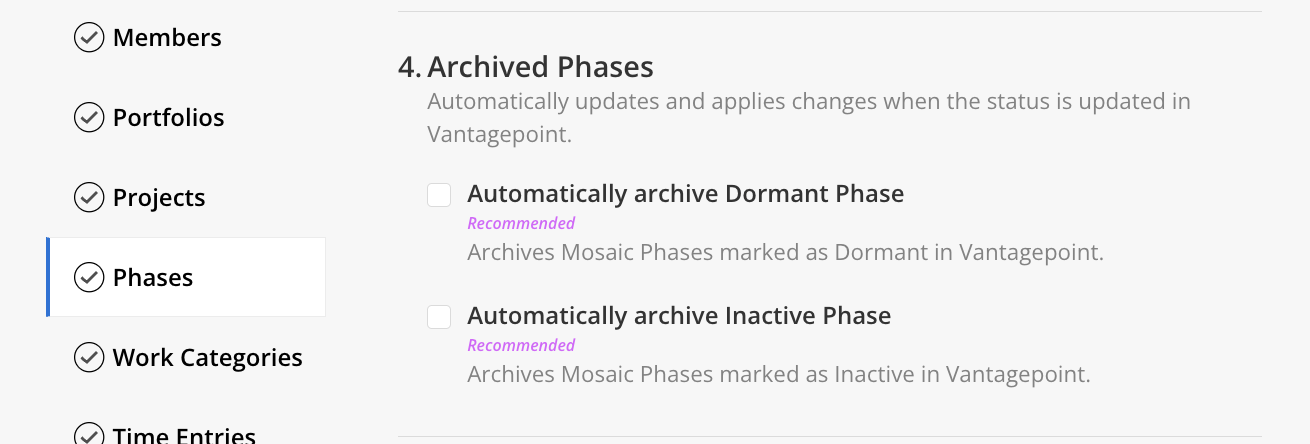
4. Archived Phases
Definition
Configures which Vantagepoint Phase statuses should automatically trigger archiving in Mosaic.
Settings Choices
- Automatically archive Dormant Phases (Recommended) — Archives Mosaic Phases marked as Dormant in Vantagepoint.
- Automatically archive Inactive Phases (Recommended) — Archives Mosaic Phases marked as Inactive in Vantagepoint.
You can select both, one, or neither option.
In Mosaic
Archived Phases are hidden from active views and also archive related Work Plans. The change takes effect when the status is updated in Vantagepoint.
5. Phase Status Matching
| Vantagepoint | Mosaic |
|---|---|
| Active (A) | Active |
| Inactive (I) | Not Started |
| Dormant (D) | Hold |
In Mosaic
Maps each Vantagepoint phase status to a corresponding Mosaic Phase status. The mapping is applied any time a phase's status changes in Vantagepoint.
Default Mapping
| Vantagepoint Status | Mosaic Status |
|---|---|
| Active (A) | Active |
| Inactive (I) | Not Started |
| Dormant (D) | Hold |
For each Vantagepoint status, select the Mosaic Phase status that should be applied. The change is applied when the status is updated in Vantagepoint.
How it works
- Each Vantagepoint status is matched to a Mosaic status. The list of source statuses comes from your connected tool, so you'll need a tested connection before you can edit.
- Unmapped statuses sync as Active — if a status isn't listed, Mosaic sets the project or phase to Active.
- Click Reset to default at any time to restore Mosaic's recommended mapping for this integration.
- Changes apply on Save (the button reads Done when there are no changes). Updates affect future syncs; already-synced records keep their current status until they next change in Vantagepoint.
For a full walkthrough of the mapping editor, see Project & Phase Status Matching.
Previously (before Status Matching): Dormant Phases Status & Inactive Phases Status
Dormant Phases Status
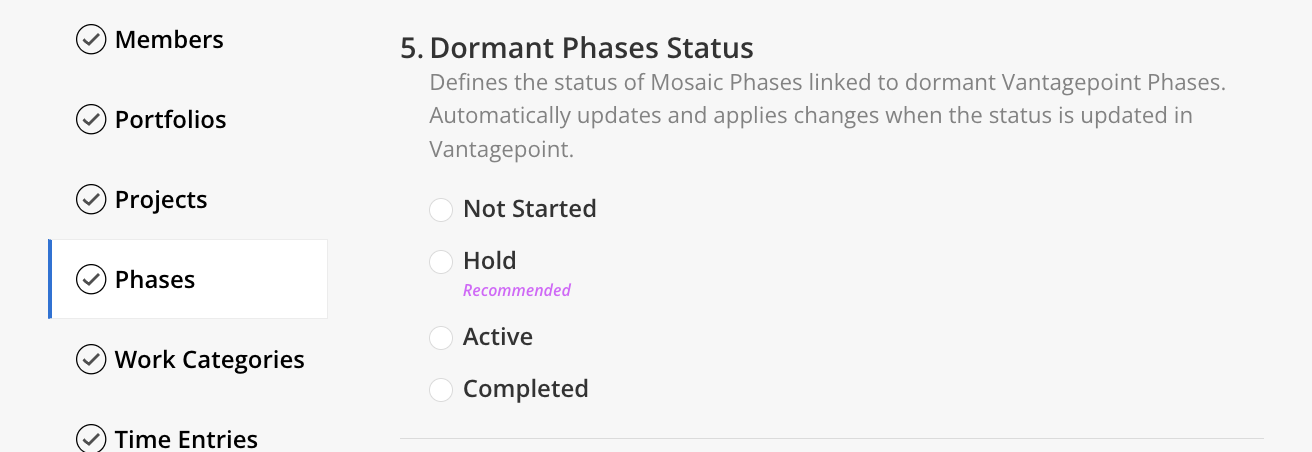
Definition
Maps the Vantagepoint "Dormant" phase status to a corresponding Mosaic Phase status.
In Mosaic
When a Vantagepoint Phase is marked as Dormant, the linked Mosaic Phase will automatically update to the selected status. The change applies when the status is updated in Vantagepoint.
Inactive Phases Status
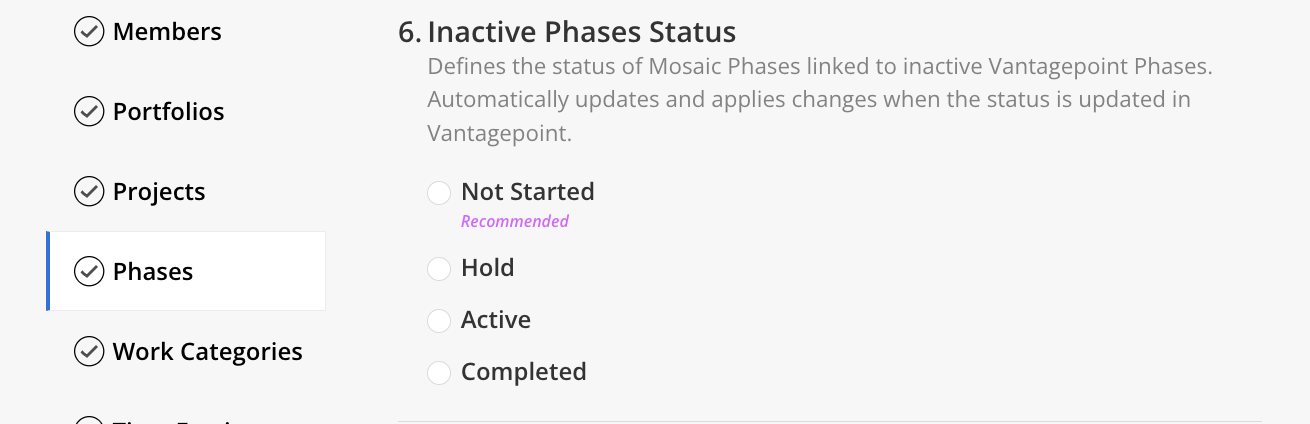
Definition
Maps the Vantagepoint "Inactive" phase status to a corresponding Mosaic Phase status.
In Mosaic
When a Vantagepoint Phase is marked as Inactive, the linked Mosaic Phase will automatically update to the selected status. The change applies when the status is updated in Vantagepoint.
6. Phase Name Source
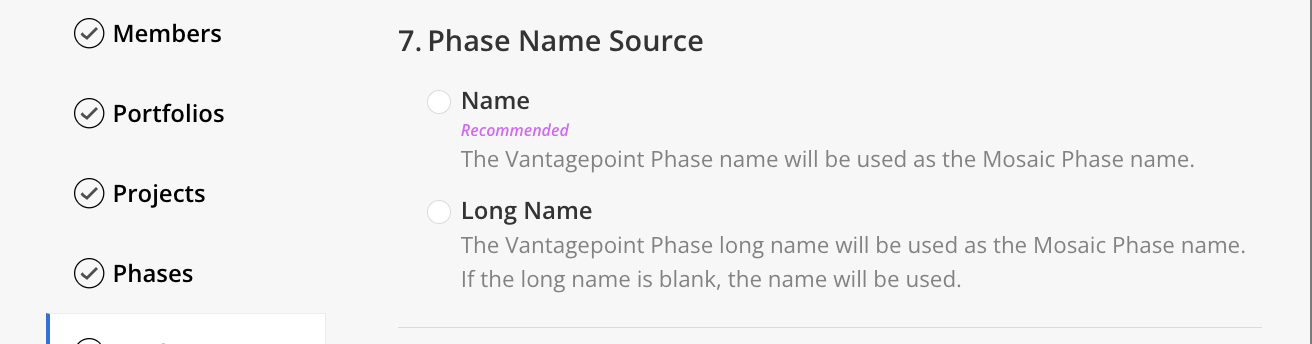
Definition
Determines which Vantagepoint Phase name field is used as the Phase name in Mosaic.
Settings Choices
- Name (Recommended) — The Vantagepoint Phase name will be used as the Mosaic Phase name.
- Long Name — The Vantagepoint Phase long name will be used as the Mosaic Phase name. If the long name is blank, the short name will be used as a fallback.
In Mosaic
The selected name source populates the Phase Name in Mosaic.
7. Phase Profit Center Name Source
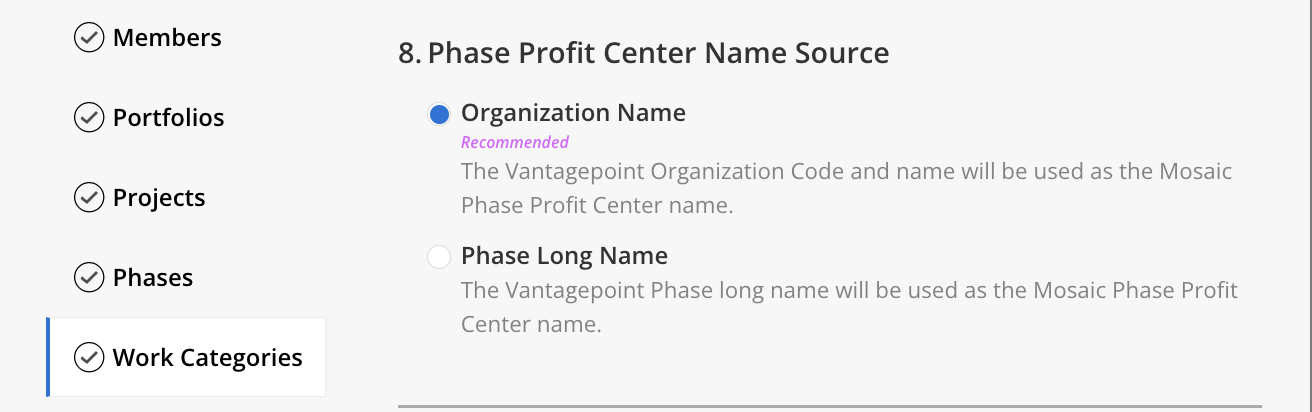
Definition
Determines which Vantagepoint field is used as the Phase Profit Center name in Mosaic.
Settings Choices
- Organization Name (Recommended) — The Vantagepoint Organization Code and Name will be used as the Mosaic Phase Profit Center name.
- Phase Long Name — The Vantagepoint Phase long name will be used as the Mosaic Phase Profit Center name.
In Mosaic
The Profit Center is a label used to associate Phases with organizational units. This setting controls the display name only.
Work Categories
1. Linking Method
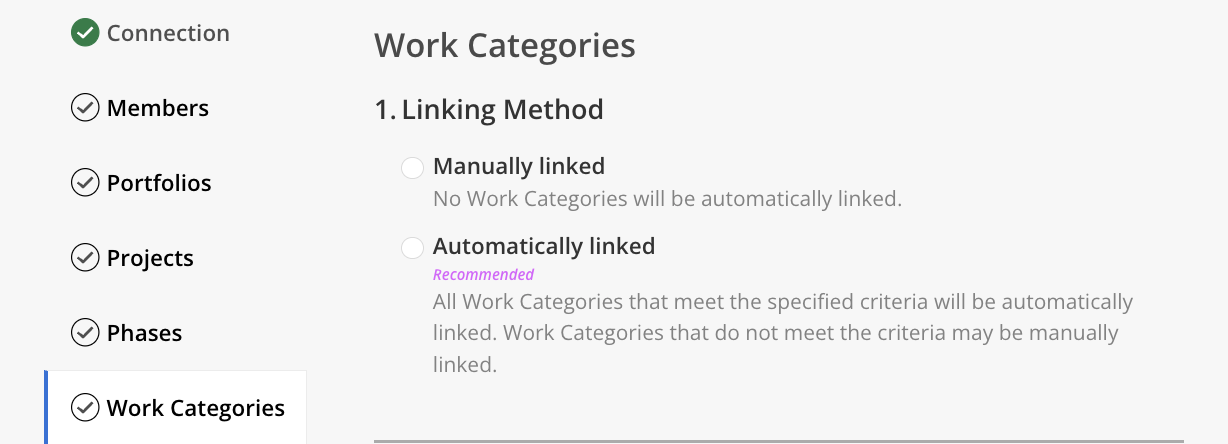
Definition
This setting determines how Vantagepoint work categories (activities / labor codes) are connected to Mosaic. Work categories classify the type of work being performed (e.g., Design, Project Management, Research) and are used to categorize time entries.
Settings Choices
- Manually linked — No Work Categories will be automatically linked. You choose which Vantagepoint work categories to import and link individually.
- Automatically linked (Recommended) — All Work Categories that meet the specified criteria will be automatically linked. Work Categories that do not meet the criteria may be manually linked.
In Mosaic
When set to Manually linked, you maintain full control over which work categories exist in Mosaic, but must manually manage the linking as new categories are created in Vantagepoint.
When set to Automatically linked, work categories are imported and linked automatically using system matching logic. This is the recommended approach for minimal maintenance. Choose Manually linked if your firm needs tighter control (e.g., inconsistent naming conventions between systems).
1. Linking Method
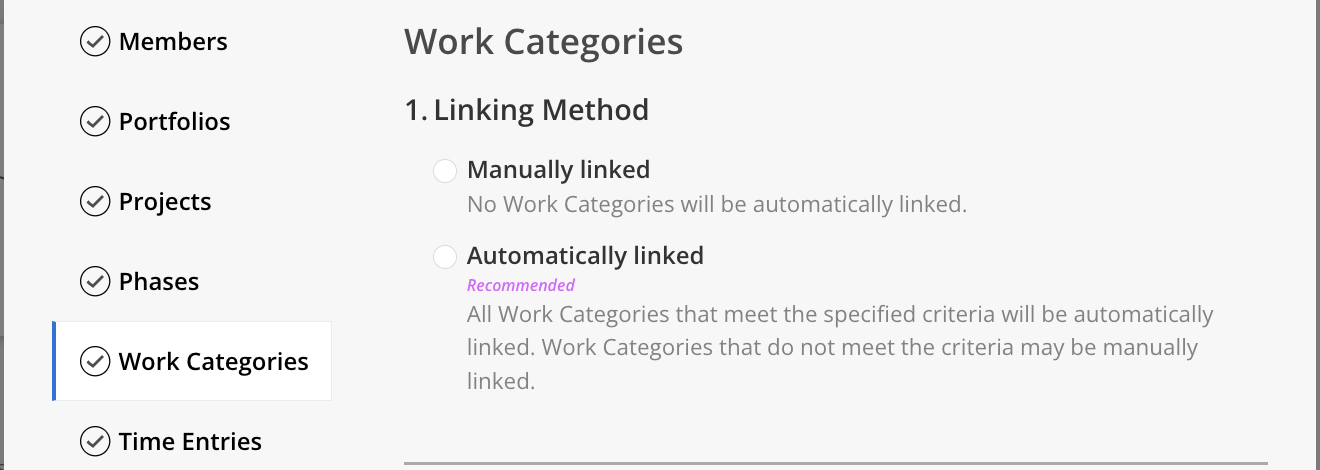
Definition
This setting determines how Vantagepoint work categories (activities / labor codes) are connected to Mosaic. Work categories classify the type of work being performed (e.g., Design, Project Management, Research) and are used to categorize time entries.
Settings Choices
- Manually linked — No Work Categories will be automatically linked. You choose which Vantagepoint work categories to import and link individually.
- Automatically linked (Recommended) — All Work Categories that meet the specified criteria will be automatically linked. Work Categories that do not meet the criteria may be manually linked.
In Mosaic
When set to Manually linked, you maintain full control over which work categories exist in Mosaic, but must manually manage the linking as new categories are created in Vantagepoint.
When set to Automatically linked, work categories are imported and linked automatically using system matching logic. This is the recommended approach for minimal maintenance. Choose Manually linked if your firm needs tighter control (e.g., inconsistent naming conventions between systems).
Time Entries
1. Transfer
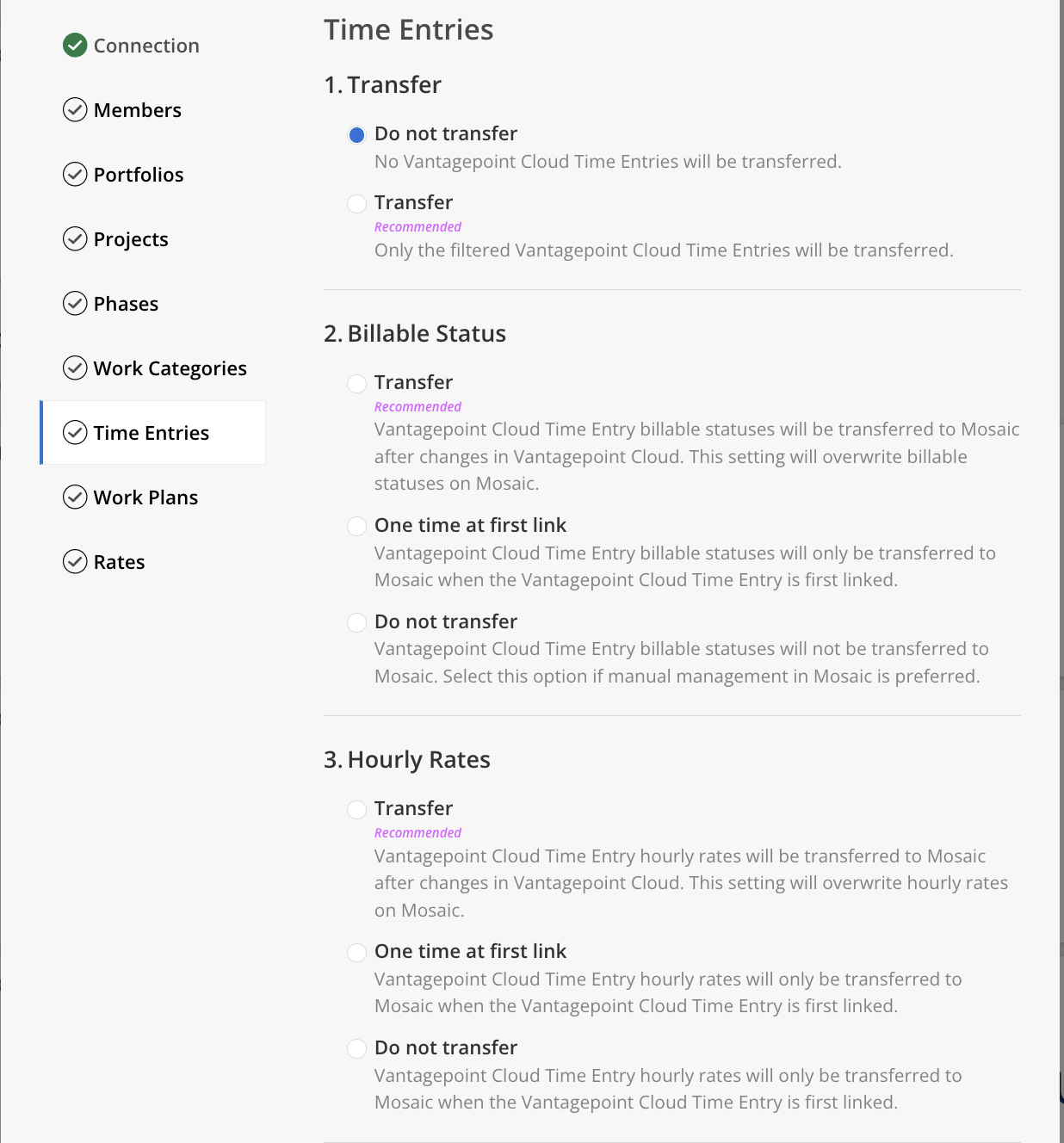
Definition
This setting controls whether time entries from Vantagepoint are transferred to Mosaic at all. Time entries are records of a member's actual hours spent on projects, usually entered on timesheets.
In Mosaic
When time entries are transferred, they appear in project Spent tabs, power budget analysis, and enable management features like approve/reject, billable overrides, rate resets, and bulk edits. Time entries also support compliance monitoring via the Timesheet Status Report. Importing time entries is highly recommended, as it enables accurate planned vs. actual budget comparison and supports forecasting across all projects.
When set to Do not transfer, no time entry data will flow from Vantagepoint. You can still import time entries via CSV or enter them manually in Mosaic.
2. Billable Status
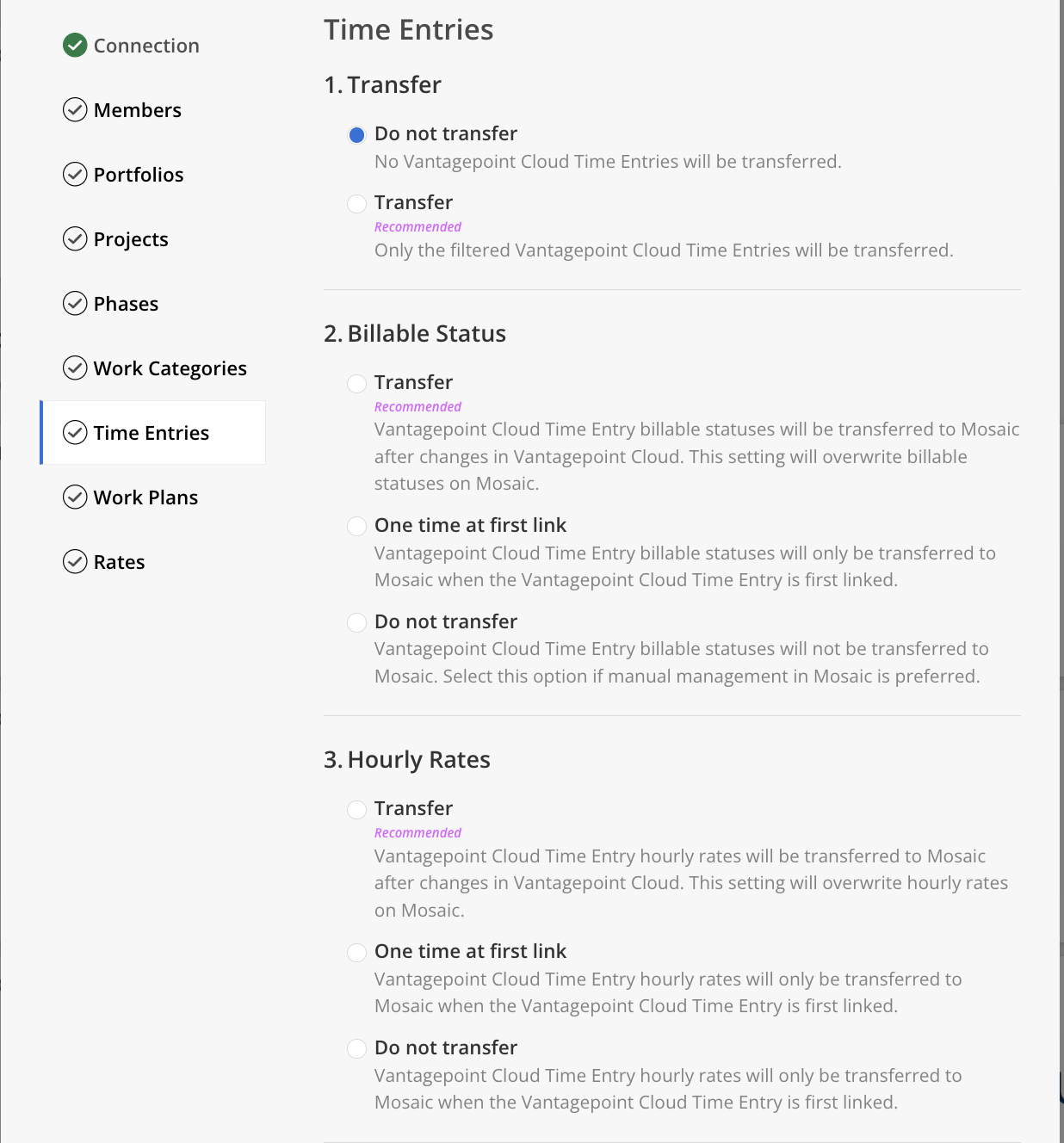
Definition
This setting controls whether the billable status of individual time entries from Vantagepoint is transferred to Mosaic. The billable status indicates whether the recorded hours are chargeable to a client.
In Mosaic
When set to Transfer, time entry billable statuses stay in sync with Vantagepoint. This ensures the Spent tab and financial reports accurately reflect which hours are billable.
When set to One time at first link, the billable status is set during initial transfer and can then be overridden in Mosaic without being overwritten.
When set to Do not transfer, billable statuses must be managed manually in Mosaic. Time entries have a Billable field that can be viewed and filtered on the Spent tab.
3. Hourly Rates
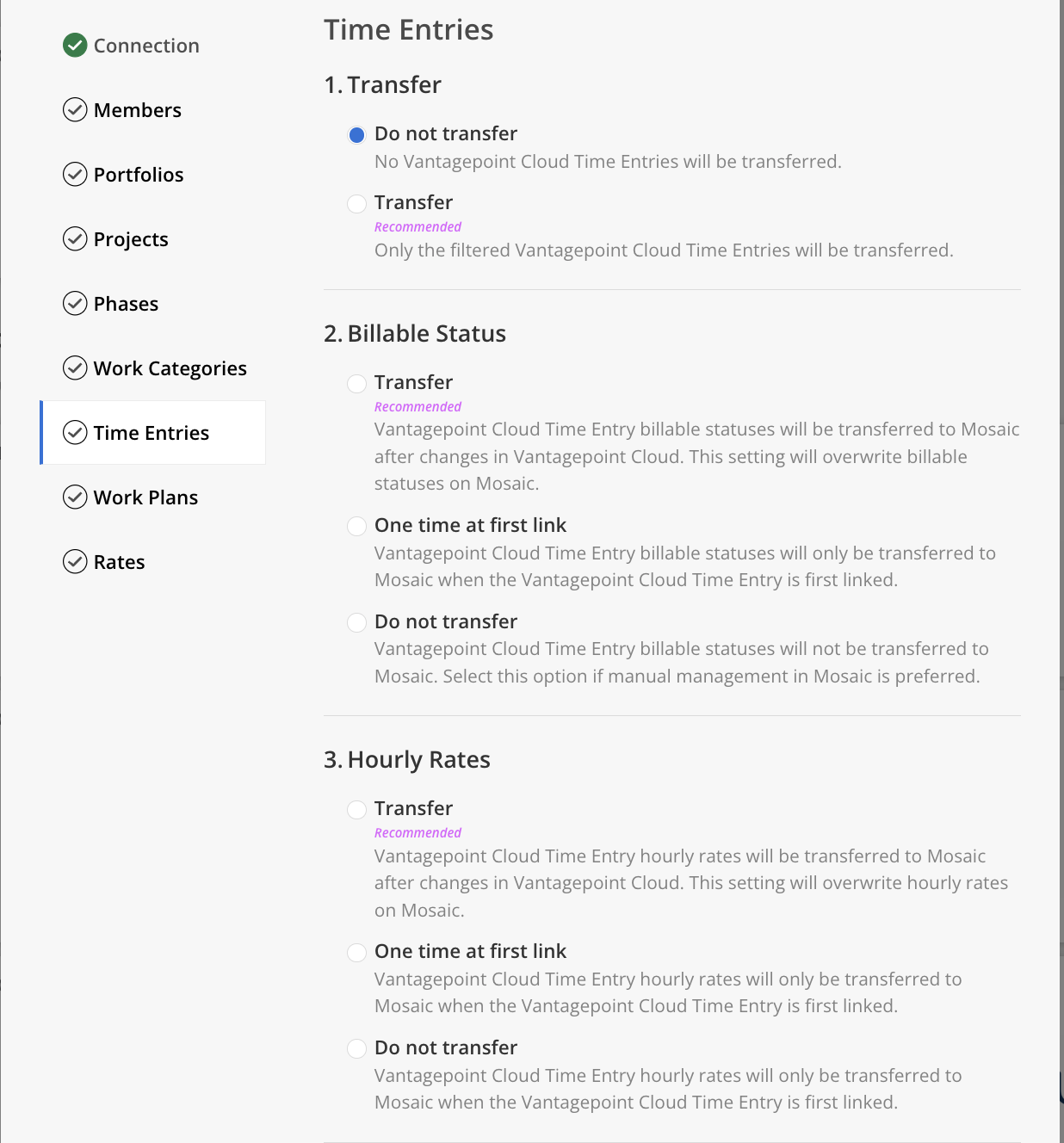
Definition
This setting controls whether time entry hourly rates from Vantagepoint are transferred to Mosaic. These are the rates associated with each individual time entry record.
In Mosaic
When set to Transfer, time entry rates stay in sync with Vantagepoint. This affects the spent amounts shown in project budget views.
When set to One time at first link (Cloud only), the rate is transferred once during initial import and preserved at its original value — useful for rate stability after work starts.
When set to Do not transfer, Mosaic-created timesheets use Mosaic rates, and Vantagepoint rate changes don't update linked time entries. This is independent of the Member-level Cost Rates Source (setting #6).
4. Zero Bill Rate Amount
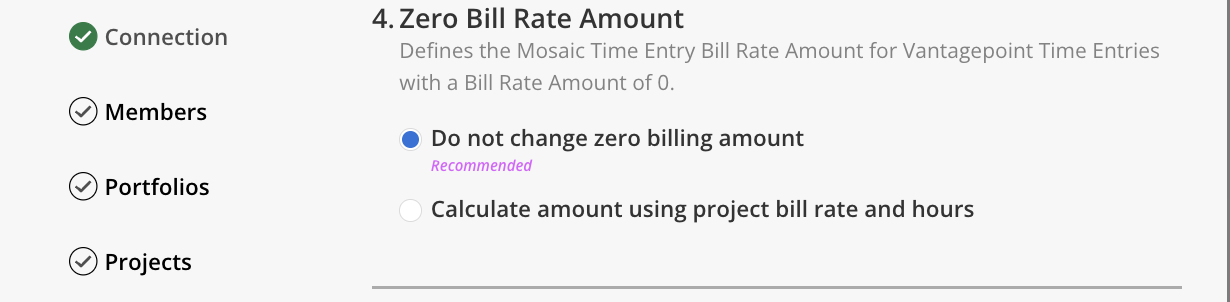
Definition
Defines how Mosaic handles Vantagepoint Time Entries that have a bill rate amount of zero.
Settings Choices
- Do not change zero billing amount (Recommended) — Time entries with a zero bill rate in Vantagepoint will remain at zero in Mosaic.
- Calculate amount using project bill rate and hours — Time entries with zero bill rates will have their rates set to null, allowing Mosaic to calculate the rate based on project rates.
In Mosaic
This setting affects the financial accuracy of time entry data. Use "Calculate amount" if your workflow intentionally leaves bill rates at zero in Vantagepoint and relies on project-level rates instead.
1. Transfer
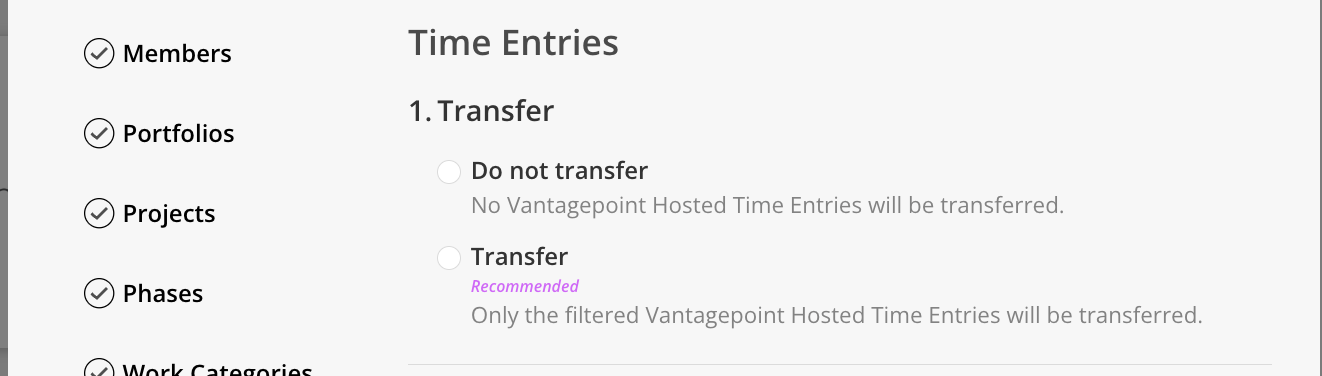
Definition
This setting controls whether time entries from Vantagepoint are transferred to Mosaic at all. Time entries are records of a member's actual hours spent on projects, usually entered on timesheets.
Settings Choices
- Do not transfer — No Vantagepoint Time Entries will be transferred.
- Combined Time (Posted and Unposted time) (Recommended) — Unapproved and approved Vantagepoint time entries will be transferred. Mosaic recommends using Unposted Time as Spent Time until all time is posted.
- Posted Time Only — Only approved Vantagepoint time entries will be transferred.
If you wish to bring in combined time, make sure you have the required tables in your replica database before enabling.
Combined Time may require configuration by the Mosaic Solutions team for On-Premise deployments. Contact your CSM if this option appears locked.
In Mosaic
When time entries are transferred, they appear in project Spent tabs, power budget analysis, and enable management features like approve/reject, billable overrides, rate resets, and bulk edits. Time entries also support compliance monitoring via the Timesheet Status Report. Importing time entries is highly recommended, as it enables accurate planned vs. actual budget comparison and supports forecasting across all projects.
When set to Do not transfer, no time entry data will flow from Vantagepoint. You can still import time entries via CSV or enter them manually in Mosaic.
2. Billable Status
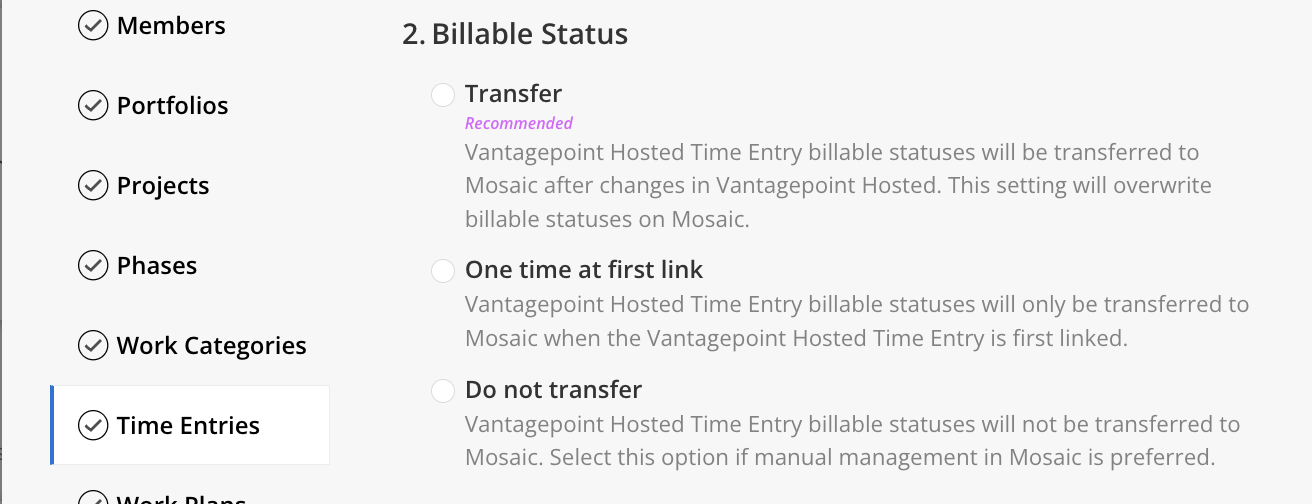
Definition
This setting controls whether the billable status of individual time entries from Vantagepoint is transferred to Mosaic. The billable status indicates whether the recorded hours are chargeable to a client.
In Mosaic
When set to Transfer, time entry billable statuses stay in sync with Vantagepoint. This ensures the Spent tab and financial reports accurately reflect which hours are billable.
When set to One time at first link, the billable status is set during initial transfer and can then be overridden in Mosaic without being overwritten.
When set to Do not transfer, billable statuses must be managed manually in Mosaic. Time entries have a Billable field that can be viewed and filtered on the Spent tab.
3. Hourly Rates
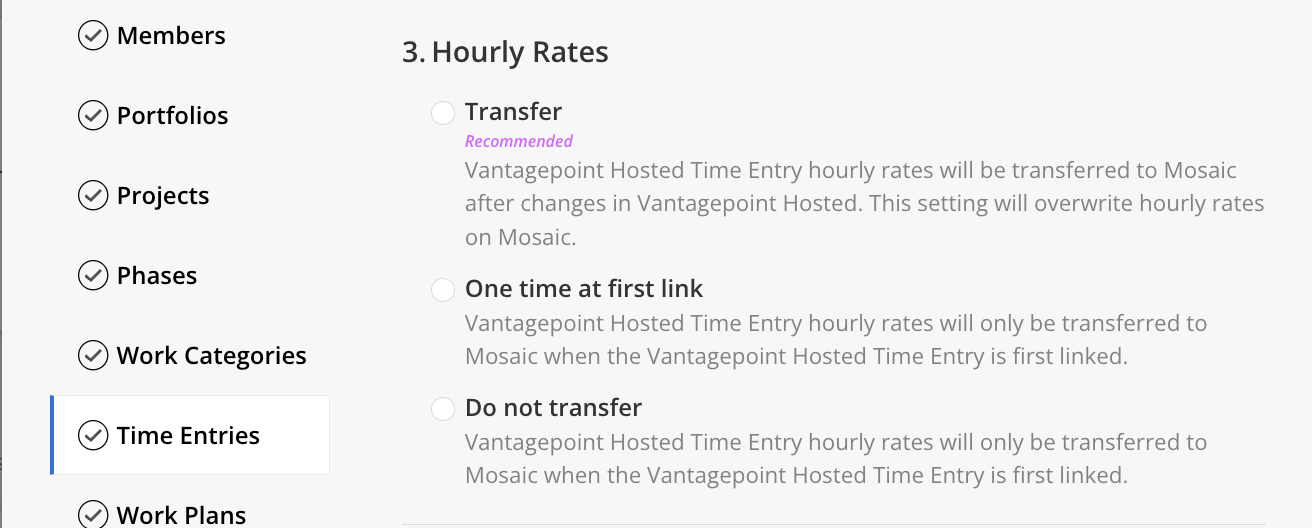
Definition
This setting controls whether time entry hourly bill rates from Vantagepoint are transferred to Mosaic. These are the billing rates associated with each individual time entry record.
In Mosaic
When set to Transfer, time entry bill rates stay in sync with Vantagepoint. This affects the spent amounts shown in project budget views.
When set to One time at first link, the rate is transferred once during initial import and preserved at its original value — useful for rate stability after work starts.
When set to Do not transfer, Mosaic-created timesheets use Mosaic rates, and Vantagepoint rate changes don't update linked time entries.
4. Cost Rates

Definition
This setting controls whether time entry cost rates from Vantagepoint are transferred to Mosaic. These are the cost rates associated with each individual time entry record, distinct from the hourly bill rates above.
This setting is controlled by the Cost Rates feature flag. Contact your Mosaic team if this option is not visible.
In Mosaic
When set to Transfer, time entry cost rates stay in sync with Vantagepoint. This affects the cost calculations shown in project budget views and profitability reports.
When set to Do not transfer, Mosaic-created timesheets use Mosaic cost rates, and Vantagepoint cost rate changes don't update linked time entries. This is independent of the Member-level Cost Rates Source setting.
5. Zero Bill Rate Amount
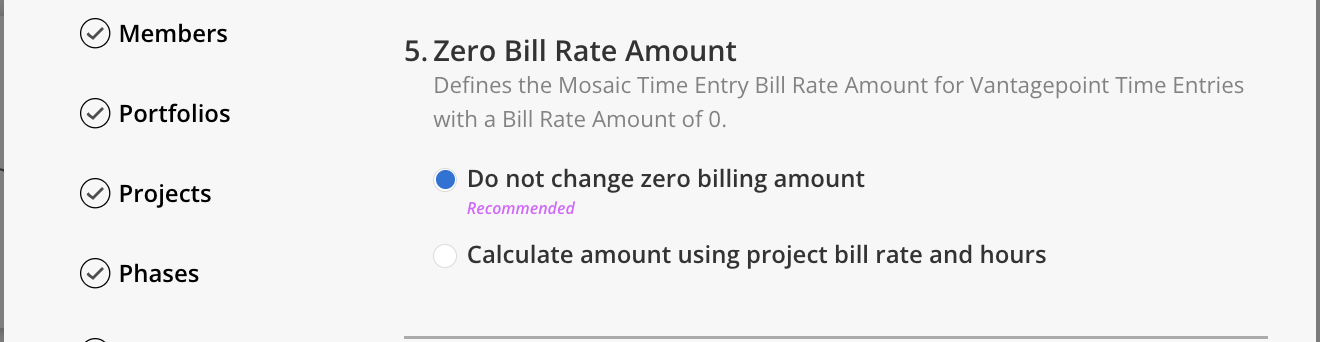
Definition
Defines how Mosaic handles Vantagepoint Time Entries that have a bill rate amount of zero.
Settings Choices
- Do not change zero billing amount (Recommended) — Time entries with a zero bill rate in Vantagepoint will remain at zero in Mosaic.
- Calculate amount using project bill rate and hours — Time entries with zero bill rates will have their rates set to null, allowing Mosaic to calculate the rate based on project rates.
In Mosaic
This setting affects the financial accuracy of time entry data. Use "Calculate amount" if your workflow intentionally leaves bill rates at zero in Vantagepoint and relies on project-level rates instead.
Work Plans
1. Transfer
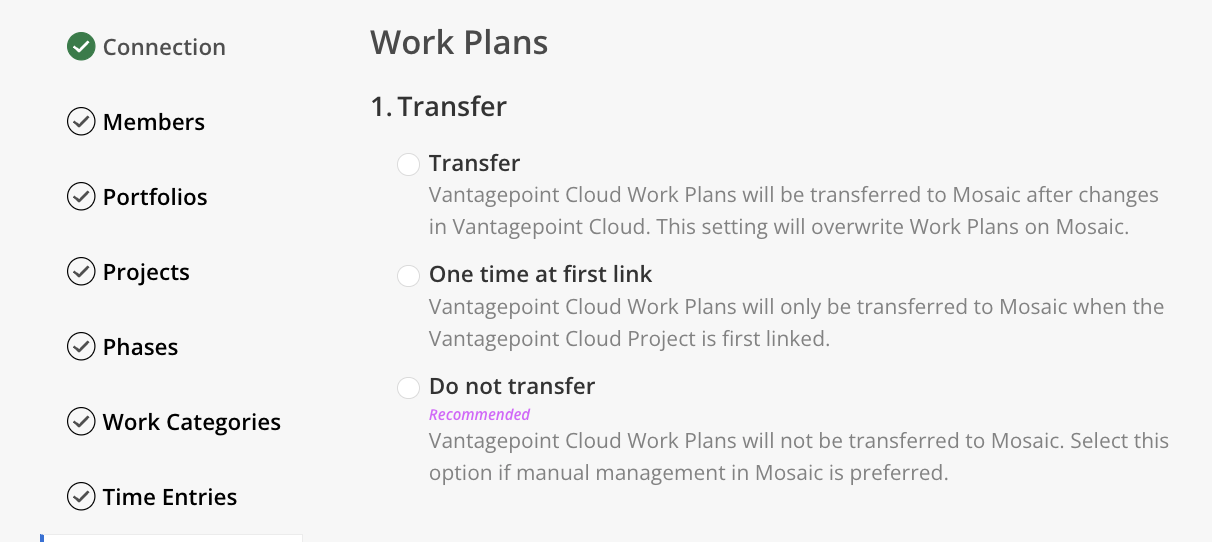
Definition
Work Plans are time-based allocations that assign people to a project or phase over a set period. This setting controls whether Vantagepoint project plans are transferred to Mosaic as Work Plans.
For Cloud deployments, the Work Plans stored procedure must be installed for this setting to function. See the API Configuration section.
In Mosaic
When set to Transfer, Vantagepoint project plans are synced as Work Plans in Mosaic. Any changes to the project plan in Vantagepoint will overwrite the corresponding Work Plans in Mosaic.
When set to Do not transfer, work plans must be created and managed entirely within Mosaic. This is the recommended approach if your team does resource planning primarily in Mosaic.
Find work plans in Mosaic under: Home (Work Plan widget), Planner space, or Workload space.
1. Transfer
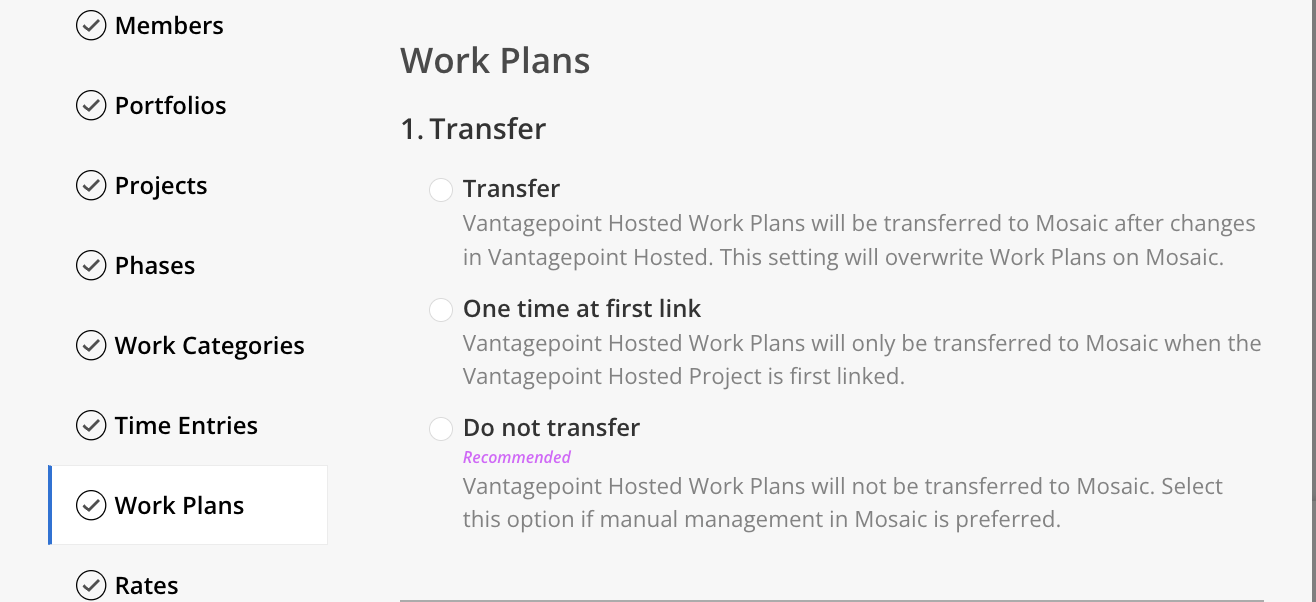
Definition
Work Plans are time-based allocations that assign people to a project or phase over a set period. This setting controls whether Vantagepoint project plans are transferred to Mosaic as Work Plans.
In Mosaic
When set to Transfer, Vantagepoint project plans are synced as Work Plans in Mosaic. Any changes to the project plan in Vantagepoint will overwrite the corresponding Work Plans in Mosaic.
When set to Do not transfer, work plans must be created and managed entirely within Mosaic. This is the recommended approach if your team does resource planning primarily in Mosaic.
Find work plans in Mosaic under: Home (Work Plan widget), Planner space, or Workload space.
Rates
1. Rate Groups
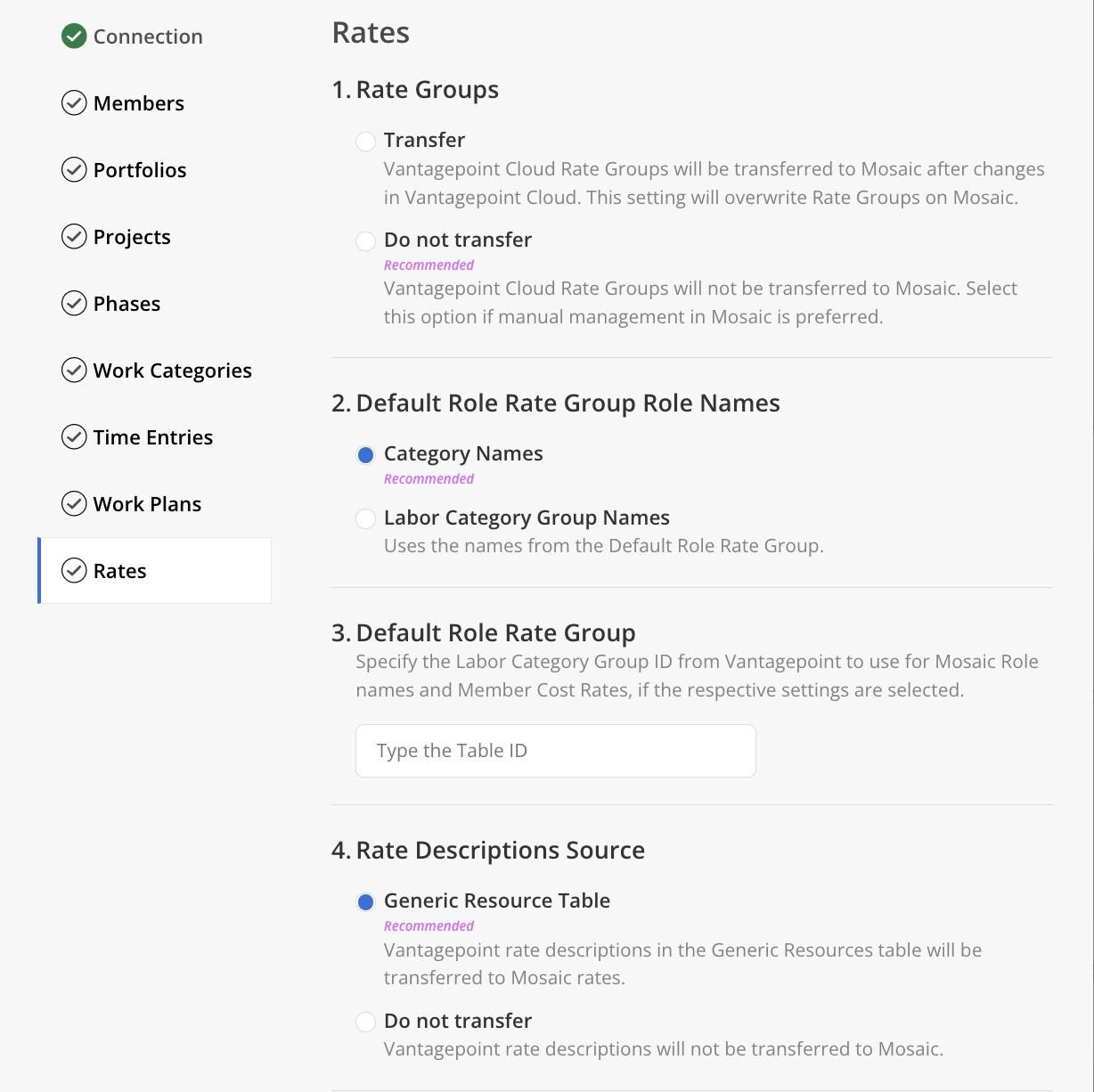
Definition
This setting controls whether rate groups (rate tables) from Vantagepoint are transferred to Mosaic. Rate groups define sets of billing rates that can be associated with projects and phases.
In Mosaic
When set to Transfer, rate groups from Vantagepoint are synced to Mosaic and kept up to date. Any changes to rate tables in Vantagepoint will overwrite the corresponding rate groups in Mosaic.
When set to Do not transfer, rate groups must be configured and maintained directly in Mosaic. Choose this if Vantagepoint rate tables are inconsistent or if Mosaic shouldn't rely on them.
Maintain either Vantagepoint or Mosaic as the primary rate group definition source. If you choose Transfer, avoid editing rate groups directly in Mosaic, as changes will be overwritten on the next sync.
2. Default Role Rate Group Role Names
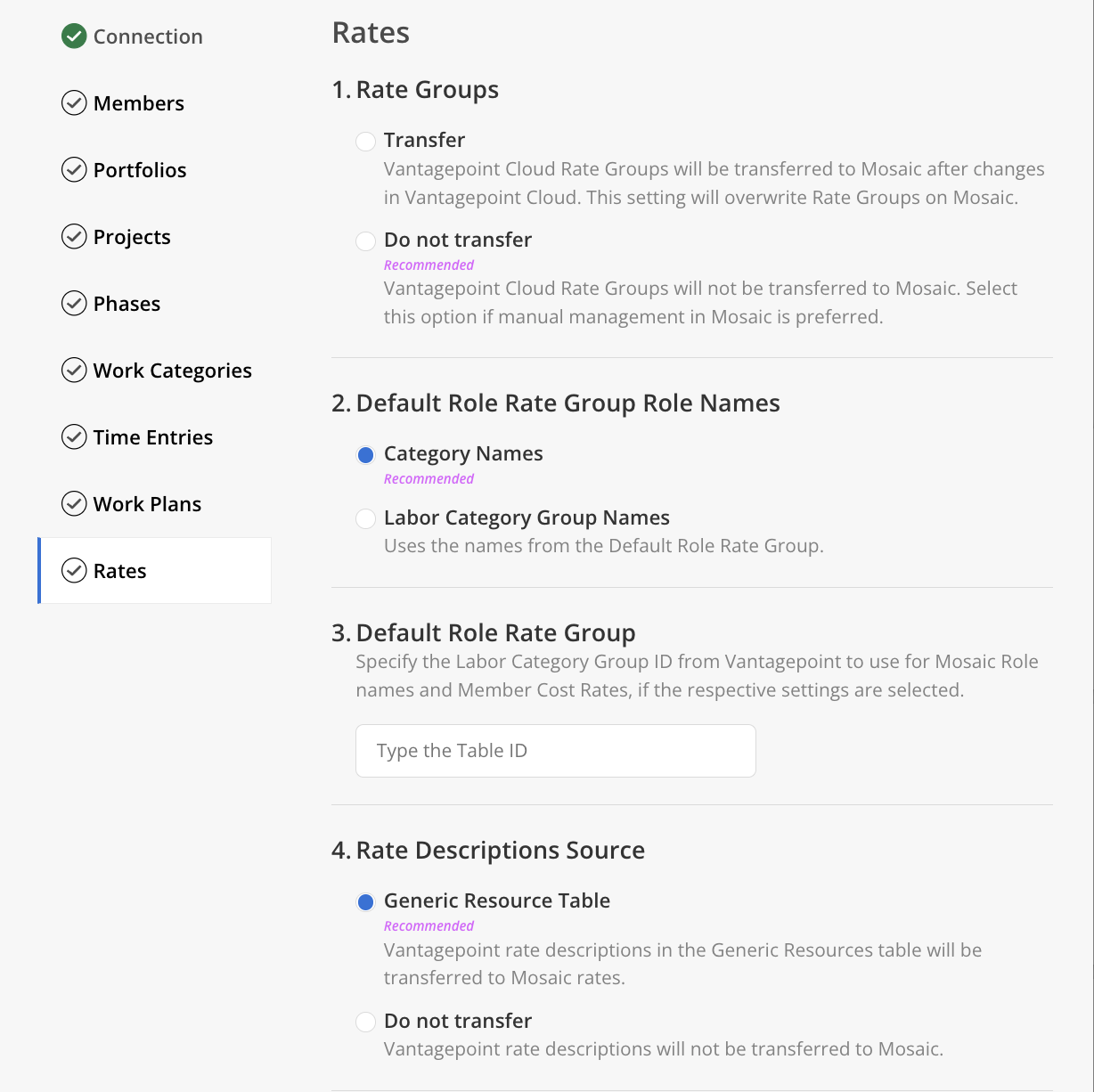
Definition
Determines the source for Role names when using the Default Role Rate Group.
Settings Choices
- Category Names (Recommended) — Uses the labor category names as Role names in Mosaic.
- Labor Category Group Names — Uses the names from the Default Role Rate Group as Role names in Mosaic.
In Mosaic
This setting only applies when a Default Role Rate Group (setting #46) is specified. If no rate group is set, this setting has no effect.
3. Default Role Rate Group
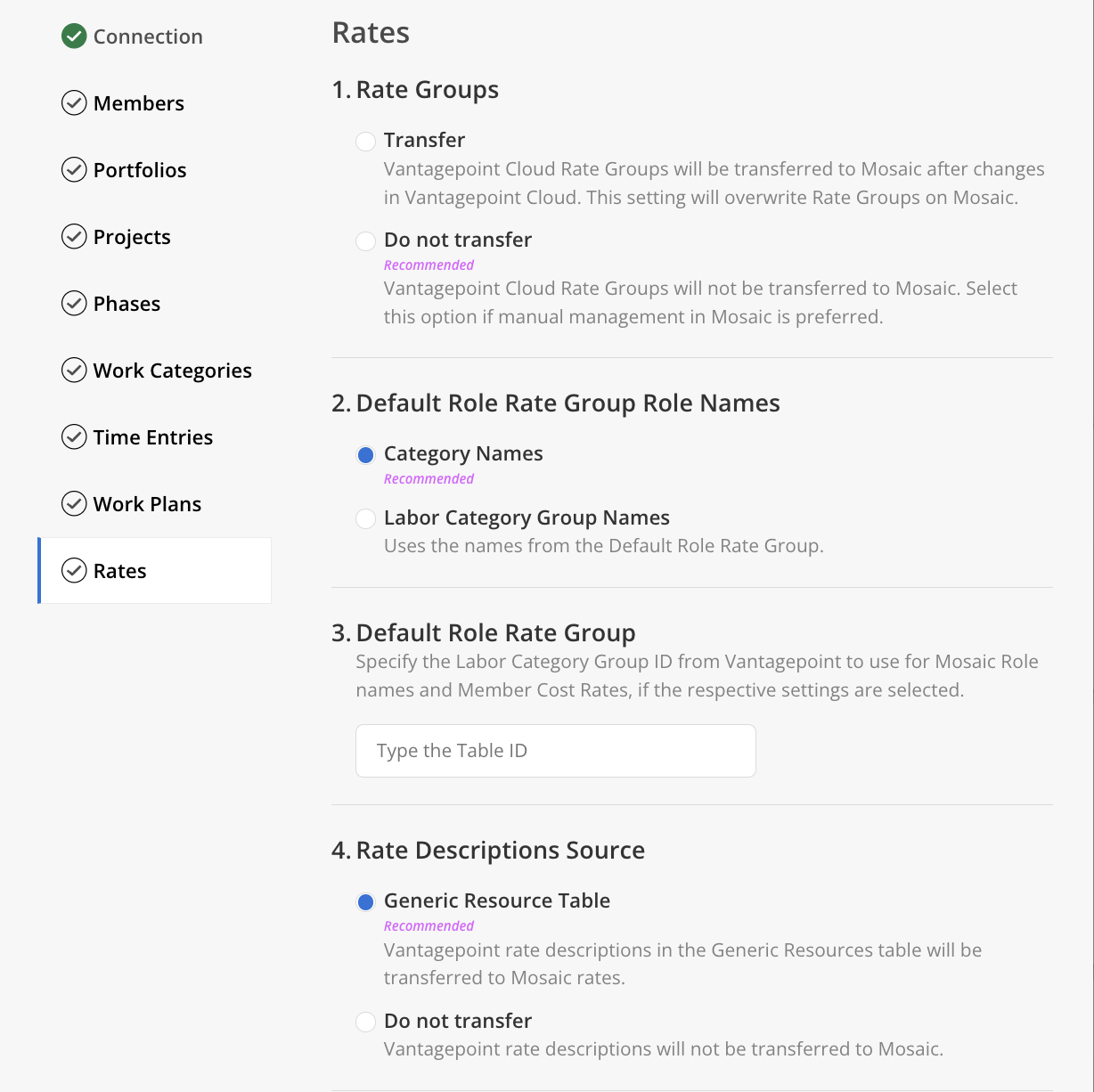
Definition
Specifies the Vantagepoint Labor Category Group ID to use for Mosaic Role names and Member Cost Rates (if the respective settings are selected).
Settings Choices
This is a text input field. Enter the numeric Labor Category Group ID from Vantagepoint.
- Leave blank if not applicable.
- The value must be a valid integer matching a Labor Category Group ID in Vantagepoint.
In Mosaic
When specified, the integration uses this rate group as the source for:
- Role names (if "Labor Category Group" is selected under Default Role Rate Group Role Names)
- Member cost rates (if "Labor Category Group" is selected under Cost Rates Source)
4. Rate Descriptions Source
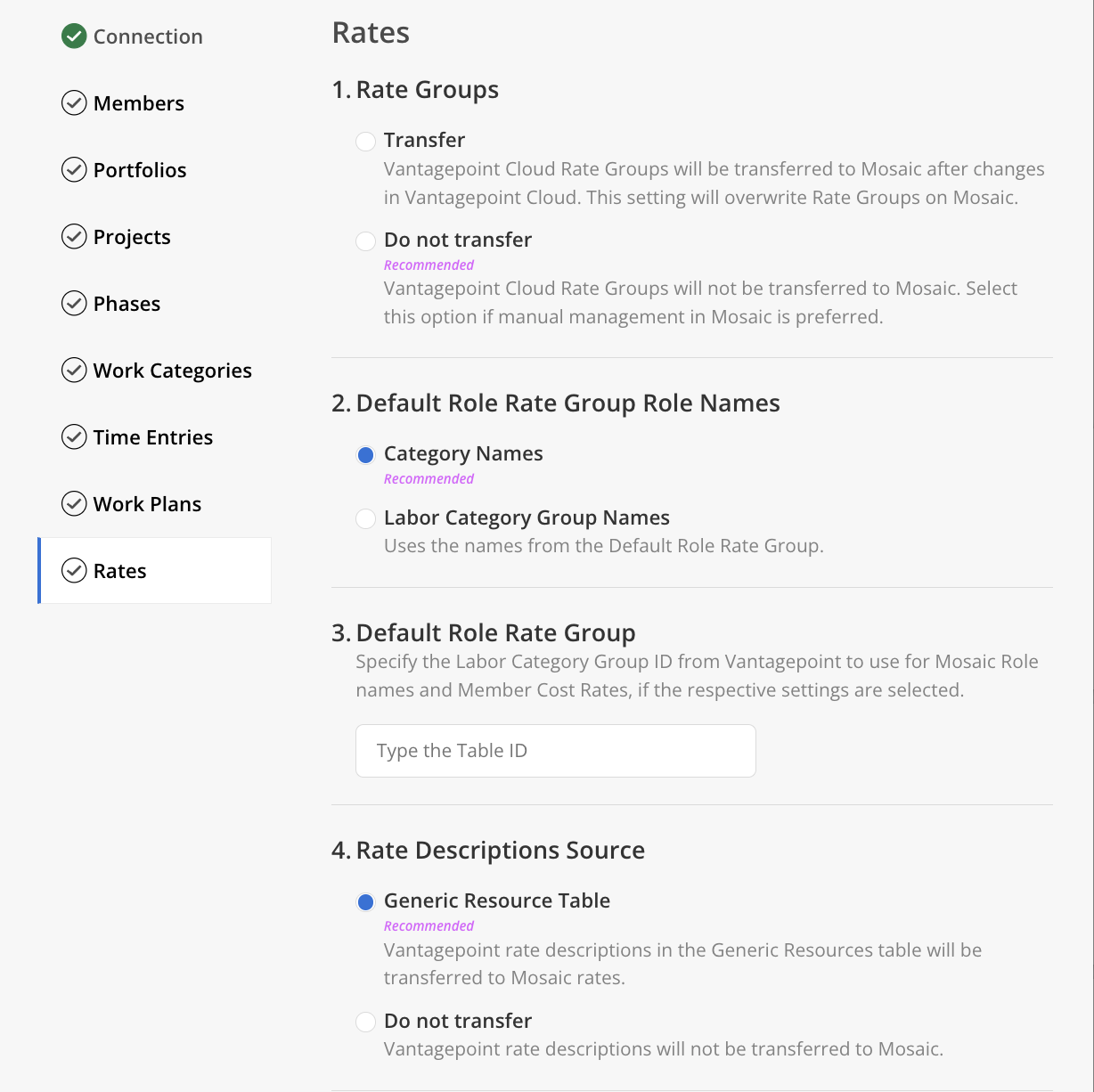
Definition
Controls whether rate descriptions from the Vantagepoint Generic Resources table are transferred to Mosaic.
Settings Choices
- Generic Resource Table (Recommended) — Vantagepoint rate descriptions in the Generic Resources table will be transferred to Mosaic rates.
- Do not transfer — Vantagepoint rate descriptions will not be transferred to Mosaic.
In Mosaic
Rate descriptions provide additional context for rate entries. When enabled, descriptions are synced from the Generic Resource table.
5. Role Source

Definition
Controls whether Vantagepoint labor categories from the Labor Category Rates table are transferred as Mosaic Member Roles.
Settings Choices
- Labor Category Table (Recommended) — Vantagepoint labor categories from the Labor Category Rates table will be transferred as Mosaic Member Roles.
- Do not transfer — Vantagepoint Member Roles will not be transferred to Mosaic.
In Mosaic
Roles appear on Member profiles and can be used for resource planning, filtering, and rate calculations across projects.
1. Rate Groups
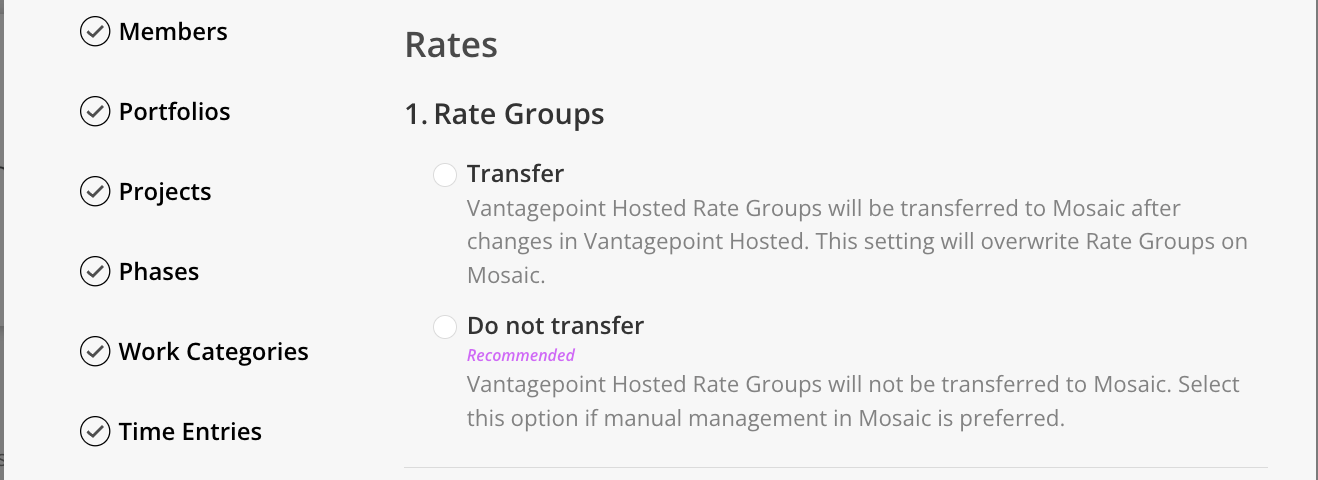
Definition
This setting controls whether rate groups (rate tables) from Vantagepoint are transferred to Mosaic. Rate groups define sets of billing rates that can be associated with projects and phases.
In Mosaic
When set to Transfer, rate groups from Vantagepoint are synced to Mosaic and kept up to date. Any changes to rate tables in Vantagepoint will overwrite the corresponding rate groups in Mosaic.
When set to Do not transfer, rate groups must be configured and maintained directly in Mosaic. Choose this if Vantagepoint rate tables are inconsistent or if Mosaic shouldn't rely on them.
Maintain either Vantagepoint or Mosaic as the primary rate group definition source. If you choose Transfer, avoid editing rate groups directly in Mosaic, as changes will be overwritten on the next sync.
2. Default Role Rate Group Role Names

Definition
Determines the source for Role names when using the Default Role Rate Group.
Settings Choices
- Category Names (Recommended) — Uses the labor category names as Role names in Mosaic.
- Labor Category Group Names — Uses the names from the Default Role Rate Group as Role names in Mosaic.
In Mosaic
This setting only applies when a Default Role Rate Group (setting #53) is specified. If no rate group is set, this setting has no effect.
3. Default Role Rate Group

Definition
Specifies the Vantagepoint Labor Category Group ID to use for Mosaic Role names and Member Cost Rates (if the respective settings are selected).
Settings Choices
This is a text input field. Enter the numeric Labor Category Group ID from Vantagepoint.
- Leave blank if not applicable.
- The value must be a valid integer matching a Labor Category Group ID in Vantagepoint.
In Mosaic
When specified, the integration uses this rate group as the source for:
- Role names (if "Labor Category Group" is selected under Default Role Rate Group Role Names)
- Member cost rates (if "Labor Category Group" is selected under Cost Rates Source)
4. Rate Descriptions Source
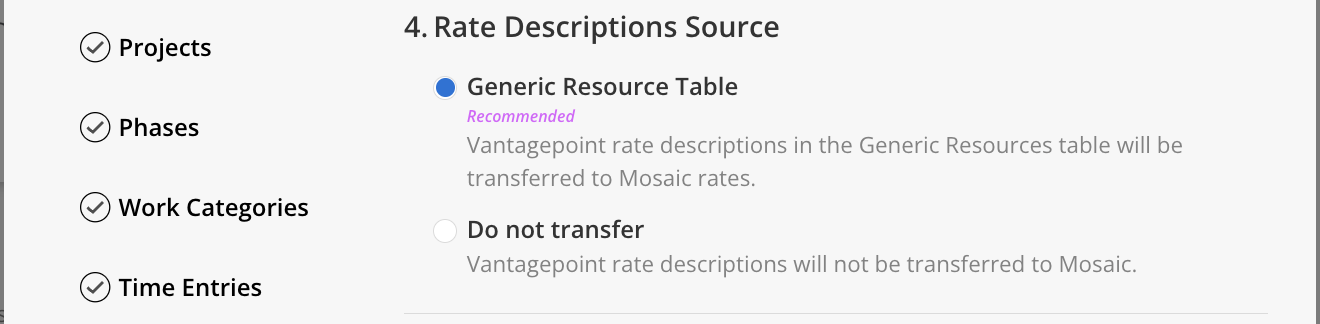
Definition
Controls whether rate descriptions from the Vantagepoint Generic Resources table are transferred to Mosaic.
Settings Choices
- Generic Resource Table (Recommended) — Vantagepoint rate descriptions in the Generic Resources table will be transferred to Mosaic rates.
- Do not transfer — Vantagepoint rate descriptions will not be transferred to Mosaic.
In Mosaic
Rate descriptions provide additional context for rate entries. When enabled, descriptions are synced from the Generic Resource table.
5. Role Source
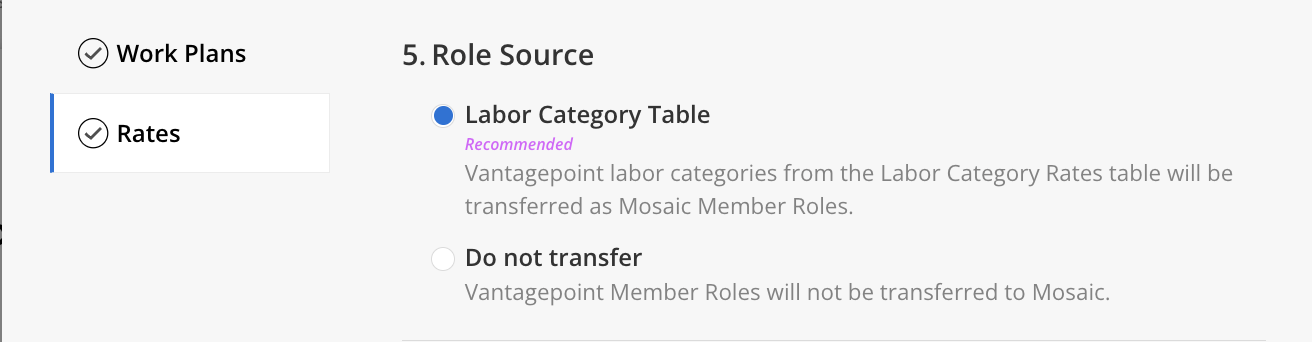
Definition
Controls whether Vantagepoint labor categories from the Labor Category Rates table are transferred as Mosaic Member Roles.
Settings Choices
- Labor Category Table (Recommended) — Vantagepoint labor categories from the Labor Category Rates table will be transferred as Mosaic Member Roles.
- Do not transfer — Vantagepoint Member Roles will not be transferred to Mosaic.
In Mosaic
Roles appear on Member profiles and can be used for resource planning, filtering, and rate calculations across projects.
6. Standard Roles and Rates
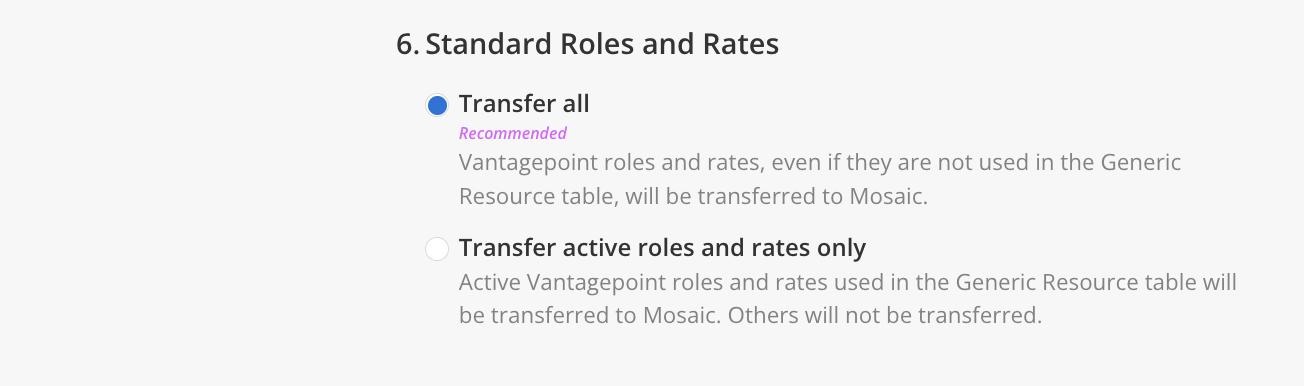
Definition
This setting controls which Standard Roles and their associated rates are transferred from Vantagepoint to Mosaic. It determines whether all roles and rates are transferred or only those that are actively used.
Settings Choices
- Transfer all (Recommended) — Vantagepoint roles and rates, even if they are not used in the Generic Resource table, will be transferred to Mosaic.
- Transfer active roles and rates only — Only active Vantagepoint roles and rates used in the Generic Resource table will be transferred to Mosaic. Others will not be transferred.
In Mosaic
When set to Transfer all, every role and rate defined in Vantagepoint will appear in Mosaic, regardless of whether it has an active generic resource entry. This ensures the complete role and rate catalog is available.
When set to Transfer active roles and rates only, only roles and rates that are actively used in the Generic Resource table will appear. This is useful if you want to limit Mosaic to only actively assigned roles and reduce clutter from unused rate entries.
Settings Summary
| # | Setting | Section | Recommended Default |
|---|---|---|---|
| 1 | Connection Credentials | Connection | — |
| 2 | API Configuration | Connection | — |
| 3 | Standard Roles | Members | Do not transfer |
| 4 | Default Roles | Members | Do not transfer |
| 5 | Cost Rates | Members | Transfer |
| 6 | Cost Rates Source | Members | Employee Job Cost Rate |
| 7 | Default for new Projects | Portfolios | No Portfolio |
| 8 | Linking Method | Projects | Automatically linked |
| 9 | Linked Project and Phase Titles | Projects | Overwrite |
| 10 | Project and Phase Billable | Projects | Transfer |
| 11 | Project and Phase Dates | Projects | Transfer |
| 12 | Project and Phase Fee | Projects | Transfer |
| 13 | Project and Phase Rate Types | Projects | Transfer |
| 14 | Project and Phase Rate Group | Projects | Transfer |
| 15 | Project-Level Member Rates | Projects | Do not transfer |
| 16 | Bill Rate Source for Member Rates | Projects | Cost Rate |
| 17 | Bill Rate Source for Role Rates | Projects | Cost Rate |
| 18 | Bill Rate Source for Work Category Rates | Projects | Cost Rate |
| 19 | Bill Rate Source for Projects with no Billing Type | Projects | Cost Rate |
| 20 | Project Managers | Projects | Transfer |
| 21 | Archived Projects | Projects | Both enabled |
| 22 | Project Status Matching | Projects | See default mapping |
| 23 | Project and Phase Default Rate Multiplier | Projects | Do not update |
| 24 | Project and Phase Fee Source | Projects | Direct Labor Fee |
| 25 | Project Name Source | Projects | Name |
| 26 | Zero Project Fee | Projects | Clear Project Fee |
| 27 | Project-level Roles | Projects | Do not transfer |
| 28 | Role Source for Role Rate Projects | Projects | Match by Name |
| 29 | Linking Method | Phases | Automatically linked |
| 30 | Non-Billable Fee as Budget | Phases | Transfer |
| 31 | Order | Phases | Phase Order |
| 32 | Archived Phases | Phases | Both enabled |
| 33 | Phase Status Matching | Phases | See default mapping |
| 34 | Phase Name Source | Phases | Name |
| 35 | Phase Profit Center Name Source | Phases | Organization Name |
| 36 | Linking Method | Work Categories | Automatically linked |
| 37 | Transfer | Time Entries | Transfer |
| 38 | Billable Status | Time Entries | Transfer |
| 39 | Hourly Rates | Time Entries | Transfer |
| 40 | Zero Bill Rate Amount | Time Entries | Do not change |
| 41 | Transfer | Work Plans | Do not transfer |
| 42 | Rate Groups | Rates | Do not transfer |
| 43 | Default Role Rate Group Role Names | Rates | Category Names |
| 44 | Default Role Rate Group | Rates | — (optional) |
| 45 | Rate Descriptions Source | Rates | Generic Resource Table |
| 46 | Role Source | Rates | Labor Category Table |
| # | Setting | Section | Recommended Default |
|---|---|---|---|
| 1 | Standard Roles | Members | Do not transfer |
| 2 | Default Roles | Members | Do not transfer |
| 3 | Cost Rates | Members | Transfer |
| 4 | Default Roles Source | Members | Billing Category |
| 5 | Cost Rates Source | Members | Employee Job Cost Rate |
| 6 | Default for new Projects | Portfolios | No Portfolio |
| 7 | Linking Method | Projects | Automatically linked |
| 8 | Linked Project and Phase Titles | Projects | Overwrite |
| 9 | Project and Phase Billable | Projects | Transfer |
| 10 | Project and Phase Dates | Projects | Transfer |
| 11 | Project and Phase Fee | Projects | Transfer |
| 12 | Project and Phase Rate Types | Projects | Transfer |
| 13 | Project and Phase Rate Group | Projects | Transfer |
| 14 | Bill Rate Source for Member Rates | Projects | Cost Rate |
| 15 | Bill Rate Source for Role Rates | Projects | Cost Rate |
| 16 | Bill Rate Source for Work Category Rates | Projects | Cost Rate |
| 17 | Bill Rate Source for Projects with no Billing Type | Projects | Cost Rate |
| 18 | Project Managers | Projects | Transfer |
| 19 | Archived Projects | Projects | Both enabled |
| 20 | Project Status Matching | Projects | See default mapping |
| 21 | Project and Phase Dates Source | Projects | Start and Estimated Completion |
| 22 | Project, Phase, and Time Entry Overhead | Projects | Do Not Apply |
| 23 | Project and Phase Default Rate Multiplier | Projects | Do not update |
| 24 | Project and Phase Fee Source | Projects | Direct Labor Fee |
| 25 | Project Name Source | Projects | Name |
| 26 | Zero Project Fee | Projects | Clear Project Fee |
| 27 | Project-level Roles | Projects | Do not transfer |
| 28 | Role Source for Role Rate Projects | Projects | Match by Name |
| 29 | Linking Method | Phases | Automatically linked |
| 30 | Non-Billable Fee as Budget | Phases | Transfer |
| 31 | Order | Phases | Phase Order |
| 32 | Archived Phases | Phases | Both enabled |
| 33 | Phase Status Matching | Phases | See default mapping |
| 34 | Phase Name Source | Phases | Name |
| 35 | Phase Profit Center Name Source | Phases | Organization Name |
| 36 | Linking Method | Work Categories | Automatically linked |
| 37 | Transfer | Time Entries | Combined Time |
| 38 | Billable Status | Time Entries | Transfer |
| 39 | Hourly Rates | Time Entries | Transfer |
| 40 | Cost Rates | Time Entries | Transfer |
| 41 | Zero Bill Rate Amount | Time Entries | Do not change |
| 42 | Transfer | Work Plans | Do not transfer |
| 43 | Rate Groups | Rates | Do not transfer |
| 44 | Default Role Rate Group Role Names | Rates | Category Names |
| 45 | Default Role Rate Group | Rates | — (optional) |
| 46 | Rate Descriptions Source | Rates | Generic Resource Table |
| 47 | Role Source | Rates | Labor Category Table |
| 48 | Standard Roles and Rates | Rates | Transfer all |
Need help? Contact the Mosaic Solutions team if you need assistance configuring any of these settings or if you'd like to discuss the best configuration for your firm's workflow.
Updated about 2 months ago